



Stable formulations containing 3-O-Ethyl-L-Ascorbic Acid for cosmetics start with a controlled aqueous phase, an appropriate pH range, and a process that limits unnecessary exposure to heat, air, and light. The ingredient is a vitamin C derivative, but its behavior should not be assumed to match that of pure ascorbic acid. Establish its compatibility and stability in the finished formula, using the raw material supplier’s specification as the starting point.
A clear solution at the end of production is only an initial observation. Color, pH, odor, active content, and physical appearance can change during storage or after contact with packaging. A useful development approach separates these observations so that discoloration is not automatically treated as proof of active loss, and an unchanged appearance is not mistaken for chemical stability.
Set the pH around the complete formula
Choose a trial pH range from the ingredient documentation and the requirements of the finished product. Then consider the other components: preservatives, gelling agents, emulsifiers, and any additional actives may each have their own operating range. A pH that favors one ingredient can weaken preservation or change viscosity elsewhere in the system.
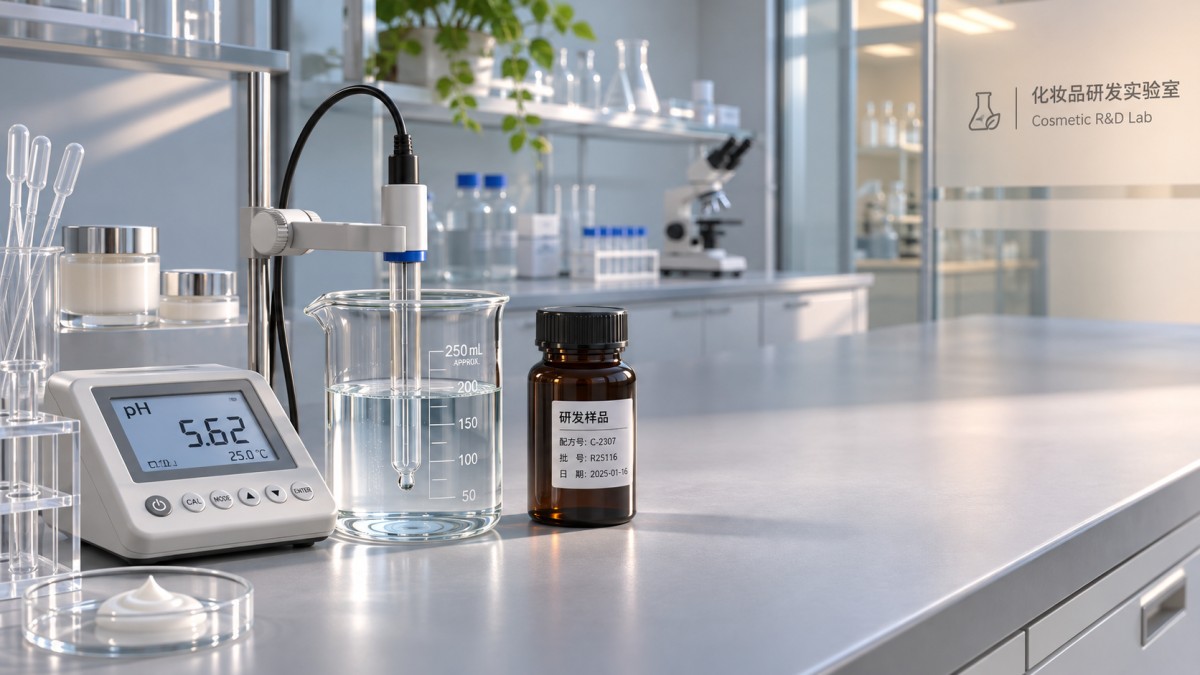
Measure pH after the active has fully dissolved and again after all ingredients have been incorporated. Adjust slowly with a suitable acid or base solution, mixing thoroughly between additions. Localized pockets of concentrated adjuster can expose sensitive ingredients to extreme conditions even when the final bulk reading appears acceptable. Record the pH after the batch has equilibrated and monitor it during stability testing.
Viscosity also affects measurement. A gel may need a suitable electrode and sufficient contact time to give a consistent reading. If a dilution is used to measure a difficult sample, document the dilution method and compare results only with measurements made the same way; the diluted sample does not necessarily have the same pH as the original product.
Control water quality and metal exposure
Use water that meets the formulation’s defined quality specification. Dissolved metal ions can promote oxidative reactions in susceptible systems, while variability in water quality can make otherwise identical batches behave differently. Review the water source when a formula that performed well in the laboratory develops unexpected color or odor during scale-up.
Contact surfaces matter as well. Examine tanks, mixing tools, transfer lines, and filling equipment for corrosion, damaged surfaces, or residues from cleaning. A discoloration that appears only after transfer can point toward equipment contact or residual cleaning chemistry rather than the active ingredient alone.
A compatible chelating agent can be evaluated where trace metals are a concern, but it is not a substitute for suitable water or clean equipment. Assess its effect on the complete formula, including preservation, clarity, and interactions with other ingredients. Keep the water source and cleaning procedure consistent across comparison batches so that changes have an interpretable cause.
Temperature and addition sequence
Confirm the ingredient’s solubility and recommended processing conditions from the relevant technical documentation. Dissolve it in the appropriate phase with adequate mixing, and avoid holding a prepared solution at elevated temperature longer than the process requires. Where the rest of the formula requires heating, adding the active during a suitable cooling stage can reduce heat exposure, provided dissolution and uniform distribution remain acceptable.
Do not assume that a lower addition temperature is automatically better. In an emulsion, the bulk must still be fluid enough to distribute the active evenly. In a gel, a fully developed viscosity can slow incorporation or trap undissolved particles. A small premix, prepared with a compatible portion of the formula’s water, can make addition more consistent; its concentration and holding time should be included in process evaluation.
For scale-up, compare the temperature and mixing history of the active-containing material, not just the batch temperature at the end of manufacture. A larger vessel can cool more slowly and may create different local mixing conditions. Take samples from suitable locations after mixing to assess uniformity, and investigate persistent particles before filling.
Separate ingredient compatibility from formulation failure
When combining actives, start with small batches that vary one component or processing condition at a time. Compare a base formula, the base with the vitamin C derivative, and the base with both the derivative and the proposed companion ingredient. Keep pH, packaging, and storage conditions aligned as far as the formulas allow. This makes it easier to distinguish an interaction from an unrelated problem in the base.
For example, a peptide-containing facial serum may be evaluated with Acetyl hexapeptide-38 as a separate cosmetic ingredient. Its supplied white-powder format allows laboratory incorporation trials, but coexistence in a formula should be established through solubility, pH, appearance, and stability testing. Do not infer that the two ingredients are compatible solely because each is used in skincare.
Cloudiness after addition can have several causes: incomplete dissolution, a pH-driven change in solubility, interaction with another material, or a change in the emulsion structure. Review when the haze first appeared and whether it persists after thorough mixing and equilibration. Heating or adding solvent to clear the batch without identifying the cause can create a different stability problem.
Packaging and storage are part of the formulation
Exposure to light and oxygen should be considered from mixing through consumer use. Minimize unnecessary open-vessel holding and air incorporation during mixing and filling. Select a container and closure suited to the product’s sensitivity; opaque or light-protective packaging and dispensing systems that limit repeated air exposure are options to evaluate.
Run stability studies in the intended pack, not only in glass laboratory containers. Packaging can alter headspace, transmit light, interact with the formula, or allow changes in water content. Store filled samples upright and, where appropriate for the pack, in other orientations to assess contact with the closure. Compare unopened samples with samples subjected to representative dispensing or opening cycles.
Read stability results together
Set acceptance criteria before testing and use a suitable analytical method if the objective is to measure the derivative’s content. Appearance and color are useful screening observations, but neither establishes how much active remains. Equally, a satisfactory assay does not resolve a failed preservative system, phase separation, or an unacceptable odor.
Track initial results and changes at defined intervals under relevant storage conditions, including the intended conditions and an appropriately selected elevated-temperature condition. Elevated-temperature testing can reveal weaknesses sooner, but it does not by itself establish the shelf life at normal storage temperature. Confirm conclusions with real-time data and assess the finished product’s microbiological quality and preservative performance separately.
When a batch drifts out of specification, retain the processing record alongside the test results: water source, raw material lot, addition temperature, pH adjustments, mixing time, filling delay, and packaging lot. Those details help narrow the investigation before the formula or process is changed.
News
Message
Chemical Engineering Field
24/7 before-sales and after-sales services
Comprehensive technical support