



Two suppliers may offer PDRN powder with the same headline purity, yet deliver materials with different DNA fragment profiles, residual salts, and impurity burdens. For technical evaluators, that difference matters: a certificate stating “high purity” does not necessarily establish identity, formulation suitability, or fitness for a regulated application.
Evaluating PDRN powder therefore requires reading specifications as a connected system. DNA size distribution describes the material’s molecular profile; assay results describe its measured content; impurity tests address what remains alongside it. The useful question is not simply “Which grade is purer?” but “Which data demonstrate that this material meets our intended requirements?”
Start with the material definition, not the percentage
Polydeoxyribonucleotide, commonly abbreviated PDRN, generally refers to a mixture of DNA fragments rather than a single molecule with one molecular weight. Commercial materials can differ in biological source, extraction and purification processes, fragmentation conditions, and final salt form. These differences should be documented before comparing numerical specifications.
A practical identity description should establish the source organism or source category, whether the material is predominantly double-stranded DNA, its counterion where relevant, and any added carriers or excipients. Source traceability also supports assessment of biological-origin risks and application-specific regulatory requirements.
Do not assume that the terms PDRN and polynucleotide, or PN, establish equivalent grades across suppliers. Naming conventions vary. The analytical profile and manufacturing description are more informative than the label alone, especially when a proposed substitution could change processing behavior or product performance.
Reading DNA size distribution in PDRN powder
A DNA mixture needs a distribution specification, not just an average. Two batches can share the same mean fragment length while having very different proportions of short fragments and long-chain material. A broad profile may also hide a secondary population that an average fails to reveal.
Size may be reported in base pairs, kilodaltons, or another molecular-weight unit. For double-stranded DNA, approximately 660 daltons per base pair is a useful conversion convention. It is not a substitute for method-specific calibration, particularly when strand structure, conformation, or analytical technique affects the result.
Request the underlying electropherogram, gel image, or chromatogram when size distribution is critical. A summary such as “within range” is difficult to evaluate without seeing peak shape, tailing, and the reference standards used.
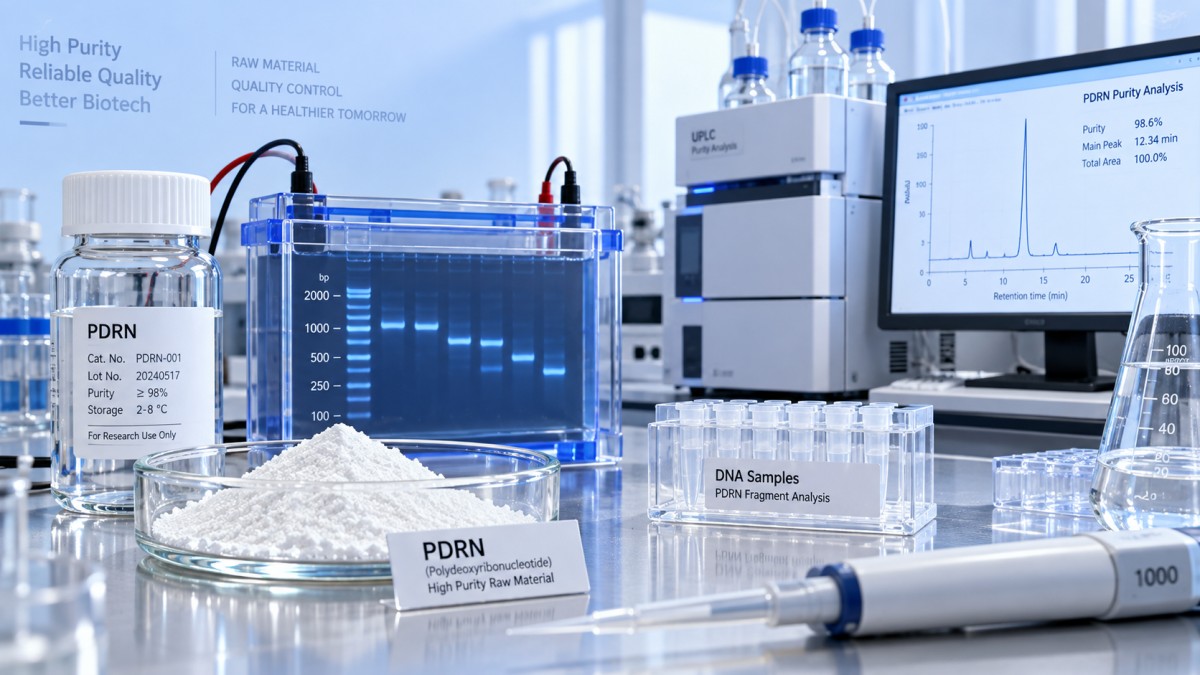
The method changes what the size result means
Agarose gel electrophoresis provides a useful visual overview, but its resolution and quantitative reliability depend on the size range, staining system, loading, and image analysis. Capillary electrophoresis can provide more detailed fragment profiling when the assay is suitable for the material and calibrated appropriately.
Size-exclusion chromatography separates according to hydrodynamic behavior rather than directly counting base pairs. Results depend on column selection, mobile phase, molecular conformation, and calibration. Multi-angle light scattering may strengthen molecular-weight characterization, but it still requires appropriate method controls and interpretation.
These techniques are complementary, not automatically interchangeable. When qualifying a second supplier, compare results using the same method where possible, or establish a justified correlation before adopting equivalent acceptance limits.
Why “99% purity” may leave important questions unanswered
Purity is meaningful only when its measurement basis is clear. A chromatographic area percentage, a DNA content assay, and a dry-basis mass fraction answer different questions. A high area percentage can coexist with substantial water or inorganic salts if those components are not detected by the method.
For PDRN powder, distinguish at least three concepts:
- Identity: evidence that the material is the expected DNA-derived substance.
- Assay: the measured amount of DNA-related material, using a defined method and reporting basis.
- Impurity profile: specified limits for unwanted components, measured with suitable individual tests.
UV absorbance at 260 nm is useful for estimating nucleic acid concentration. Ratios such as A260/A280 and A260/A230 can flag possible contamination, but they are screening indicators rather than comprehensive purity measurements. RNA, free nucleotides, buffer composition, pH, and low sample concentration can affect interpretation.
A DNA-selective fluorescence assay can provide complementary information, although its response may depend on fragment length and strand state. Agreement between orthogonal methods increases confidence; disagreement should trigger investigation rather than an automatic choice of the more favorable result.
Build impurity limits around the intended application
There is no single numerical specification that makes every PDRN powder suitable for pharmaceutical, nutraceutical, and cosmetic use. Route of administration, dosage, formulation, jurisdiction, and manufacturing controls determine which limits are appropriate. Availability as a raw material does not establish authorization for every application.
Residual protein and RNA are relevant purification indicators. Depending on the manufacturing process, evaluators may also need data on residual solvents, processing reagents, elemental impurities, inorganic residues, and moisture. Water content deserves particular attention because it influences both the actual DNA content per gram and storage behavior.
Microbial quality and bacterial endotoxins require separate consideration. A satisfactory microbial count does not demonstrate low endotoxin content, and endotoxin testing does not establish sterility. For parenteral development, raw-material results alone cannot establish that a finished product is suitable for injection; validated manufacturing controls and applicable finished-product requirements remain essential.
Request application-appropriate limits with methods, units, and reporting thresholds. “Not detected” is incomplete without a detection limit. Similarly, a result expressed per gram may need conversion to the expected dose or exposure before its significance becomes clear.
Translate supplier documents into usable acceptance criteria
A useful certificate of analysis identifies the lot, specification limits, actual results, methods or method references, and authorization details. It should distinguish tests performed on that batch from periodic monitoring or results inferred from process controls.
The supporting technical data sheet and safety data sheet serve different purposes. Neither replaces a batch-specific COA. Likewise, a reference to ISO or cGMP should be checked for its scope, issuing basis, site coverage, and relevance to the supplied material rather than treated as blanket proof of suitability.
During supplier qualification, ask for representative lot data, stability evidence, packaging details, storage conditions, and change-notification procedures. Define how identity, size distribution, assay, and critical impurities will be verified at incoming inspection. A retained sample and agreed reference method can make later investigations much less ambiguous.
Also assess the powder after reconstitution under intended processing conditions. Monitor dissolution, clarity, pH, and DNA size where relevant. Heat, unsuitable pH, nucleases, or aggressive processing may alter the profile; a satisfactory release result does not guarantee stability throughout formulation.
Keep related ingredient evaluations separate
For a company supplying ingredients across pharmaceutical, nutraceutical, and cosmetic markets, such as Jinan Jianfeng Chemical Co., Ltd., established in 2011, application-specific documentation is particularly important. A broad portfolio does not mean that one specification framework fits every raw material.
For example, skincare developers may also evaluate the cosmetic peptide raw material AHK-Cu. Its peptide identity and copper-related characterization require a different analytical approach from DNA fragment profiling. If ingredients are considered for the same formulation, compatibility and stability must be tested rather than inferred from separate supplier specifications.
The strongest PDRN powder specification is ultimately a defensible agreement: a clearly defined material, a reproducible size profile, an assay with an explicit basis, and impurity limits matched to use. Those elements turn a reassuring percentage into evidence that a technical team can actually evaluate.
News
- ▶ Pharma West Africa 2026
- ▶ Sexam Factory Due Diligence: Verify Product Identity and Manufacturing Scope
- ▶ PDRN Powder Specifications: Understanding DNA Size Distribution and Purity
- ▶ Paraxanthine as a Nootropic Ingredient: Evidence and Formulation Trade-Offs
- ▶ Water-Soluble Glabridin Claims: True Solubility or a Dispersible Delivery System?
Message
Chemical Engineering Field
24/7 before-sales and after-sales services
Comprehensive technical support