



A quotation for a “sexam factory” is not ready for price comparison until the product identity and production site are documented. The term alone does not establish a chemical name, composition, or grade. An attractive price can become expensive if the delivered material has a different concentration, requires additional testing, or comes from an undisclosed source. Start with a written identity statement and a clear account of which production steps the quoted facility performs.
Qualification should connect the quotation, specification, batch certificate of analysis, and manufacturing records to the same material. A factory address adds little assurance when it cannot be linked to the product and batch being offered.
Resolve the product name before comparing quotations
Ask what “sexam” refers to in the quotation: a trade name, internal product code, abbreviation, or spelling error. Do not infer a substance from a similar-looking name. Obtain the recognized chemical or ingredient name, relevant synonyms, and CAS number where applicable. For mixtures or formulated ingredients, request the component identities and concentration ranges; a single identifier might describe only the principal component.
A CAS number is a cross-reference, not a complete specification. Grade, salt form, hydration state, stereochemistry, and formulation still affect suitability. For peptide materials, sequence and relevant modifications can be necessary to distinguish closely related substances. Confidential information can be reviewed under an agreed disclosure arrangement, but unresolved identity should remain a qualification barrier.
Compare the naming across the quotation, technical data sheet, safety data sheet, container label, and certificate of analysis. Differences need an explanation that is recorded and traceable. A trade name on one document and a chemical name on another are acceptable when the relationship is established; an unexplained change in composition is not.
Define what the factory actually manufactures
“Direct factory supply” does not specify the extent of manufacturing. A facility might synthesize the substance, purify purchased crude material, blend a concentrate, or divide bulk material into smaller packs. Each arrangement creates different dependencies and requires different evidence.
Request the legal entity and physical address associated with each relevant operation. The contracting entity, production facility, testing laboratory, and shipping warehouse can differ. Those differences are manageable when responsibilities are explicit and batch traceability remains intact.
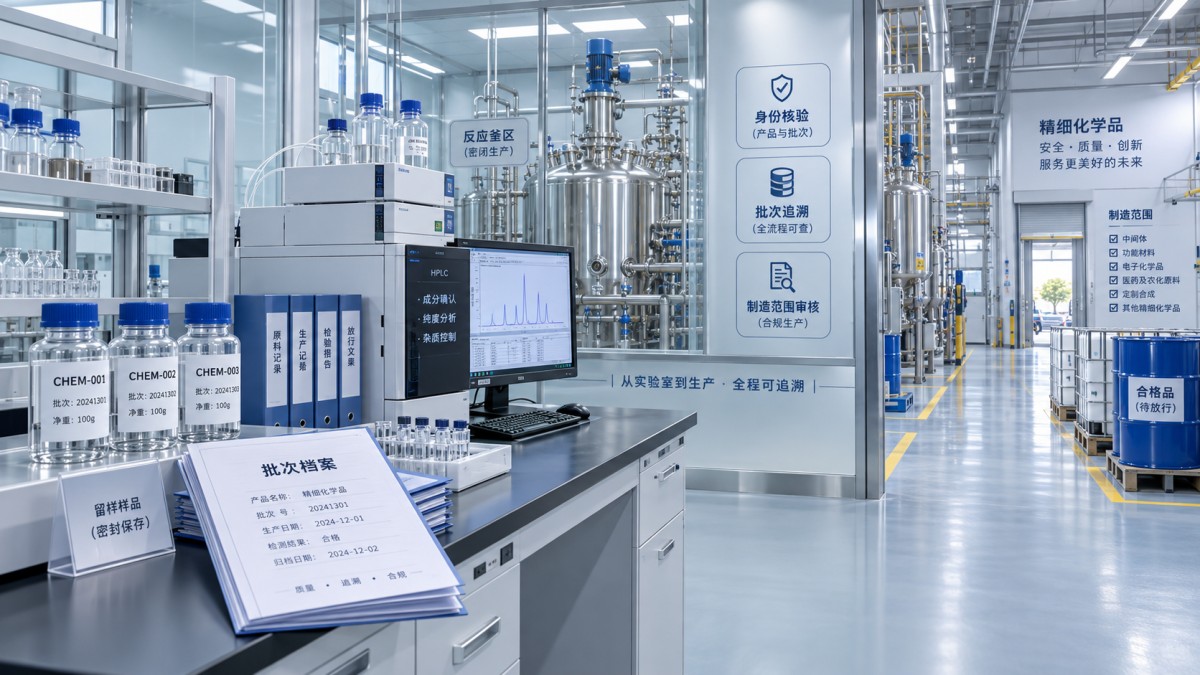
Factory photographs and equipment lists provide context, but product-specific records carry more weight. An installed reactor does not establish that the quoted material is made there. A process flow tied to equipment identifiers, supported by an attributable batch record, offers stronger evidence. Commercially sensitive records can be redacted while retaining dates, batch references, operations, and approval details.
Read the specification behind the purity claim
A headline purity figure is incomplete without the analytical method and reporting basis. Chromatographic area percentage describes the relative detector response under a particular method; it does not automatically establish mass content. Water, residual solvents, inorganic residues, or poorly detected components can change the amount of usable material in a shipment.
For example, a listing for Acetyl hexapeptide-38 describes a white cosmetic peptide powder with a stated 99% main-component value and factory-direct supply. Qualification still requires clarification of what that value measures, confirmation of peptide identity, and evidence of which manufacturing operations occur at the named site. Powder appearance and a high percentage alone do not establish suitability for a skincare formulation.
Build the acceptance specification around the intended application. Identity, assay or content, relevant impurities, moisture, and residual solvents deserve attention where they influence performance or safety. Microbiological controls become relevant when the material and downstream process create a credible contamination concern. Avoid importing limits from an unrelated grade simply because its specification is readily available.
Separate specification limits from batch results. A certificate that repeats “conforms” provides less information than numerical results for quantitative tests. Request the method reference, units, reporting basis, batch number, manufacturing or testing dates, and authorized release details. Where a critical result is unclear, review the underlying chromatogram or arrange independent testing using a suitable method.
Use site evidence to test capacity and quality claims
Capacity should be expressed for the specific product and agreed grade. Total reactor volume or annual site output cannot establish available capacity for a material requiring lengthy purification, specialized drying, or shared equipment. Ask for the typical batch size, production cycle, release-testing time, and scheduling constraints that support the quoted lead time.
Distinguish demonstrated output from planned expansion. Recent, redacted production records can substantiate an operating claim. Equipment purchase plans describe future capability. If purification or final release is outsourced, include that operation in the lead-time assessment rather than relying only on the synthesis schedule.
Audit evidence should follow the product through receiving, processing, testing, storage, and release. A remote review can resolve document questions and demonstrate selected operations; it offers limited assurance about areas outside the camera view. An on-site audit is more useful when facility suitability, contamination controls, or record integrity remain unresolved. In either format, findings need corrective actions and evidence of closure.
Quality acronyms require separate interpretation. A certificate of analysis is a batch document, while a safety data sheet communicates hazard and handling information. Neither is a facility certification. An ISO certificate needs a stated standard, valid dates, site address, and relevant scope. A cGMP claim requires clarification of the framework and operations covered; it does not automatically establish every supplied material as pharmaceutical grade.
Make the quoted price reflect the accepted material
Compare offers using the same composition, assay basis, packaging, and release requirements. A diluted preparation and a neat powder need different quantity calculations. Likewise, a dry-basis assay can overstate delivered content when moisture is ignored. Calculate cost per accepted quantity of the required component only after these bases are aligned.
Include costs directly created by qualification: independent testing, sample evaluation, special packaging, storage conditions supported by stability information, and rejected-lot handling. Small packs reduce exposure during initial evaluation but can add repacking fees and introduce additional handling. Original sealed bulk packs preserve a simpler custody record, although they commit more inventory.
A successful sample evaluation should lead to a controlled specification, not an assumption that future lots will be identical. Record the approved production site, material source where relevant, test methods, packaging, and change-notification obligations. Define how source or process changes will be assessed before shipment and how discrepancies will be investigated.
When identity remains unresolved, pause material approval. When manufacturing scope is narrower than advertised, reassess the offer against the verified scope. The purchase agreement should state the accepted material and its traceable production arrangement clearly enough that a later shipment can be judged against the same evidence used to approve the initial order.
News
- ▶ Pharma West Africa 2026
- ▶ Sexam Factory Due Diligence: Verify Product Identity and Manufacturing Scope
- ▶ PDRN Powder Specifications: Understanding DNA Size Distribution and Purity
- ▶ Paraxanthine as a Nootropic Ingredient: Evidence and Formulation Trade-Offs
- ▶ Water-Soluble Glabridin Claims: True Solubility or a Dispersible Delivery System?
Message
Chemical Engineering Field
24/7 before-sales and after-sales services
Comprehensive technical support