



A lower copper peptide price can become a higher formulation cost when the powder contains less active material. Before comparing quotations, establish exactly what each supplier is selling and how its active content is measured. The useful starting point is cost per gram of the specified active on an as-supplied basis, followed by the cost of using that material successfully in your formula.
Two powders with similar descriptions may differ in peptide identity, copper complex composition, moisture, carrier ingredients, and analytical specifications. Those differences determine how much material you need, what enters the formulation alongside it, and whether a cheaper offer is suitable for production.
Define the material before comparing its price
“Copper peptide” describes a category rather than a single interchangeable ingredient. A quotation should identify the peptide sequence, whether the material is supplied as a copper complex, and the composition covered by its specification. Different peptide sequences should not be treated as equivalent simply because both products contain copper.
For example, Jinan Jianfeng Chemical Co., Ltd. lists AHK-Cu as a powder raw material for cosmetic formulation. When considering it for a serum or essence, compare offers for the same defined ingredient and intended use. A quotation for another copper peptide or a diluted preparation belongs in a separate comparison unless formulation development has established its suitability as an alternative.
Also define what “active” means in your comparison: the complete copper–peptide complex, the peptide portion, or another explicitly specified analytical quantity. These bases are not automatically interchangeable. A total copper result alone cannot establish the amount of the intended copper–peptide complex because it does not distinguish all possible sources or forms of copper.
Calculate copper peptide price on an active-content basis
The calculation is straightforward once the active content is expressed as a mass fraction of the material received:
Cost per gram of active = price per gram of supplied material ÷ active mass fraction as supplied.
If the quotation is per kilogram, convert the price to the same mass unit before calculating. For a solution or carrier blend, use the active fraction of the entire supplied preparation, including its solvent or carrier. Do not use the purity of the peptide before dilution.
The break-even relationship is useful during negotiation: a more concentrated material has a lower active cost when its proportional increase in active content exceeds its proportional increase in price. This avoids assuming that either the cheapest powder or the highest concentration must offer the best value.
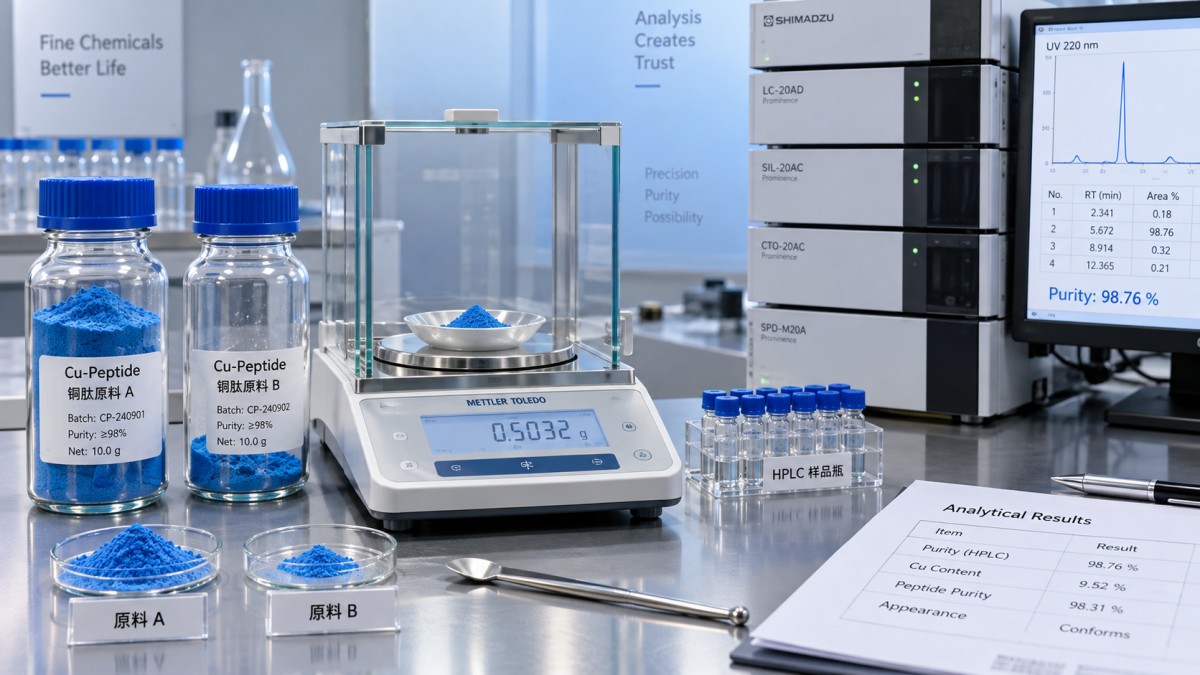
Keep the result tied to its evidence. If one offer provides a batch assay and another provides only a minimum specification, label those bases separately. For a forward supply agreement, calculating against the contractual minimum can provide a more dependable budgeting basis than using an unusually strong sample batch.
Why a purity result may not tell you how much active you are buying
HPLC area purity and quantitative active content answer different questions. Area purity generally describes the proportion of detected chromatographic signal assigned to the target peak under a particular method. It does not automatically describe the target compound’s mass fraction in the whole powder.
Water, inorganic salts, and some carriers may contribute little or no signal under the chosen detection conditions. Different substances can also produce different detector responses. A clean chromatogram can therefore coexist with a meaningful amount of material outside the reported peak-area calculation.
For pricing, request an assay that quantifies the defined active against an appropriate reference, with its reporting basis stated. Identity testing, chromatographic purity, and quantitative assay support different parts of the purchasing decision; one result should not silently substitute for another.
Moisture creates another common mismatch. A dry-basis assay expresses content after excluding the specified moisture contribution, while an as-supplied assay reflects the material actually weighed into production. Where the stated correction covers water only:
As-supplied active fraction = dry-basis active fraction × (1 − water mass fraction).
Apply that conversion only when the assay and moisture results use compatible definitions. Loss on drying can include volatile substances besides water. Also avoid correcting an assay twice when it is already reported on an as-supplied basis.
Read the supporting documents for different purposes
A certificate of analysis should connect the delivered batch to its specification and actual results. A technical data sheet helps explain handling and formulation conditions. A safety data sheet supports safe storage and handling. None of these documents replaces the others.
The information that most directly supports a price comparison includes:
- Identity and composition: the specified peptide or complex, declared carriers, and other intentionally added ingredients.
- Assay definition: what is measured, the analytical method, and whether the result is reported as supplied or on a dry basis.
- Batch results: quantitative assay, moisture where relevant, and impurity or microbiological results appropriate to the intended application.
- Supply conditions: packaging, storage requirements, shelf life or retest period, and remaining usable life at delivery.
A document showing only acceptance limits provides less information about a particular batch than one showing measured results. Likewise, a sample certificate should not be treated as the result for a future delivery. Build the agreed identity, assay basis, and acceptance limits into the purchase specification.
Quality-system credentials can support supplier qualification, but they do not establish the concentration or suitability of an individual batch. Evaluate those claims separately from the analytical evidence used in the cost calculation.
Move from active cost to finished-formula cost
Once the offers are comparable, calculate the ingredient cost for your intended formula:
Required supplied material = target active mass in the batch ÷ active mass fraction as supplied.
Multiply that amount by the quoted material price. Ensure the formulation target uses the same definition of active as the assay; a target stated for the peptide portion cannot be inserted unchanged into a calculation based on the complete copper complex.
Then consider what accompanies the active. A diluted preparation may simplify weighing and incorporation at low addition levels. Its carrier may also introduce components that affect viscosity, preservation, ingredient declarations, or compatibility. A concentrated powder offers more formulation flexibility, but requires suitable weighing equipment and a dependable incorporation procedure.
Solubility and stability must be assessed in the intended formula. pH, chelating ingredients, processing temperature, and the wider formulation can affect copper-containing peptide systems. A raw material’s assay does not establish that the active will remain in the desired form throughout manufacturing and storage.
A laboratory sample is therefore useful for checking dissolution, incorporation, appearance, and relevant stability behavior before committing to volume. Base any allowance for processing losses on measured results from that process rather than a generic assumption.
Make the quotation comparable through delivery and use
Add freight, applicable import costs, required transport conditions, and incoming testing to calculate landed cost per gram of active. Compare equivalent delivery terms and order quantities; a bulk quotation and a small development order may reflect different packaging and service costs.
Minimum order quantity can change the decision even when the normalized price is attractive. If demand is uncertain, buying more material than you can use within its supported storage period can outweigh the unit-price saving. Packaging that limits repeated opening may also be valuable where moisture control or handling consistency matters.
Before requesting a revised offer, send suppliers the same ingredient identity, active-content basis, required documents, order quantity, delivery terms, and packaging requirements. Ask them to separate material pricing from additional charges. Choose among materials that meet the agreed specification, then use normalized active cost and formulation results to decide which offer delivers the best purchasing value.
News
- ▶ Pharma West Africa 2026
- ▶ Pharmaceutical-Grade PDRN: Mapping Quality Data to the Intended Use
- ▶ Copper Peptide Pricing: Compare Cost per Gram of Active, Not Just Powder
- ▶ Copper Peptide Raw Materials for Serums: Identity and Compatibility Checks
- ▶ “5 Amino 1mg” Research Powder: Is 1 mg a Pack Size or a Product Identifier?
Message
Chemical Engineering Field
24/7 before-sales and after-sales services
Comprehensive technical support