



Select a copper peptide raw material only when its peptide identity, copper loading, and supplied concentration are defined well enough to calculate a reproducible serum dose. A high purity figure alone cannot establish these properties. Selection also requires evidence that the material remains soluble and chemically suitable in the intended formula, including its pH, preservative system, chelators, and other active ingredients.
Two materials sold under the same general description can deliver different amounts of peptide and copper at the same addition rate. Those differences affect formulation comparisons before stability testing even begins. Establish a common composition basis first, then compare performance in the actual serum.
Define the material behind the copper peptide name
“Copper peptide” describes a category rather than a complete chemical identity. If the intended ingredient is GHK-Cu, documentation should identify the glycyl-L-histidyl-L-lysine peptide and describe its copper complex. A peptide sequence, a cosmetic ingredient name, and a chemical identifier serve different purposes; agreement between them supports traceability, but none independently establishes the composition of a delivered batch.
Request the supplied form: isolated powder, hydrated material, or a solution containing water, solvents, stabilizers, or preservatives. For powders, distinguish peptide assay from chromatographic purity and identify the basis used for copper content. For solutions, obtain the active concentration and vehicle composition. Counterions, residual salts, and moisture influence both dosing and the electrolyte load entering a serum.
The stated peptide-to-copper relationship also needs an analytical basis. A manufacturing feed ratio does not establish the final complex composition. Excess uncomplexed peptide or copper can alter behavior even when the principal chromatographic peak looks acceptable. Specifications should explain how copper loading is controlled and whether loosely bound or unbound copper is assessed.
Read purity, assay, and copper results together
A reported HPLC purity generally describes the relative chromatographic response under a particular method. It does not automatically represent the mass fraction of copper peptide in the container. Water, inorganic salts, and compounds with weak detector response can escape that percentage. Peptide assay, moisture, and total copper therefore answer questions that chromatographic purity alone leaves open.
A certificate of analysis becomes more useful when it includes actual batch results, method references, and reporting conventions rather than only acceptance limits. Resolve whether each percentage refers to material as supplied or to a dry basis. Where assay and copper results appear inconsistent, investigate the calculation basis and analytical uncertainty before attributing the difference to defective material.
Compatibility follows the complete serum environment
Use the candidate’s documented working pH range as a starting point, then test the intended formula within that range. Acidification changes peptide protonation and copper coordination; alkaline conditions introduce different coordination and precipitation risks. There is no universal pH window that establishes compatibility for every copper peptide preparation and serum.
Measure pH after all ingredients have equilibrated and again during storage. An acceptable reading immediately after mixing can conceal later drift. Buffer identity matters alongside the pH value because some buffer components interact with copper. Dilute acid or alkali additions also reduce local pH extremes during adjustment.
Chelators require particular attention. EDTA and other metal-binding ingredients can compete with the peptide for copper, with the outcome governed by pH, concentration, and the competing equilibria. A clear serum can still contain a changed distribution of copper species. Compare the complete formula with a matched version lacking the chelator, using analytical evidence alongside appearance.
Reducing ingredients, including ascorbic acid, introduce a separate compatibility question involving copper redox chemistry and oxidation pathways. Derivative forms require their own assessment; the word “vitamin C” does not define a single chemical behavior. Strongly acidic exfoliating systems also combine pH effects with possible ligand interactions.
Research formulations containing Spermine Dihydrate, a water-soluble polyamine supplied for research and cosmetic development, warrant a targeted comparison because its amine groups introduce additional copper-binding possibilities. Water solubility alone does not establish compatibility with a copper peptide complex.
Preservatives and rheology modifiers belong in the same assessment. Organic-acid preservative systems constrain the usable pH, while electrolytes and copper interactions can alter polymer thickening. A viscosity loss without visible sediment can therefore reflect a polymer response rather than peptide degradation. Preservative efficacy must be established in the finished serum; chemical stability data cannot substitute for that evaluation.
Use paired samples to explain changes
A useful screening design separates raw-material behavior from formula interactions. Prepare the copper peptide in the intended aqueous vehicle, the complete serum, and selected variants omitting suspected interacting ingredients. Include a serum without copper peptide to reveal changes caused by the base itself. Keep active concentration, preparation conditions, and sample containers comparable.
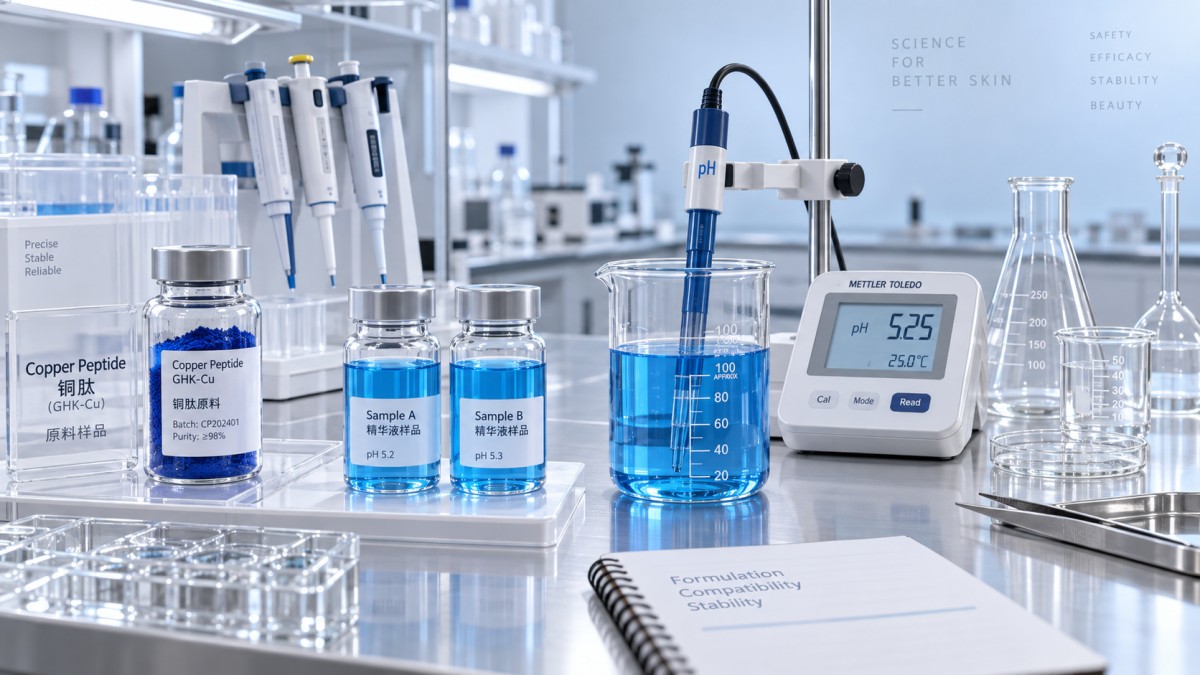
Record initial appearance, pH, turbidity, viscosity, and an appropriate analytical baseline. Follow the same measurements under the intended storage conditions and relevant temperature or light stresses. Accelerated exposure supports comparison and investigation, but shelf-life assignment still requires evidence representative of normal storage.
Interpret color changes with care. A weaker blue appearance can result from dilution, coordination changes, precipitation, or chemical degradation. Conversely, retained color does not establish retained peptide integrity. Where discoloration accompanies a changed spectrum, use a suitable peptide method and copper assessment to distinguish the possible causes. Analytical preparation itself must be evaluated so that extraction or dilution does not create the change being measured.
Test packaging during this stage when the serum will contact pumps, closures, or coated components. Compare filled packages with a suitable inert reference container. Differences can reveal adsorption, contamination, or package-related instability that a bulk sample would miss.
Carry the selected composition into production
Bench compatibility does not automatically transfer to a larger batch. Addition order, mixing intensity, temperature, and hold time determine the local conditions encountered by the ingredient. Pre-dissolve the material in a compatible portion of the vehicle where appropriate, and document the dissolution endpoint. Avoid concentrated contact with acidic actives, chelators, or pH-adjustment solutions.
If addition during cooling is proposed, define the temperature and maximum hold time from stability evidence. “Add below a certain temperature” is incomplete without considering the duration of exposure. Confirm uniform distribution after mixing, especially when the serum becomes viscous before the copper peptide is introduced.
Supplier qualification should finish with acceptance criteria tied to the tested composition: identity evidence, quantitative content, copper reporting basis, relevant impurity controls, and performance in the intended formula. Evaluate additional lots to determine whether observed differences fall within the established formulation tolerance. A change in vehicle, counterion, assay method, or copper-loading specification should trigger a focused comparison with the qualified material before routine substitution.
News
- ▶ Pharma West Africa 2026
- ▶ Copper Peptide Raw Materials for Serums: Identity and Compatibility Checks
- ▶ “5 Amino 1mg” Research Powder: Is 1 mg a Pack Size or a Product Identifier?
- ▶ Glabridin Price Differences: Comparing Purity, Test Methods, and Order Size
- ▶ Lab-Grade Methylene Blue Trihydrate: Assay Basis and Impurity Checks
Message
Chemical Engineering Field
24/7 before-sales and after-sales services
Comprehensive technical support