



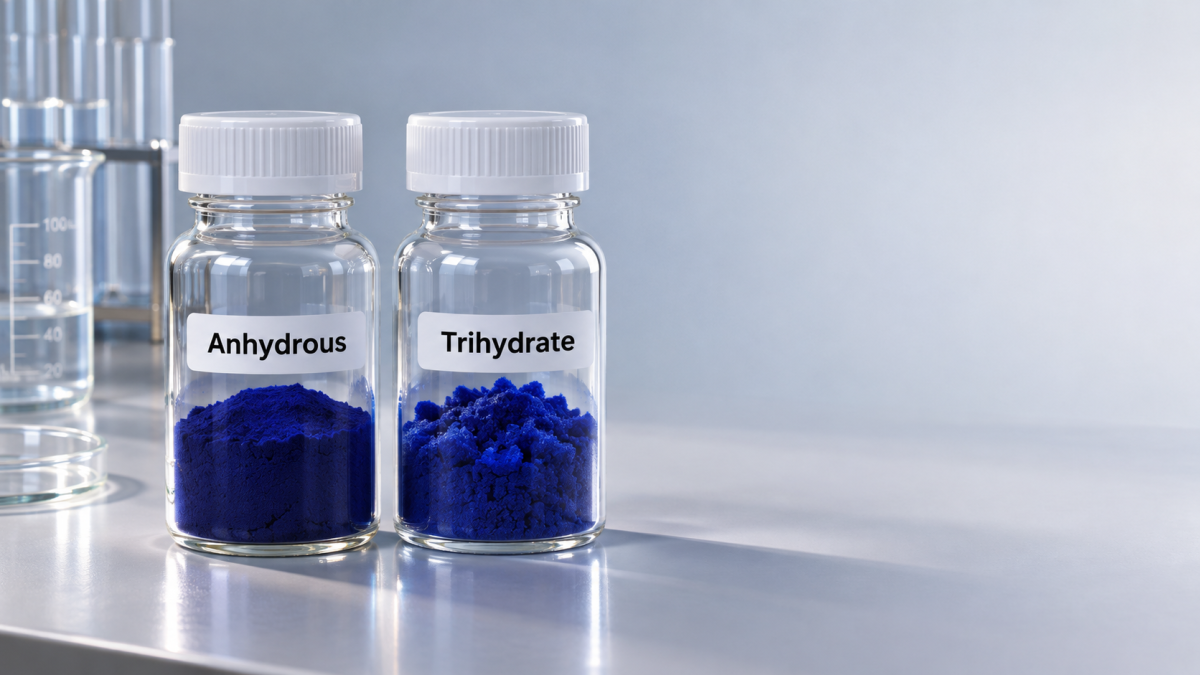
Methylene Blue Trihydrate and anhydrous methylene blue contain the same dye component, but the trihydrate also includes water in its crystal structure. That difference changes molecular weight and the mass needed to deliver an equivalent amount of dye. For technical evaluators, the first checks are the specified chemical form, the assay reporting basis and the water content of the actual batch. Without those details, two apparently similar specifications cannot be compared reliably.
What changes chemically between the two forms?
Methylene blue is commonly supplied as a chloride salt. Its nominal anhydrous formula is C16H18ClN3S, while the trihydrate is represented as C16H18ClN3S·3H2O. The three water molecules are associated with each formula unit in the hydrate; they are not an additional dye ingredient.
For the chloride salt, the nominal molecular weights are approximately 319.85 g/mol for the anhydrous form and 373.90 g/mol for the trihydrate. The theoretical water fraction of the trihydrate is therefore about 14.5% by mass. These figures describe ideal compositions, not necessarily the water or dye content of a commercial batch.
How much material is equivalent?
On a purely theoretical basis, 1.000 g of anhydrous methylene blue chloride corresponds to approximately 1.169 g of the trihydrate for the same number of moles of dye. Conversely, 1.000 g of ideal trihydrate corresponds to approximately 0.855 g of the anhydrous form. This is a molecular-weight conversion, not a substitute for the batch assay.
For an actual formulation, first express each batch’s dye content on the same basis, such as grams of anhydrous-equivalent methylene blue chloride per gram of material as received. Divide the required anhydrous-equivalent mass by that value to obtain the material quantity. If a certificate reports assay on a dried basis, the evaluator must understand the drying method and apply the appropriate moisture correction before using it as an as-received value.
Avoid correcting for water twice. An assay already reported as anhydrous equivalent on an as-received basis may already reflect the effect of water. Conversely, a result reported against the trihydrate formula cannot automatically be treated as an anhydrous-equivalent result. The test method and calculation on the certificate of analysis (COA) determine which conversion is appropriate.
Which form is better for a formulation?
Choose based on the required dye dose, the formulation’s water tolerance and the quality controls available—not the hydrate name alone. If a dry blend has a tightly controlled water budget, evaluate the measured water content of the proposed batch and its effect on the complete formulation. A material labelled anhydrous should still be checked for actual moisture, because the name does not establish a zero-water batch.
If an aqueous solution is being prepared, equivalent dye content may be more important than the nominal hydrate form for the dose calculation. However, substitution should still be assessed against the applicable solubility procedure, impurities and product specification. Do not assume that equal calculated dye content makes two grades interchangeable for every analytical, industrial or regulated use.
Solid-state handling also matters. Hydration and moisture can change with storage conditions, potentially affecting weighing and assay interpretation. Request the supplier’s recommended packaging, storage conditions and retest period, then assess whether those controls fit the site’s dispensing and inventory practices.
What should a technical review request?
- Identity and intended grade: Confirm the salt, hydrate designation and intended application. A dye grade suitable for one use is not automatically suitable for pharmaceutical, diagnostic or other regulated use.
- Assay method and basis: Ask whether the result is calculated as anhydrous material, trihydrate or another stated basis, and whether it is reported as received or after drying.
- Water measurement: Obtain the batch result and method. Loss on drying and a specific water determination do not necessarily measure the same thing; volatile substances other than water may affect loss on drying.
- Impurities and batch consistency: Compare limits and results using methods appropriate to the intended use. A high headline assay alone does not establish an acceptable impurity profile.
- Supply and handling: Review packaging, storage, retest information and change-control arrangements before qualifying a substitution.
The same distinction between a headline specification and its test basis applies to other fine-chemical raw materials, although they should not be compared as substitutes. For example, the supplied information for Coenzyme Q10, a nutraceutical ingredient, lists both 99% purity and an assay of at least 98.0%. An evaluator would need the corresponding methods and reporting bases before interpreting those figures as equivalent measures.
Use a common basis before comparing offers
For a meaningful technical and cost comparison, convert each acceptable batch to the same as-received, anhydrous-equivalent dye basis. Then compare the amount required, impurity controls, documentation and handling requirements. If the assay basis or water result is missing, obtain clarification before applying the theoretical 1.169 conversion factor or approving a change of form.
News
Message
Chemical Engineering Field
24/7 before-sales and after-sales services
Comprehensive technical support