



PDRN OEM Suppliers: What to Confirm Before Developing a Skincare Line
Choosing a PDRN OEM supplier is an important first step in developing a skincare line that meets your quality, budget, and market requirements. For procurement professionals, the decision involves more than comparing prices: PDRN sourcing, ingredient documentation, formulation capabilities, manufacturing standards, and regulatory considerations all deserve attention. This guide outlines the key points to confirm before selecting a partner, helping you reduce sourcing risks and move from product concept to production with greater confidence.
The most useful question to ask at the start is not “What is your price per unit?” It is “What exactly is included in that price?” One quotation may cover a stock formula and standard bottle; another may assume custom development, different PDRN specifications, and a separate testing budget. Without a common brief, the lower number can be misleading.
Establish what the supplier is actually supplying
“PDRN supplier” can describe a raw material distributor, an ingredient manufacturer, a contract formulator, or a finished-product factory. Some businesses coordinate several of these functions without performing all of them in-house. That arrangement is not necessarily a problem, but the division of responsibility should be visible before samples are approved.
Ask who sources and releases the PDRN ingredient, who owns the formula, where the finished product will be manufactured, and which party handles stability testing and regulatory documentation. If subcontractors are involved, establish who investigates an out-of-specification batch and who bears the cost of a delay or rejected shipment.
A raw material quotation is not equivalent to an OEM offer. Conversely, a finished-product quote may provide little information about the ingredient itself unless you request it. Both levels matter when the product’s positioning depends on PDRN.
Check the PDRN specification before comparing prices
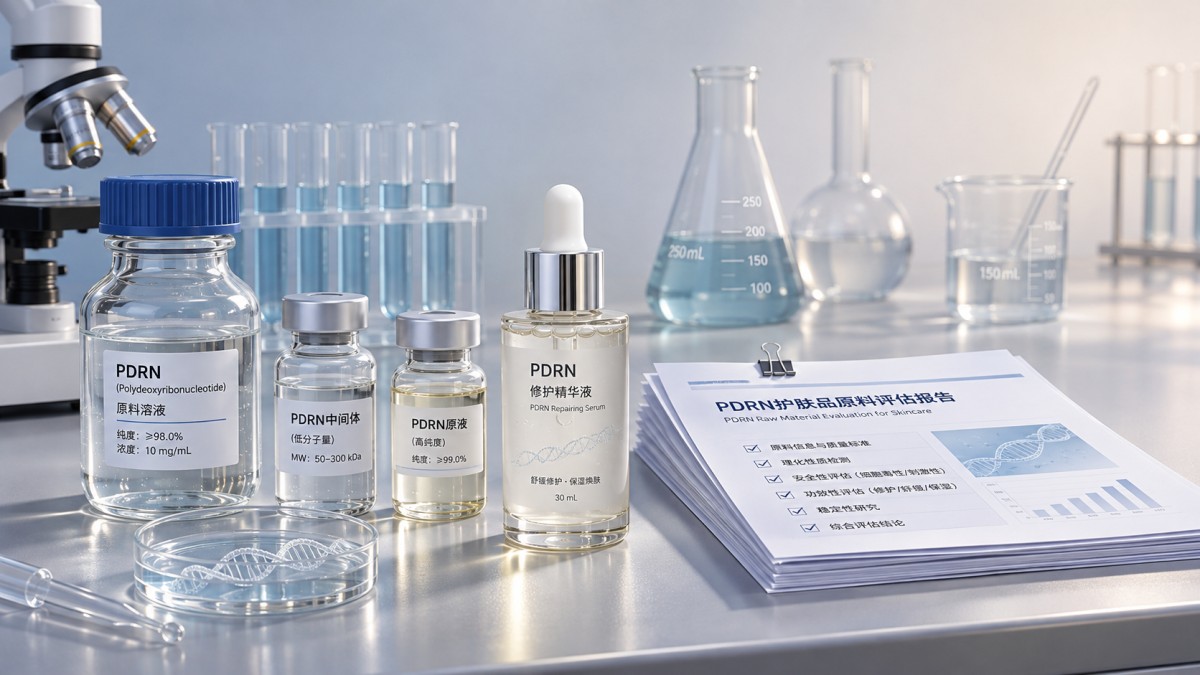
PDRN is commonly discussed in terms of source and processing, but commercial materials may differ in composition and presentation. Ask for the biological source, extraction or manufacturing overview, ingredient naming, concentration or assay basis, physical form, storage conditions, shelf life, and recommended handling. Where relevant to the material, request information on molecular-weight distribution and the methods used to characterize it.
The distinction between ingredient concentration and use level in the finished formula is especially important. A supplier may quote a PDRN-containing solution rather than a neat material. If one proposal lists the percentage of solution added and another lists the concentration of active material, the figures cannot be compared directly. Ask the formulator to express both on the same basis and document the calculation.
Request a representative certificate of analysis, technical data sheet, and safety data sheet, followed by batch-specific documents for production lots. Review the test methods and acceptance limits, not just the fact that a document exists. Depending on the source and intended use, questions about microbial quality, impurities, and traceability may also need specific answers. Agree in advance on what happens if an incoming lot does not meet the approved specification.
Separate formula development from proof that the product will hold up
A lab sample can look and feel right while still leaving major production questions unanswered. Discuss the intended format—serum, cream, mask, or another topical product—and ask the formulator how the proposed ingredient will be incorporated. Processing conditions, pH, preservative system, packaging, and other ingredients may all influence the finished formula. The relevant limits should come from the material supplier’s data and the formulation work, not assumptions based on a different PDRN grade.
Before approving a launch schedule, establish a test plan for the actual formula and pack. Depending on the project, that may include stability, microbiological quality, preservative effectiveness, packaging compatibility, and appropriate safety assessment. Confirm the duration, cost, sample quantities, and acceptance criteria. Accelerated testing can inform a decision, but it should not automatically be treated as a substitute for all longer-term evidence.
Also ask what is included if the first trial fails. One revision may be covered by a development fee; repeated reformulation, new packaging components, and retesting may not be. Those details often matter more to the final budget than a small difference in the initial sample price.
Build a comparable landed-cost model
For each proposal, use the same product size, target formula, packaging, order quantity, delivery destination, and commercial terms. Request an itemized quote that distinguishes one-time charges from costs incurred on every order.
- Development: formula work, samples, revisions, and ownership or licensing terms.
- Verification: stability, microbiological, compatibility, safety, and claim-support testing where applicable.
- Production: bulk formula, filling, packaging components, labels, coding, and batch documentation.
- Commercial and logistics: minimum order quantity, tooling, freight, insurance, duties where applicable, and payment terms.
- Change costs: reformulation or requalification if an ingredient, packaging component, or manufacturing site changes.
A low minimum order can reduce inventory exposure for a first launch, but unit costs and packaging choices may be less favorable. A larger run can improve the quoted unit price while tying up cash and increasing the cost of unsold stock. Model both scenarios against the product’s expected shelf life and replenishment plan rather than treating the lowest unit price as the automatic winner.
Confirm the manufacturing route and the evidence behind claims
Ask for the name and location of the proposed manufacturing site and current evidence of its quality system. If a supplier refers to ISO or cGMP, check the applicable standard, scope, issuing body, site, and validity rather than assuming the statement covers every product or operation. Agree on batch records, release criteria, retention samples, change notification, complaint handling, and recall cooperation in the quality agreement.
The target market also needs to be settled early. Ingredient acceptability, labeling, product notification, safety documentation, and permitted claims depend on the jurisdiction and the finished product. A supplier’s statement that a formula is “globally compliant” is not a substitute for a market-specific review. Have the responsible regulatory professional check the ingredient identity and proposed claims before artwork and packaging are finalized.
Keep cosmetic positioning separate from medical positioning. A topical skincare product should not be assumed to have the same regulatory status or evidence base as an injectable product using similarly named ingredients. Claims about treatment, tissue repair, or other physiological effects need particular scrutiny against local rules and the evidence available for the finished product.
Consider the wider ingredient brief without confusing functions
A PDRN concept may sit within a broader portfolio of skin or scalp products, but each ingredient should earn its place in the formula and budget. For example, Acetyl Tetrapeptide-3 is offered as a cosmetic-grade powder, with a stated purity of 99%, for skincare and scalp- and hair-focused cosmetic development. It is a separate peptide ingredient, not a substitute for PDRN. Confirm its batch specification and formulation suitability independently if it is being considered for a related product.
Jinan Jianfeng Chemical Co., Ltd., established in 2011, supplies materials across cosmetic, pharmaceutical, and nutraceutical applications and offers customized solutions. When discussing a project with any ingredient partner, clarify whether it is supplying raw materials, coordinating formulation, or arranging finished-product manufacturing; those services require different documents and commercial commitments.
Make the shortlist earn its place
Send the same written brief to shortlisted suppliers: target market, product format, desired PDRN specification, planned order quantity, packaging direction, testing expectations, and launch timing. Ask each to identify assumptions and exclusions in its response.
Before paying a development deposit, resolve the points that would be hardest to change later: the ingredient source, formula ownership, manufacturing site, testing responsibilities, and cost of revisions. A supplier that can explain those boundaries clearly is easier to evaluate than one offering an attractive price without a defined scope.
News
- ▶ Pharma West Africa 2026
- ▶ PDRN OEM Suppliers: What to Confirm Before Developing a Skincare Line
- ▶ NAD OEM Suppliers: Evaluating Formulation Support and Batch Testing
- ▶ Glabridin Supplier Samples: How to Evaluate Purity and Batch Consistency
- ▶ Paraxanthine Bulk Suppliers: A Checklist for Supplement Ingredient Buyers
Message
Chemical Engineering Field
24/7 before-sales and after-sales services
Comprehensive technical support