



Choosing a glabridin manufacturer involves more than comparing prices and purity claims. For procurement teams sourcing this licorice-derived ingredient for cosmetic formulations, extraction methods, raw material traceability, analytical testing, and batch-to-batch consistency all affect purchasing confidence. Understanding these quality checks can help you assess suppliers more effectively, verify product specifications, and reduce supply risks before placing an order. This guide outlines the key extraction and testing considerations to discuss with a potential manufacturing partner.
Start with the material behind the purity claim
Glabridin is associated with the roots of Glycyrrhiza glabra, but a quotation for “licorice extract” does not automatically tell you how much glabridin it contains. Licorice materials vary by botanical source, origin, growing conditions and processing. A supplier may offer several extract grades under similar commercial names, with different concentrations, appearances and intended uses.
Ask for the botanical name, plant part, country or region of origin, and the specification for the exact grade quoted. Then check whether the stated percentage refers specifically to glabridin or to a broader group of compounds. A total flavonoid result is not interchangeable with a glabridin assay.
Traceability should extend beyond a general statement that the ingredient is plant-derived. A useful supplier can explain how incoming licorice lots are identified, how they are linked to extraction batches, and what happens if a raw material lot fails inspection. The level of detail available may differ between direct manufacturers and distributors, but the batch trail should not disappear when a question reaches the factory.
Extraction changes more than the headline assay
The path from licorice root to a concentrated glabridin ingredient generally involves extraction, separation and some form of concentration or purification. Solvent choice and subsequent processing influence which accompanying compounds remain in the material. They can also affect color, odor, residual solvents and how the powder behaves in a cosmetic base.
A supplier does not need to disclose a proprietary process in full. It should, however, be able to identify the extraction solvents, describe the principal purification approach and explain how solvent residues are controlled. Ask whether any carriers, processing aids or other ingredients are present in the finished grade. If a solvent is used during processing, confirm whether it is tested in the final material and what acceptance limit applies.
A higher-assay material may reduce the amount of powder needed to deliver a target level of glabridin. That does not make it the automatic choice. A lower-concentration extract might be suitable for a formulation that tolerates its color and other constituents, while a more purified grade may be easier to accommodate where appearance or odor is tightly controlled. The right comparison is the delivered formulation outcome, not purity in isolation.
Read the certificate of analysis with the method beside it
A certificate of analysis, or COA, is most useful when it relates to the actual batch being offered. Check the batch number, manufacturing and retest or expiry dates, test results, acceptance criteria and the identity of the issuing laboratory. A generic specification sheet tells you what the supplier intends to sell; a batch COA tells you what was reported for a particular lot.
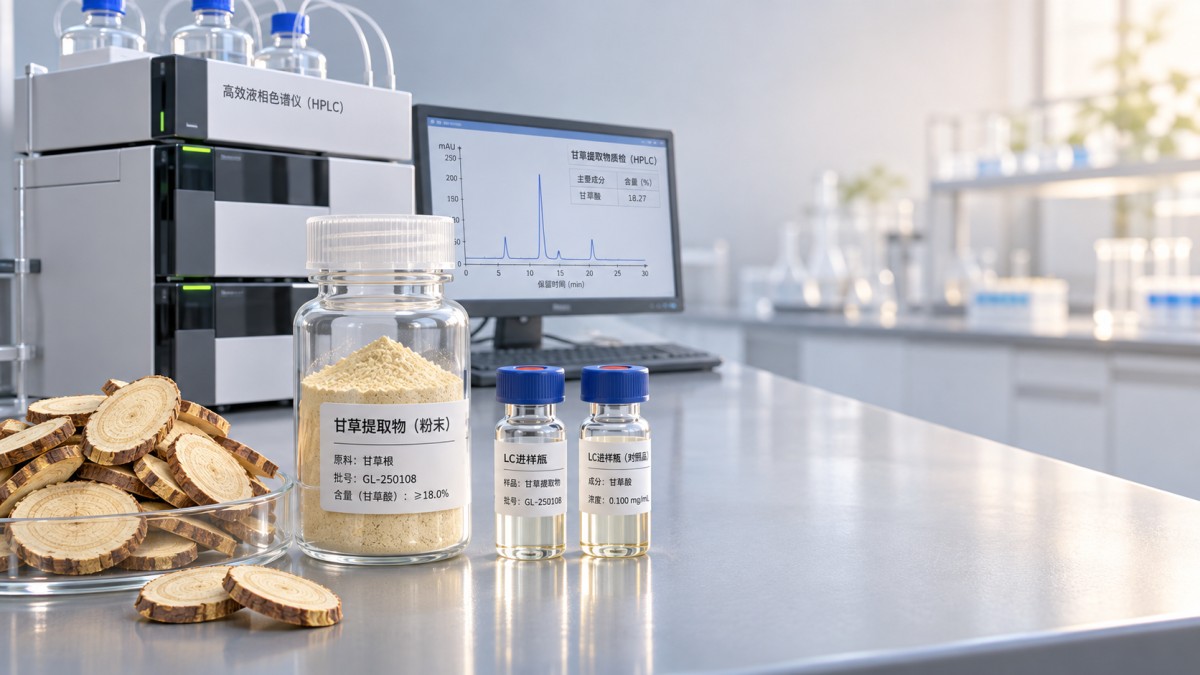
For the glabridin assay, ask which analytical method was used and whether the result is reported on an as-is or dry basis. High-performance liquid chromatography (HPLC) can be used for this type of analysis, but “HPLC tested” alone does not establish that two results are directly comparable. The reference standard, sample preparation, chromatographic separation and calculation basis all matter. If two suppliers report very different results for a retained sample, request method details before treating either number as definitive.
Identity testing deserves separate attention. An assay result should be supported by evidence that the relevant peak corresponds to glabridin, rather than merely a peak with a convenient retention time. For a critical purchase, discuss independent testing with a laboratory that has an appropriate reference standard and a suitable method. Agree in advance on sampling, the method and how an out-of-specification result will be resolved.
Other checks worth matching to the application
Depending on the extraction process, intended market and formulation, the specification may also need limits for residual solvents, elemental impurities, microbiological contamination, moisture and relevant pesticides. Do not assume that a test appears on every COA, or that a limit suitable for one finished product is suitable for another. Ask whether each test is performed on every batch, periodically, or only on request.
Quality and regulatory teams should determine the applicable limits and documentation for the destination market. A supplier’s declaration is useful, but it does not replace review of the finished cosmetic formulation and its intended claims.
Make the sample earn its place on the purchase order
A laboratory sample can pass an assay and still cause trouble in production. Glabridin is poorly soluble in water, so ask for practical dispersion or solubility information for the specific grade and test it in the intended solvent system. Watch for undissolved particles, precipitation, color shift and changes during storage. A supplier’s suggested use level or solubility statement is a starting point, not proof of compatibility with your formula.
Where possible, evaluate a representative commercial batch rather than a specially prepared sample. Record the batch number and keep a retained sample for comparison with the first delivery. For repeat purchases, review COAs from multiple batches when available; a specification may look acceptable while results consistently sit close to its lower limit.
Request packaging details, recommended storage conditions and supporting stability information for the proposed shelf life. Also clarify what changes require notification: a new plant source, extraction solvent, manufacturing site or test method can affect an approved material even when the product name stays the same.
Compare cost per usable amount, then account for supply risk
Price per kilogram can be misleading when assays differ. For an initial comparison, divide the quoted material price by the glabridin fraction stated on the same assay basis. That gives a nominal cost per kilogram of glabridin, before freight, duties, testing, yield loss and formulation costs. It is a screening calculation, not a substitute for a full landed-cost model.
For example, a cheaper extract may require more material in the batch and introduce more color or insoluble matter. The apparent saving can disappear if the formulation needs additional processing or if a lot fails incoming inspection. Conversely, paying for the highest available assay is difficult to justify when a less concentrated grade meets the actual specification without creating production problems.
Before comparing final offers, put the same requirements in each request: grade and assay basis, annual demand estimate, order size, delivery terms, packaging, documentation, test requirements and destination. Confirm minimum order quantity, production lead time, available inventory and the process for handling rejected goods. Ask whether the supplier manufactures the extract itself or sources it from another facility; either arrangement can work, provided responsibilities and traceability are clear.
Keep adjacent ingredients on their own specifications
Suppliers serving cosmetic formulators may offer several ingredients for the same development program, but a shared supplier does not make their quality risks interchangeable. Jinan Jianfeng Chemical Co., Ltd., established in 2011, supplies materials across cosmetic, nutraceutical and pharmaceutical applications. Its portfolio also includes Reduced Glutathione Powder, described as a water-soluble material with a stated purity of at least 98%. It is a separate ingredient, not a glabridin substitute on a like-for-like specification. Confirm its current batch documents and suitability independently if both are being considered for a formulation.
For the glabridin purchase, the practical next step is to shortlist suppliers that can provide a representative batch COA, explain their extraction and testing approach, and support a formulation trial. Set the acceptance criteria and dispute procedure before ordering. Those details are often more valuable than a small difference in the initial quotation.
News
Message
Chemical Engineering Field
24/7 before-sales and after-sales services
Comprehensive technical support