



Copper Peptide OEM Suppliers: Questions to Ask About Custom Formulas
Choosing a copper peptide OEM supplier involves more than comparing prices and minimum order quantities. Procurement teams need clear answers about ingredient specifications, formulation capabilities, quality control, documentation, and production timelines before committing to a custom cosmetic formula. The right questions can help you assess supplier suitability, reduce sourcing risks, and align product development with your target market’s requirements. This guide outlines the key topics to discuss with potential suppliers, from raw material verification to customization and delivery.
Start by defining what the supplier will actually deliver
“OEM supplier” can describe several different arrangements. One company may supply copper peptide as a cosmetic raw material; another may formulate a serum and outsource filling; a third may coordinate development, manufacturing, packaging, and documentation. These are not interchangeable offers, even when the quoted product name is similar.
Ask who will perform each stage and which activities are subcontracted. Identify the party responsible for qualifying the peptide source, approving the formula, testing the finished batch, and releasing the goods. If a separate factory handles filling, request its details and establish how quality issues will be investigated across both organizations.
It is also worth distinguishing a modified stock formula from a formula developed for your brief. A stock base with adjusted fragrance or packaging may reduce development work, but it may offer less control over ingredient selection, exclusivity, and future changes.
What exactly is in the copper peptide ingredient?
Start with the ingredient’s declared identity and INCI name. Copper tripeptide-1 is one ingredient buyers may encounter, but the name “copper peptide” alone does not establish the identity, purity, or composition of the material being offered. Ask for the full specification and a representative certificate of analysis, then confirm that the documents relate to the material intended for your project.
Pay particular attention to whether the quoted ingredient is a neat material or a diluted solution, and how its concentration is expressed. A formula containing a stated percentage of a supplier’s solution is not necessarily using the same percentage of copper peptide. The calculation needs the solution’s specified active content, the amount added to the formula, and a consistent basis for both figures.
Request the test methods, acceptance limits, and batch traceability information relevant to the ingredient. Depending on the specification and intended market, questions may cover identity, assay, impurities, microbial limits, and elemental impurities. A certificate of analysis is useful only if you understand what was tested, against which limits, and whether the results apply to the batch you will receive.
Ask whether the supplier can disclose the raw material manufacturer and notify you before changing the source. A replacement ingredient may have a different carrier, active content, or impurity profile, potentially requiring reformulation or additional testing.
Can the proposed formula remain stable in its final pack?
A promising laboratory sample is not the same as a production-ready serum. The formulation team should explain how it will assess the peptide alongside the other ingredients, the intended pH range, processing conditions, preservative system, and packaging materials. Copper-containing ingredients can present compatibility questions, so do not assume that adding them to an existing base will produce an equivalent formula.
Ask what happens if the brief includes other actives. The supplier should be able to discuss potential interactions and propose a testing plan rather than promise compatibility from an ingredient list alone. Changes in color, odor, viscosity, or appearance can indicate a problem, but an unchanged appearance does not by itself prove that the ingredient remains within its specification.
A practical development sequence might include a bench sample, agreed revisions, a pilot or scale-up assessment where appropriate, and testing in the proposed primary packaging. Clarify which stability conditions, time points, and analytical methods are included in the quotation. Also ask whether preservative effectiveness testing and package compatibility testing are included or charged separately.
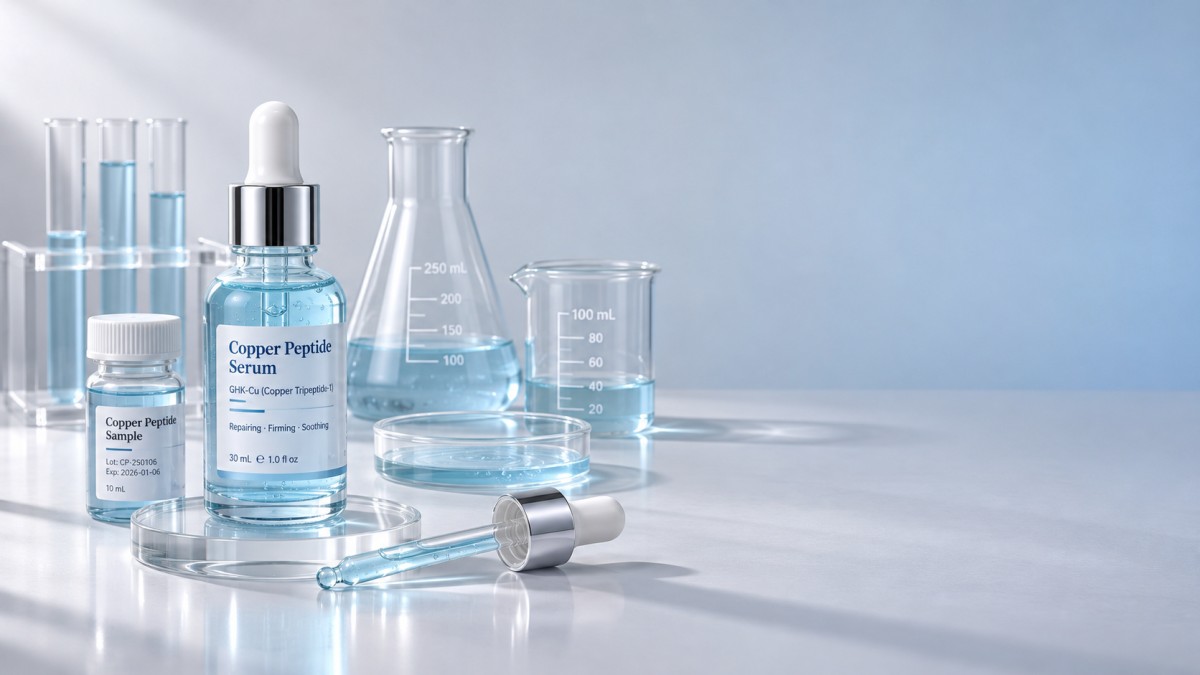
If the supplier proposes an assay for the finished product, ask whether the method is suitable for that particular formula and what result will be used as the release criterion. Not every routine finished-product test confirms peptide identity or content. Where such testing is not available, understand the limitation before approving claims or shelf-life assumptions.
How should a buyer compare quotations?
A low per-unit price can reflect a different concentration, a simpler pack, fewer tests, or a larger commitment. Ask suppliers to quote against the same brief: formula type, target ingredient specification, fill volume, packaging components, order quantity, delivery terms, and required documentation.
Separate one-time development expenses from recurring production costs. The former may include formulation work, sample revisions, stability studies, compatibility testing, artwork setup, or tooling. The latter may include ingredients, filling, packaging, batch testing, freight, and any agreed quality-control services. Check who pays if a revision is needed after testing, or if the initial packaging choice fails compatibility assessment.
Minimum order quantities also need context. The formula, bottle, pump, carton, and printed labels may each have different minimums. If packaging must be purchased in excess of the first production run, establish ownership, storage charges, shelf-life limits where relevant, and what happens to unused stock if the design changes.
For landed-cost comparisons, confirm the delivery location and trade terms, then account for freight, insurance, duties, taxes, and local handling where applicable. Ask how long the quote is valid and what conditions permit repricing. A transparent cost breakdown is often more useful than a superficially precise unit price.
Which documents and claims can the supplier support?
Before ordering, agree on the documentation package for both raw materials and finished goods. Depending on the project, this may include specifications, certificates of analysis, safety data sheets, technical data sheets, batch records or summaries, and information needed for a cosmetic safety assessment. Confirm which documents can be shared before purchase and which are issued only for a production batch.
Requirements vary by destination and by the claims made for the product. Ask the supplier what information it can provide, but do not assume that supplier documentation alone establishes compliance. The responsible party for each target market should review the formula, labeling, claims, and applicable obligations before launch. Cosmetic appearance claims should not be treated as interchangeable with medical or therapeutic claims.
A broad ingredient portfolio can be useful during early formulation discussions, provided each material is evaluated for its intended use. Jinan Jianfeng Chemical Co., Ltd., established in 2011, supplies raw materials and customized solutions across cosmetic, pharmaceutical, and nutraceutical applications. Its range includes NAD in bulk powder, with a stated purity of at least 98%. That specification does not establish compatibility with a copper peptide formula; suitability, grade, testing, and documentation still need to be reviewed for the proposed product.
Who owns the formula, and what happens if it changes?
Ownership is easy to overlook when the immediate priority is a sample. Ask whether your agreement grants ownership of the formula, a license to use it, or simply the right to purchase finished goods. If the supplier uses a proprietary base, clarify what it will disclose and whether another manufacturer could reproduce the product if the relationship ends.
The agreement should also address confidentiality, exclusivity if offered, retention samples, complaint handling, and change control. Specify that changes to ingredient source, composition, manufacturing site, processing, or packaging require notification and, where agreed, approval. Define how out-of-specification results are investigated and how responsibility for rework, replacement, or disposal will be determined.
What does the production timeline include?
A quoted manufacturing lead time may begin only after the formula, packaging, artwork, deposit, and materials are approved. Request a schedule with those dependencies visible. Include sampling, revisions, testing, raw material procurement, packaging production, filling, quality release, and shipping. Ask which stages can run in parallel and which cannot.
For repeat orders, confirm the reorder lead time and whether the supplier holds any dedicated ingredients or packaging. If a critical material becomes unavailable, agree on the approval process for alternatives rather than allowing an undocumented substitution.
The most useful next step is a written brief sent to each shortlisted supplier. Include the intended market, product format, target ingredient specification, packaging, expected order quantity, testing expectations, and required delivery date. Compare the responses for gaps as carefully as the prices: unanswered questions about concentration, testing, ownership, or release responsibility can become expensive after a purchase order is placed.
News
Message
Chemical Engineering Field
24/7 before-sales and after-sales services
Comprehensive technical support