



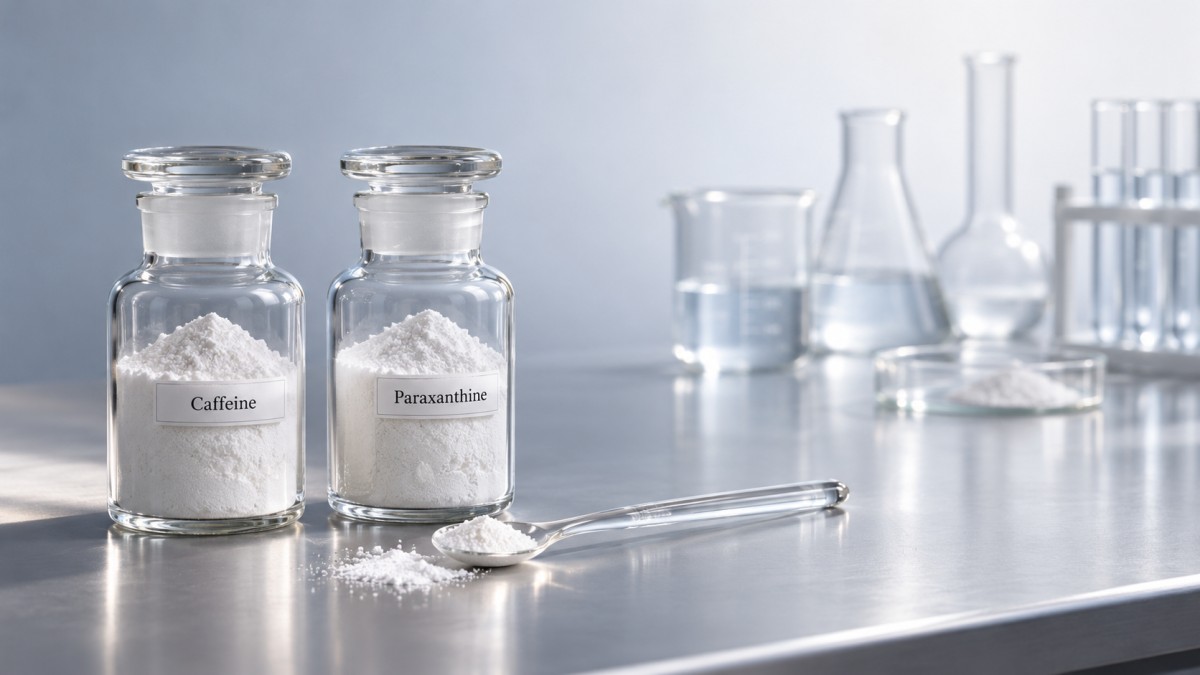
Caffeine is generally the more straightforward choice when a formulation needs a well-characterized stimulant with an established history of use. A paraxanthine stimulant ingredient may be worth evaluating when product differentiation matters and the development team can support additional work on evidence, specifications, and market access. The two are related, but they are not interchangeable by weight or identical in their regulatory treatment.
The decision should start with the intended product and population: a single-serving pre-workout powder, a daily capsule, and a ready-to-drink beverage create different demands for dose, stability, taste, and labeling. From there, compare the ingredients against the performance and documentation needed for that specific application.
How paraxanthine and caffeine differ in the body
Caffeine and paraxanthine are methylxanthines. After caffeine is consumed, the body converts a substantial portion of it to paraxanthine, mainly through metabolism in the liver. Taking paraxanthine directly introduces that compound without relying on the same initial conversion step.
Both interact with pathways involved in alertness, including adenosine receptor activity. Adenosine normally contributes to the buildup of sleep pressure, so blocking its effects can increase perceived wakefulness. Similarity in mechanism, however, does not establish identical effects at the same dose. Absorption, distribution, metabolism, and individual sensitivity all influence the response to an ingredient.
Direct paraxanthine intake also does not reproduce the full exposure profile of caffeine. Caffeine remains present while it is being metabolized and can form other metabolites. For that reason, a formulation cannot be assessed by assuming that paraxanthine is simply caffeine delivered in a more direct form.
What the comparison means for ingredient selection
Caffeine offers a practical advantage when a development team needs to connect a proposed serving size to a substantial body of human research. That does not mean every caffeine formula is automatically effective or suitable: the total serving, other stimulants, target users, and product claims still matter.
Paraxanthine is more compelling as a candidate for a defined product concept than as a presumed universal upgrade. A study reporting an effect in one population or under one set of test conditions does not establish the same effect in a different product. Assess whether the study used the same ingredient identity, a relevant serving size, a comparable population, and an outcome that supports the intended claim.
Can paraxanthine replace caffeine at the same dose?
Not as a default formulation rule. A milligram-for-milligram substitution may be a useful starting point for designing a comparison, but it is not proof of equivalent alertness, exercise performance, tolerability, or duration.
Start with the effect the product is intended to deliver and identify human studies relevant to that outcome. Then assess the proposed amount against the study conditions, expected frequency of use, and characteristics of the intended users. A short-term test in healthy adults, for example, does not by itself establish suitability for prolonged daily use or for sensitive populations.
If a formula contains both ingredients, evaluate the combined stimulant exposure rather than treating the paraxanthine component as separate from the caffeine component. Ingredients that add caffeine from botanical sources also belong in the calculation. A finished-product assessment should account for the complete serving and foreseeable use alongside other caffeine-containing products.
Safety and claims need separate decisions
Caffeine can cause unwanted effects such as sleep disruption, nervousness, and a rapid heartbeat, particularly when intake is high or the user is sensitive. Responses vary between individuals, and timing matters: a serving taken late in the day can be less compatible with sleep than the same serving taken earlier.
Paraxanthine should also be treated as a stimulant in safety planning. Its relationship to caffeine does not establish that it is free from comparable concerns. Avoid describing it as non-stimulating, universally better tolerated, or safe for all caffeine-sensitive users without evidence appropriate to the proposed claim and population.
For either ingredient, define who the product is intended for and who should avoid it. Consider interactions with other stimulant ingredients, medicines, and relevant health conditions when developing the safety assessment and label. Evidence of an acute effect should not be presented as evidence of long-term safety.
Claims require their own review. A study measuring a laboratory marker, for example, does not automatically support a consumer-facing claim about sustained energy or exercise performance. The measured outcome, dose, population, and wording all need to align.
Formulation checks before choosing a supplier
Begin with a clear specification for the exact material being purchased. The name on a catalog listing is not enough to establish identity, purity, or suitability for a finished supplement.
- Identity and assay: Request the chemical identity, an appropriate identity test, assay method, and acceptance criteria. Review how the method distinguishes the target compound from related methylxanthines and other impurities.
- Impurity profile: Ask which process-related impurities and residual solvents are controlled, using limits appropriate to the manufacturing process and intended use. An assay result alone does not describe the whole material.
- Batch documentation: Review a representative certificate of analysis alongside the agreed specification. The certificate should report batch-specific results; a specification describes the limits those results must meet.
- Contaminant controls: Establish applicable requirements for microbiological quality and elemental contaminants based on the ingredient, manufacturing process, and finished product.
- Physical properties: Check particle size, flow, bulk density, and handling behavior where relevant. These properties can affect blending uniformity, capsule filling, and powder processing even when chemical purity is acceptable.
- Stability and packaging: Assess storage conditions and packaging for the raw material, then test the finished formulation through its intended shelf life. Raw-material shelf life does not automatically transfer to a flavored powder or beverage.
For a beverage, bench work should include dissolution under the actual processing conditions, as well as observation for precipitation and changes during storage. For a low-dose capsule or powder blend, content uniformity deserves particular attention: a potent ingredient can meet its bulk specification while individual servings vary if mixing is inadequate. Taste and interactions with flavors, acids, sweeteners, and other actives should be assessed in the complete formula.
Jinan Jianfeng Chemical supplies raw materials and customized solutions across nutraceutical and related applications. During sourcing, the useful discussion is not just whether an ingredient is available, but whether its specification, documentation, and supply arrangements match the proposed product. A sample can support formulation work, while qualification of commercial batches remains a separate step.
Make market access an early screen
Before investing in a paraxanthine formula, define the countries of sale, product category, intended serving, target population, and proposed claims. An ingredient accepted for one use or under one set of conditions should not be assumed to have the same status in another market or product category. A supplier’s commercial availability or quality documentation is not, by itself, authorization to sell a finished product.
Review the finished label as well as the ingredient status. Requirements or restrictions may depend on the product’s stimulant content, warnings, presentation, and claims. This assessment can change the commercial decision even when the ingredient performs well in a bench prototype.
Choose caffeine when the project depends on established evidence, familiar sourcing, and a conventional stimulant position. Consider paraxanthine when the intended market permits the proposed use and the product has a clear reason to carry the additional evidence and qualification work. In either case, the strongest selection is the one supported by a defined dose, relevant human evidence, a controlled material specification, and a formulation that remains consistent through its intended shelf life.
News
Message
Chemical Engineering Field
24/7 before-sales and after-sales services
Comprehensive technical support