



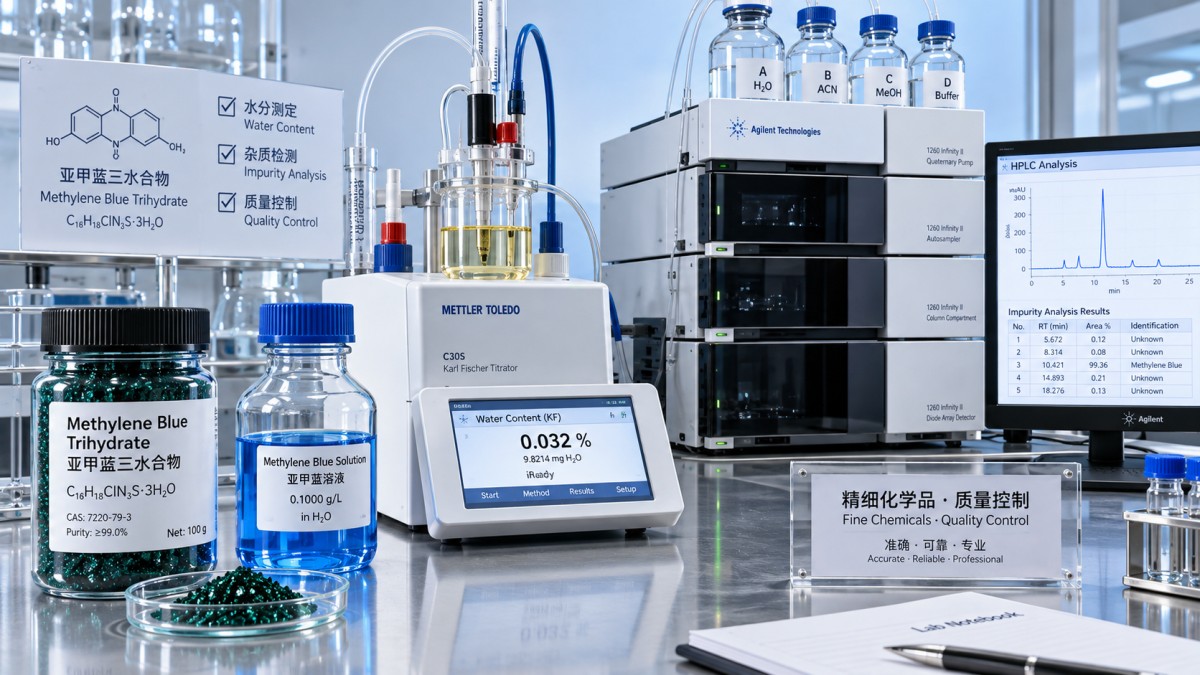
A high assay value is not enough to approve methylene blue trihydrate lab grade. The result must identify both the chemical form being measured and the basis used to report it. An assay expressed as anhydrous methylene blue on a water-free basis cannot be compared directly with a result reported for material as received.
The practical decision is whether the batch contains the expected dye, whether its water content is understood, and whether impurities could affect the intended experiment. “Lab grade” alone does not answer these questions. A useful certificate of analysis connects each acceptance limit to a defined test method and reporting basis.
Read the assay basis before comparing purity claims
Methylene blue trihydrate contains water associated with its crystalline form. That water contributes to the mass weighed into a preparation, but it does not contribute additional methylene blue dye. Consequently, a sample can have high chemical purity while its dye content per gram differs from that of an anhydrous material.
Two details must be separated: what chemical form the assay calculates and what sample mass the calculation uses. A certificate may express the result as anhydrous methylene blue while correcting the sample mass for water. Another may use a different convention. The word “purity” does not make those results equivalent.
A dried basis and an anhydrous basis are not automatically interchangeable. Loss on drying measures mass lost under the prescribed conditions; that loss can include volatile substances as well as water. Karl Fischer testing is designed to determine water, although the procedure still needs to work appropriately with the sample matrix.
Do not interpret expected hydration water as contamination. Equally, do not assume that the word “trihydrate” guarantees the exact water content of every received batch. Storage, packaging, and sample conditioning can affect the material. Measured water data provide the connection between the declared form, the assay calculation, and the amount actually weighed.
For quantitative solution preparation, use the molecular form and assay correction required by the procedure. If concentration is defined as anhydrous methylene blue equivalents, the calculation must account for hydration and the assay basis consistently. Applying a moisture correction twice creates an error just as readily as omitting it.
What the assay method can—and cannot—tell you
A result labelled “HPLC purity” may represent the percentage of integrated chromatographic peak area assigned to methylene blue. That is not automatically a mass-based assay. Water, inorganic salts, and substances that do not respond to the detector may contribute little or nothing to the reported chromatogram.
Related compounds can also have different detector responses. Unless the method accounts for those differences, area normalization provides a chromatographic profile rather than a complete measurement of composition. A strong main peak therefore does not establish that everything else in the container has been quantified.
A calibrated chromatographic assay can provide more useful quantitative information, provided the reference standard, its assigned potency, sample preparation, and calculation are defined. Separation also matters: an impurity hidden beneath the main peak can affect the reported result.
Visible spectrophotometry measures absorbance, but structurally related dyes may absorb in overlapping regions. Solvent, concentration, pH, and aggregation can influence the spectrum. Such a method can be suitable for a defined procedure, yet it should not be treated as a complete impurity screen.
When reviewing a certificate, distinguish an identity test, a content assay, and a related-substances test. They answer different questions. A blue solution supports neither full identity confirmation nor a conclusion that the batch is free of interfering impurities.
Choose impurity checks around the laboratory application
There is no single impurity panel that makes every batch suitable for every use. The most useful checks address substances that can change the measurement, reaction, or biological response.
Related dyes and degradation products
Azure dyes and other related colorants can affect staining behavior and optical measurements. Their importance depends on whether the procedure needs a general stain, a reproducible absorbance response, or a tightly controlled chemical composition.
For sensitive work, request a related-substances method capable of separating relevant components. Reporting individual impurities can be more informative than a single total because different compounds may interfere differently. Acceptance limits should reflect the application and method capability rather than an arbitrary demand for the highest available purity.
Inorganic residues and elemental contaminants
A chromatographic result does not replace checks for inorganic material. Excess salts can alter ionic strength, while trace metals may interfere with redox reactions or biological systems. Depending on the application, useful controls may include residue on ignition or sulfated ash and targeted elemental testing.
Ash is a broad indicator of nonvolatile inorganic residue; it does not identify individual metals. Targeted elemental analysis answers a different question. Also, methylene blue is a chloride salt, so the expected counterion must be distinguished from unwanted inorganic contamination.
Residual solvents, insoluble matter, and biological contamination
Residual-solvent testing is relevant when the manufacturing process can leave solvents that matter to the intended use. The requested panel should follow process knowledge rather than a generic list unrelated to production.
Insoluble matter can disrupt microscopy, clog filters, or introduce turbidity into optical measurements. A dissolution check under the actual preparation conditions can reveal an operational problem, although it cannot identify every chemical impurity.
For cell-based work, chemical purity alone does not establish suitability. Microbial contamination or endotoxin may require separate controls. Sterility and endotoxin are distinct attributes, and neither should be inferred from an assay result or the laboratory-grade label.
Turn the certificate into a release decision
Define the intended use before setting the purchasing specification. Routine staining may emphasize consistent staining performance and dissolution. Quantitative optical work may require tighter control of related dyes and concentration calculations. Redox or cell-based studies may place greater weight on specific interfering contaminants.
A practical review should establish:
- Identity and form: the declared material matches the required hydrate and has an appropriate identity test.
- Assay interpretation: the reported chemical form, reporting basis, and method are explicit.
- Water or drying loss: the result supports the assay calculation and preparation procedure.
- Relevant impurities: limits address the intended use, with suitable methods and reporting thresholds.
- Traceability: the certificate identifies the batch, specification, testing information, and applicable storage or retest conditions.
A “passes” entry may be adequate for some qualitative tests, but numerical results are more useful for tracking assay, moisture, and specified impurities across batches. An unlisted impurity has not necessarily been tested. Likewise, a result below a reporting limit is meaningful only when that limit is sufficiently low for the application.
When a specification cites a compendial standard, identify the applicable monograph and edition. Compliance requires the relevant requirements to be met; borrowing one assay method does not establish full compendial compliance. Laboratory grade also does not establish pharmaceutical suitability or suitability for administration to people.
Keep handling consistent with the approved specification
Use the supplier’s safety data sheet to determine handling controls, protective equipment, and disposal arrangements. Minimize dust during weighing, contain spills promptly, and prevent contaminated material from returning to the original container. Strong staining can make poor housekeeping visible, but visible color is not a measure of exposure.
Keep containers tightly closed and follow the specified storage conditions. Repeated opening can change moisture exposure, while prepared solutions may behave differently from the original solid. Solution storage conditions and usable life should therefore follow the laboratory procedure rather than being inferred from the powder’s shelf life.
Before releasing a new batch, make one comparison explicit: does the certificate describe material that will behave as required when weighed, dissolved, and used in this procedure? A clear assay basis, an appropriate impurity panel, and controlled handling make that decision defensible.
News
- ▶ Pharma West Africa 2026
- ▶ Glabridin Price Differences: Comparing Purity, Test Methods, and Order Size
- ▶ Lab-Grade Methylene Blue Trihydrate: Assay Basis and Impurity Checks
- ▶ Paraxanthine Stability in Formulations: Testing pH, Heat, and Storage Effects
- ▶ Buying Sexam Raw Material: Resolve Product Identity Before Comparing Quotes
Message
Chemical Engineering Field
24/7 before-sales and after-sales services
Comprehensive technical support