



Two glabridin quotes can list the same purity and still represent materially different purchases. A specification of “98% by HPLC” may describe chromatographic peak area rather than the amount of glabridin in each kilogram delivered. Differences in assay calculation, moisture, residual solvents, batch evidence, and order terms can therefore make the cheaper quote more expensive on a usable-material basis.
A meaningful glabridin price comparison starts with an agreed specification and testing basis, then accounts for quantity and delivery costs. Without that common basis, a price difference cannot reliably be attributed to better value, higher quality, or supplier margin.
Establish what the quoted material actually contains
Glabridin is a constituent of licorice, but a licorice extract containing glabridin is not equivalent to highly purified glabridin. The quotation should identify the material explicitly, including its chemical identity, declared glabridin content, and any carriers or other added ingredients. Terms such as “licorice active,” “glabridin extract,” and “high-purity powder” are not sufficiently precise for comparing offers.
Higher purity can require additional separation and purification, with associated yield losses and processing costs. That provides a technical reason for a price premium, but not proof that any particular premium is justified. The relevant question is whether the additional purity is measured credibly and needed for the intended formulation.
A lower-content extract may introduce more accompanying plant constituents. These can affect color, odor, solubility, or formulation consistency. A highly purified grade reduces that accompanying material, but it does not automatically guarantee suitable dissolution, stability, or performance in a finished product.
Before comparing prices, align these specification fields:
- Identity and composition: glabridin identity, declared content, and the presence or absence of carriers.
- Assay basis: chromatographic area percentage or quantitative mass content, reported as received or on a dry basis.
- Relevant impurity limits: water, residual solvents, and other contaminants appropriate to the source and application.
- Physical requirements: appearance and, where formulation handling depends on it, particle-size or dissolution requirements.
Not every application needs the most restrictive specification. Paying for tighter limits makes sense when they address an actual formulation, safety, or acceptance requirement—not simply because the grade has a higher headline purity.
Why identical HPLC percentages may not be equivalent
HPLC is an analytical technique, not a complete specification. A result depends on sample preparation, chromatographic separation, detection settings, reference materials, and the calculation used. “HPLC: 98%” leaves several commercially important questions unanswered.
In an area-normalization calculation, the glabridin peak is compared with the total integrated chromatographic peak area. That result does not automatically equal a 98% mass fraction. Different compounds can produce different detector responses, some components may not be detected under the selected conditions, and water or certain residual solvents may not be represented by the reported chromatogram.
A quantitative assay using a suitable glabridin reference standard provides a different basis: the amount of glabridin is calculated against a calibrated response. Its reliability still depends on method suitability, reference-standard purity, extraction recovery, and adequate separation from interfering compounds.
The reporting basis matters as well. A dry-basis assay corrects for moisture according to the stated calculation, whereas an as-received assay describes the material in its delivered condition. Comparing one with the other without adjustment can overstate the active content of the purchased powder.
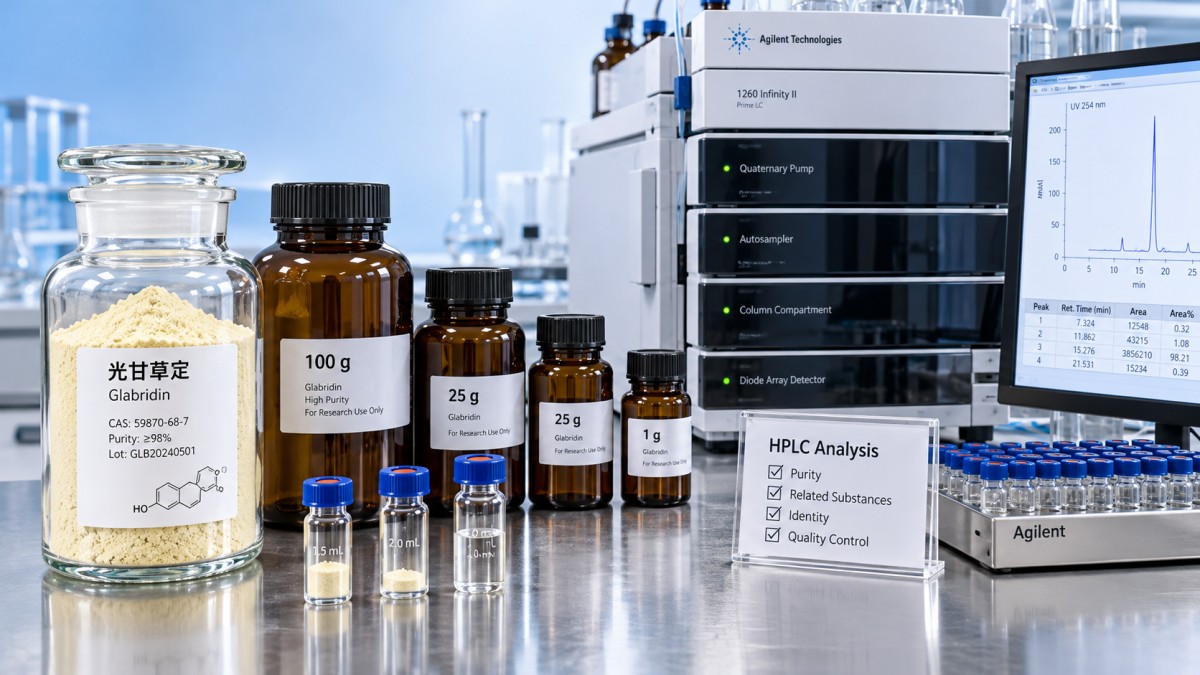
Request the assay calculation, reporting basis, reference-standard details, and a representative chromatogram. The purpose is not to collect the longest analytical report; it is to establish whether the two suppliers are measuring the same attribute. A chromatogram alone does not prove quantitative accuracy, and a clean-looking main peak does not rule out co-elution.
Where a meaningful price difference remains unexplained, independent testing of representative samples using the same suitable method can make the comparison more defensible. Agree on the sampling procedure and acceptance criteria before ordering, including how conflicting laboratory results will be resolved. Otherwise, “failed purity” can become a dispute over methods rather than material quality.
Convert price per kilogram into a comparable cost
Once the assays are comparable, calculate cost per kilogram of verified glabridin rather than relying only on powder price:
Cost per kilogram of glabridin = landed cost per kilogram of material ÷ verified glabridin mass fraction.
Consider a hypothetical comparison—not a market price reference. Material A costs $900 per kilogram landed and contains 90% glabridin by a comparable as-received quantitative assay. Material B costs $1,020 per kilogram landed and contains 98%. Their costs per kilogram of glabridin are $1,000 and approximately $1,041, respectively.
Material B has the higher active-adjusted cost despite its higher purity. It may still be the better purchase if its impurity profile or formulation behavior avoids unacceptable color, additional processing, or rejected batches. Conversely, paying its premium has little justification if Material A satisfies all relevant requirements.
This calculation should not use an HPLC area percentage as though it were a verified mass fraction. Nor does active-adjusted cost establish that two grades are functionally interchangeable. It is a comparison tool after technical suitability has been established.
Landed cost should include the quoted shipping basis, freight, insurance where applicable, import charges, and clearance costs. Testing, sampling, and qualification expenses also matter, particularly for small orders. Keep recoverable taxes separate from nonrecoverable costs, and compare quotations in the same currency using a consistent exchange-rate basis.
Order size changes both the price and the exposure
A small order carries fixed costs that cannot be spread across much material: sampling, release testing, documentation, packing, and shipment handling. A larger order can reduce those costs per kilogram. The discount may also depend on whether the supplier can allocate existing stock or must schedule a new production batch.
Ask for quantity breaks under unchanged specifications and commercial terms. A useful comparison might include the initial qualification quantity, a realistic production order, and a larger scheduled requirement. Comparing a sample-pack price with a bulk production price without identifying these differences gives a misleading picture of savings.
Check what “larger order” means operationally. One shipment from one batch differs from a blanket order delivered in several releases. Split deliveries can reduce inventory exposure but introduce storage, retesting, freight, and allocation questions. The agreement should identify who holds the stock and whether each release comes from the approved batch.
The lowest unit price may require more inventory than can be consumed within the supported shelf life. For glabridin, storage instructions and protection from light should be confirmed, alongside the packaging suitable for repeated opening or subdivision. Calculate savings against financing costs, storage requirements, and the risk of unused material.
A bulk discount is valuable only when the material remains acceptable and usable. Buying excess quantity to reach a lower price tier can increase total expenditure even while reducing the quoted price per kilogram.
Make the quotation enforceable at batch level
A generic certificate of analysis describes an offered grade; it does not establish the quality of the shipment. Request a batch-specific certificate for available stock or agree on the release documentation for newly produced material. Distinguish measured results from specification limits: “conforms” provides less information than a reported result for a critical attribute.
Traceability should connect the sample, certificate, packaging labels, and delivered batch. If qualification relies on a sample, confirm whether the commercial order will use that same batch. When it will not, define which characteristics must remain consistent and what evidence is required before shipment.
A general quality-management certificate does not replace product-specific evidence, and analytical purity alone does not establish suitability for every intended use or destination market. Documentation requirements should be tied to the actual application rather than accepted as broad claims of “global compliance.”
The purchase agreement should capture the assay method and basis, impurity limits, packaging, quantity tolerance, delivery terms, and rejection procedure. It should also address notification of changes that could affect quality, such as a different manufacturing site or purification process.
When two glabridin prices remain far apart after these conditions are aligned, ask the supplier to explain the remaining difference in concrete terms: tighter release limits, additional testing, available stock, batch allocation, or delivery commitments. A premium supported by a requirement has measurable value. A premium supported only by an identical purity label does not.
News
- ▶ Pharma West Africa 2026
- ▶ Glabridin Price Differences: Comparing Purity, Test Methods, and Order Size
- ▶ Lab-Grade Methylene Blue Trihydrate: Assay Basis and Impurity Checks
- ▶ Paraxanthine Stability in Formulations: Testing pH, Heat, and Storage Effects
- ▶ Buying Sexam Raw Material: Resolve Product Identity Before Comparing Quotes
Message
Chemical Engineering Field
24/7 before-sales and after-sales services
Comprehensive technical support