



A high assay result from a glabridin supplier sample is not, by itself, evidence that commercial lots will meet the same specification. A meaningful evaluation must establish what the reported percentage measures, whether the analytical method distinguishes the target compound from related extract components, and how results vary across independently manufactured batches.
The most useful comparison is therefore not simply “40% versus 90%.” It is a comparison of identity, assay basis, impurity profile and repeatability under defined testing conditions. A sample can pass an initial purity test yet still create problems if its composition, solubility or residual solvent profile changes in later deliveries.
Start with the definition behind the purity claim
Glabridin is a specific constituent of licorice root extract, not a synonym for total licorice flavonoids. A certificate of analysis (COA) should state whether the reported result is the content of glabridin itself or a broader measurement expressed as an equivalent. Those figures are not interchangeable, even when both appear as percentages.
Check whether the assay is reported on an as-is, dried or another stated basis. Moisture and other volatile material can make results on different bases appear inconsistent. For example, if a material contains 5% loss on drying and the method permits its use for this correction, an as-is result of 40.0% corresponds approximately to 42.1% on a dried basis: 40.0 divided by 0.95. The calculation is only valid when the loss-on-drying measurement and the assay reporting convention support that conversion.
Units matter as well. A result expressed in mg/g can be converted to a percentage by mass only when the reporting basis is the same: 400 mg/g corresponds to 40.0% by mass. Ask the supplier to clarify any use of “extract ratio,” “standardized extract” or “total flavonoids” before comparing the result with a glabridin-specific specification.
Commercial specifications also need to be interpreted in context. For example, Glabridin is listed in grades of at least 40% and at least 90%, with customization available. That distinction is useful for setting an initial target, but the acceptance decision still depends on the analytical basis and the requirements of the intended formulation.
Read the COA as a record of a particular lot
A useful COA connects each result to a sample that can be traced back to a defined batch. Match the lot number on the container with the document, and check the manufacturing date, test date, retest or expiry date, storage conditions and specification version. A generic specification sheet describes what a supplier intends to provide; it does not establish what was measured in the sample under review.
For the assay, look for the analytical technique, acceptance limit, numerical result and reporting basis. A result reported only as “complies” gives less information for later batch trending than a numerical value. For tests such as microbiological limits or specified contaminants, the method, detection or reporting limit and units are also important when interpreting a “not detected” result.
Review the remaining tests against the intended use rather than assuming that the assay covers overall quality. Depending on the material and process, relevant attributes can include identity, loss on drying, residual solvents, elemental impurities and microbiological quality. A statement that residual solvents meet a standard is more informative when accompanied by the applicable procedure, solvents assessed and actual results or limits. Likewise, “pesticide residue negative” should be understood in relation to the compounds screened and the method’s reporting limits; it does not mean every possible pesticide is absent.
If a result comes from a contract laboratory, establish which tests it performed and which were supplied by the manufacturer. Document provenance matters when investigating a discrepancy or agreeing how future lots will be released.
Verify that the assay is specific enough for the extract
High-performance liquid chromatography is a practical approach for quantifying a target constituent in a complex botanical extract, provided the method is suitable for the sample matrix and intended specification. A chromatogram should show adequate separation of the target peak from nearby components. A large peak at the expected retention time alone does not establish identity or purity: co-eluting material can contribute to the apparent result.
Request the method or a sufficiently detailed summary, a representative chromatogram and information about the reference standard. Useful details include the standard’s identity, assigned purity and traceability, sample preparation, calibration approach, detection wavelength and calculation basis. Where appropriate, additional identity evidence, such as spectral or mass-spectrometric data, can strengthen confidence in the peak assignment.
Method suitability should address specificity, accuracy or recovery, precision, linearity and the relevant measurement range. Recovery deserves particular attention: incomplete extraction during sample preparation can give a low result, while interference from other extract components can give a high one. For a 40% grade and a 90% grade, the same method may be usable, but dilution and sample preparation must place each solution within the validated range.
An independent laboratory result is most informative when it can be interpreted against the supplier’s method. Before declaring a disagreement, compare the sample basis, reference-standard correction, preparation procedure, integration rules and rounding. Agree on an investigation procedure and an appropriate acceptance approach in advance; the difference between two results should be assessed against method precision and measurement uncertainty, not an arbitrary percentage alone.
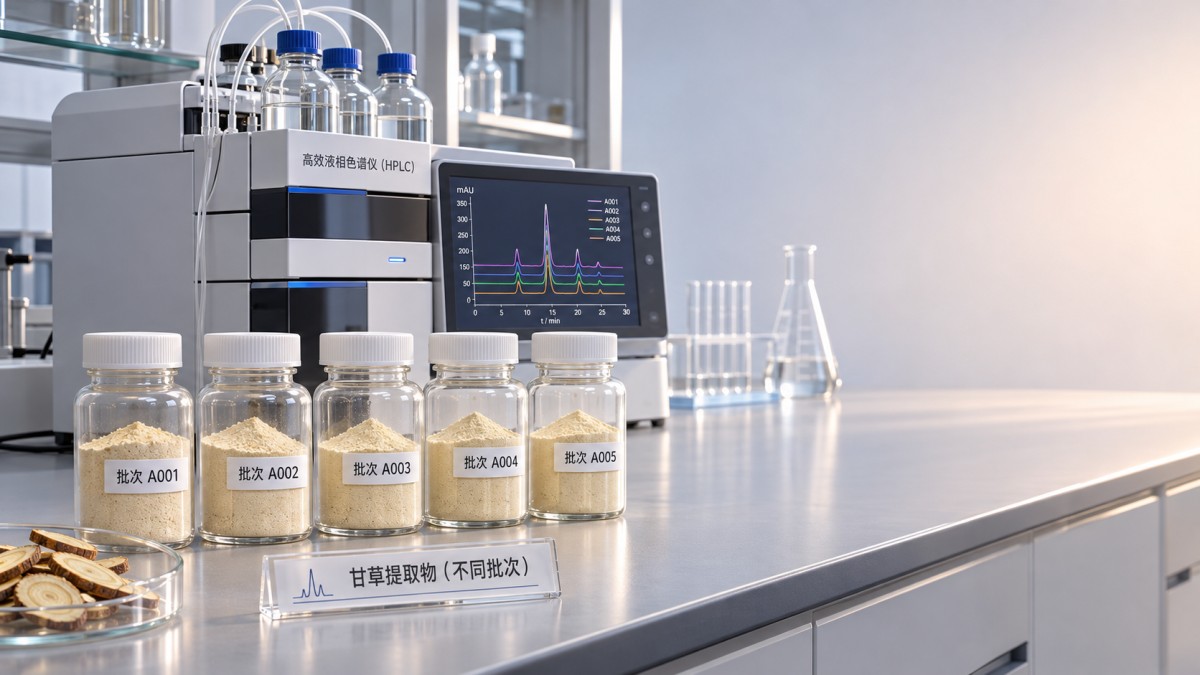
Sample more than one production batch
One retained sample demonstrates the characteristics of one lot at one point in time. To assess consistency, request samples and lot-specific COAs from multiple independently manufactured batches. Confirm that the samples are not subdivisions of the same blended lot and that the production scale and process are representative of the material intended for supply.
Test the batches using the same receiving procedure and, where feasible, the same laboratory method. Take representative increments from the container using a documented sampling plan; a result from an unrepresentative portion cannot establish lot uniformity. Protect samples from conditions that could alter them, and record container, handling and storage details.
Compare more than the assay average. A series of passing results clustered close to the lower specification limit leaves less room for analytical variability or process drift than a series comfortably within the agreed range. Conversely, a higher assay does not automatically make a batch preferable if its other constituents affect color, dissolution or formulation behavior.
Trend the target content alongside chromatographic profiles and other relevant attributes. Similar assay values can conceal changes in neighboring peaks, indicating that the non-target fraction has shifted. Such a change is not automatically a defect, but it warrants investigation if it coincides with a different raw material source, extraction solvent, purification step or formulation outcome.
Ask for an explanation of any out-of-trend result, rejected batch or significant process change where that information is available. Batch consistency is a property of a controlled process, not a claim that every lot will have identical analytical values.
Connect analytical acceptance to formulation performance
An assay defines the amount of target compound; it does not fully characterize the remaining material. In an extract standardized to 40%, a substantial fraction consists of other constituents and any permitted residual materials. At 90%, that fraction is smaller, but its composition can still affect performance. The appropriate grade depends on the formulation’s target dose and tolerance for those other components.
Calculate the required ingredient loading from the measured or specified content, while allowing for the formulation’s own acceptance criteria. For illustration, achieving 0.1% active content theoretically requires 0.25% of a 40% material or approximately 0.111% of a 90% material. This is a composition calculation, not a recommendation for use level or a guarantee of finished-product performance.
Because the material is described as oil soluble, evaluate dissolution in the actual oil phase or solvent system rather than relying on a general solubility claim. Check processing temperature, mixing time, clarity and any precipitation after cooling or storage. Appearance can vary between grades and specifications, so compare color and odor with agreed reference samples under consistent conditions rather than treating a single visual description as proof of identity.
For finished products sensitive to light or oxidation, use a stability program appropriate to the formulation and packaging. Raw-material storage guidance—cool, dry and protected from light—does not by itself establish finished-product stability or justify a shelf life after incorporation.
Set release rules before approving commercial supply
Translate the evaluation into an agreed specification covering identity, glabridin assay and reporting basis, relevant impurities, test methods and limits. Record which laboratory result governs release, how analytical disputes will be investigated and what changes require notification. These may include changes to the botanical source, extraction or purification process, analytical method, manufacturing site or packaging.
For pharmaceutical use, the required controls depend on the material’s role, intended market and applicable regulatory framework; an extract’s COA or a reference to USP testing is not, by itself, evidence of suitability for a drug product. Cosmetic applications likewise require specifications aligned with the finished product and its destination markets.
A defensible approval rests on three connected observations: the sample is correctly identified and measured, representative batches show acceptable variation, and the material performs within the formulation’s limits. If any one of those remains unresolved, a favorable purity number should be treated as an initial finding rather than a basis for unrestricted supply approval.
News
- ▶ Pharma West Africa 2026
- ▶ Glabridin Supplier Samples: How to Evaluate Purity and Batch Consistency
- ▶ Paraxanthine Bulk Suppliers: A Checklist for Supplement Ingredient Buyers
- ▶ Copper Peptide OEM Suppliers: Questions to Ask About Custom Formulas
- ▶ Sexam Bulk Suppliers: Assessing Batch Capacity and Supply Continuity
Message
Chemical Engineering Field
24/7 before-sales and after-sales services
Comprehensive technical support