



Paraxanthine Bulk Suppliers: A Checklist for Supplement Ingredient Buyers
Choosing a paraxanthine bulk supplier requires more than comparing prices. Supplement ingredient buyers must assess product quality, documentation, manufacturing capabilities, and supply reliability before committing to a partner. This checklist outlines the key questions to ask when sourcing paraxanthine, from specifications and testing to regulatory documentation and order fulfillment, helping procurement teams make informed decisions and reduce sourcing risks.
Paraxanthine is a caffeine metabolite that may be considered for stimulant-containing supplement formulations. For procurement teams, its relationship to caffeine is not a substitute for ingredient qualification: identity, impurity profile, permitted use, and finished-product requirements need to be assessed on their own merits.
Start With a Specification, Not a Price List
A useful quotation begins with a shared definition of the material. Ask each prospective supplier for its proposed specification and compare it against the requirements of the intended formulation, manufacturing process, and destination market. Two offers described simply as “paraxanthine powder” may cover different acceptance limits, testing methods, or packaging arrangements.
The specification discussion should cover identity and assay, relevant impurities, residual solvents where applicable, moisture, microbiological limits, and elemental impurities. Request the analytical methods and acceptance criteria rather than relying on a single headline purity figure. A high assay result does not by itself establish that all other quality attributes are suitable.
Physical properties matter too. If the ingredient will be blended into a powder or filled into capsules, ask about particle characteristics, flow, and any available handling information. A material that meets its chemical specification can still create processing difficulties if it does not perform consistently in the production line.
Read the COA Alongside the Test Methods
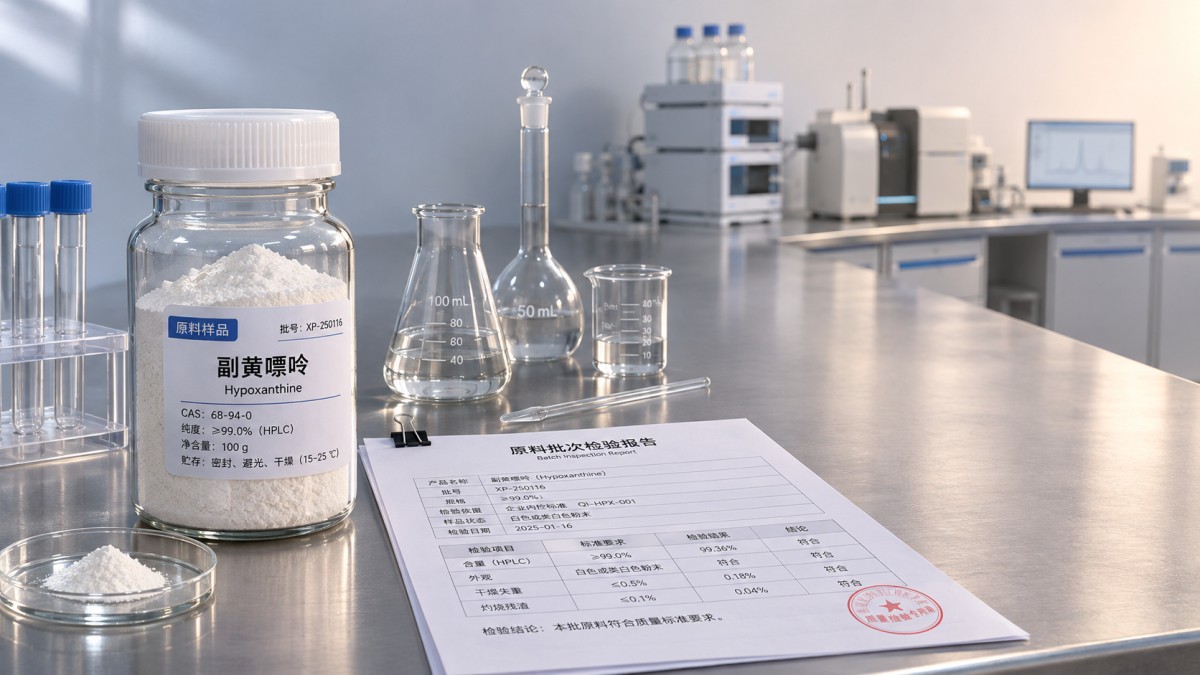
A certificate of analysis is a starting point, not a complete supplier qualification. Request a representative COA during evaluation and a batch-specific COA for each shipment. Check that the batch number, test results, limits, dates, and product identification align with the material being offered.
For critical tests, ask whether the work is performed by the manufacturer or an external laboratory, and whether the methods are appropriate for the intended measurement. In particular, discuss how the assay distinguishes paraxanthine from related compounds and how relevant process-related impurities are controlled. If an independent laboratory will test incoming material, agree in advance on methods and sampling arrangements to reduce avoidable disputes over results.
Also request a safety data sheet and available technical documentation. These documents serve different purposes: a safety data sheet supports handling and transport decisions, while a COA reports results against stated tests. Neither replaces a review of the manufacturing controls behind the batch.
Identify Who Makes the Ingredient and How Changes Are Managed
A supplier may manufacture an ingredient, source it through a partner, or act as a distributor. Any of these arrangements can work, but the purchasing team needs to understand the chain of responsibility. Ask who manufactures the material, where testing takes place, and who investigates deviations or complaints.
Document requests should be proportionate to the risk and the stage of qualification. Depending on the project, these may include a manufacturing flow summary, traceability information, quality-system details, and an opportunity to audit or complete a supplier questionnaire. If a supplier mentions cGMP or ISO credentials, verify the certificate, issuing body, scope, site, and validity; a corporate claim does not automatically cover every product or production location.
Change control deserves attention before the first purchase order. A change in manufacturing site, production process, analytical method, specification, or packaging can trigger a new assessment by the brand or contract manufacturer. Agree on which changes require advance notification and what supporting documents will be provided.
Check Regulatory Suitability for the Actual Market
Ingredient availability does not establish that a proposed supplement can be sold in every jurisdiction. Regulatory status can depend on the destination, ingredient history, intended use, dose, claims, and supporting evidence. Before placing a commercial order, have the relevant regulatory team or adviser assess the specific formulation and market.
Ask the supplier what ingredient information it can share to support that review, including identity, manufacturing process, specifications, and available safety information. Treat a general statement such as “suitable for supplements” as a prompt for further questions, not as a market-specific legal conclusion. The finished-product manufacturer remains responsible for assessing its own obligations.
Compare Landed Cost and Usable Material
The lowest price per kilogram may not be the lowest purchasing cost. Request quotations on a consistent basis, including quantity, packaging, delivery terms, destination, currency, and validity period. Clarify which party pays freight, insurance, customs charges, and any local taxes or clearance fees.
A practical comparison should also account for sample and qualification costs, third-party testing, minimum order quantities, payment terms, and the inventory tied up by a large first order. Where assay values differ, compare the cost per unit of active content using the agreed assay basis—but only after confirming that both materials meet every other requirement. An assay-adjusted price cannot compensate for unacceptable impurities or missing documentation.
Ask how pricing changes at different order volumes and whether repeat orders are subject to new setup, testing, or freight charges. For a launch with uncertain demand, a smaller initial order may have a higher unit price but reduce exposure if the formulation or market requirements change.
Test Supply Reliability Before Scaling
Lead time should be defined precisely: does it begin at quotation acceptance, purchase order confirmation, payment, or sample approval? Ask whether the quoted period covers production only or includes testing, document release, and shipment preparation. For imports, transit and customs clearance add separate uncertainties.
A sample can help assess identity, handling, and formulation compatibility, but it does not prove that every later batch will behave identically. Confirm whether the sample represents commercial production and whether the same specification and methods will apply to bulk orders. Retain an agreed reference sample where appropriate, and establish a process for investigating discrepancies.
Discuss packaging sizes, container materials, storage conditions, retest or expiry dating, and remaining shelf life at dispatch. If demand is recurring, ask about forecast requirements, order flexibility, and how the supplier handles interruptions. A second qualified source can reduce dependency, provided it is assessed against the same technical and regulatory requirements rather than treated as an interchangeable fallback.
Keep Ingredient Categories Separate During Supplier Review
A broad portfolio can be useful when a company sources ingredients for several product lines, but it should not blur the intended use of each material. Jinan Jianfeng Chemical Co., Ltd., established in 2011, describes a portfolio spanning nutraceutical ingredients, active ingredients, vitamins, plant extracts, cosmetic raw materials, and OEM/ODM dietary supplement services.
For example, AHK-Cu is presented as a peptide powder for cosmetic formulation, not as a substitute for a supplement ingredient. The distinction illustrates why buyers should request product-specific specifications and documentation rather than assume that information for one material applies across a supplier’s range.
Before selecting a paraxanthine bulk supplier, consolidate the agreed specification, market, forecast volume, test responsibilities, delivery terms, and change-notification requirements in writing. That gives both the purchasing and quality teams a basis for comparing offers—and a reference point if the commercial order differs from the sample or initial quotation.
News
- ▶ Pharma West Africa 2026
- ▶ Paraxanthine Bulk Suppliers: A Checklist for Supplement Ingredient Buyers
- ▶ Copper Peptide OEM Suppliers: Questions to Ask About Custom Formulas
- ▶ Sexam Bulk Suppliers: Assessing Batch Capacity and Supply Continuity
- ▶ Sexam Price Comparison: What to Check Before Accepting a Low Quote
Message
Chemical Engineering Field
24/7 before-sales and after-sales services
Comprehensive technical support