



NAD Factory Audits: Questions About Process Controls and Supply Continuity
Auditing an NAD factory requires more than reviewing certificates and comparing prices. For teams sourcing nicotinamide adenine dinucleotide for pharmaceutical, nutraceutical, or cosmetic applications, the harder questions concern process consistency, impurity control, batch traceability, and supply continuity. A competitive quotation means little if material repeatedly needs additional testing or arrives too late for production.
The useful audit is therefore not a tour of clean rooms and equipment. It is a test of whether the supplier can explain how an accepted batch was made, why it meets the agreed specification, and what happens when production does not go to plan.
Establish exactly what the factory supplies
Before discussing capacity, confirm the chemical identity, grade, manufacturing site, and intended application. NAD+, NADH, and NAD+ precursors are not interchangeable purchasing specifications. Even within one ingredient category, differences in salt form, water content, assay basis, and packaging can make apparently similar quotations difficult to compare.
Ask whether the contracting supplier performs synthesis, purification, drying, testing, and packaging itself. Outsourcing is not automatically a problem; undisclosed outsourcing is. The audit should identify who controls each operation, who releases the batch, and whether subcontractor changes require customer notification. A supplier's broad product catalog does not prove that every listed ingredient is manufactured at its own site.
Application also changes the assessment. Material intended for pharmaceutical development may require a different documentation package from a cosmetic ingredient. Food or nutraceutical positioning does not establish authorization in every destination market. Agree on the applicable requirements before treating any grade designation as sufficient.
Follow one batch through the process
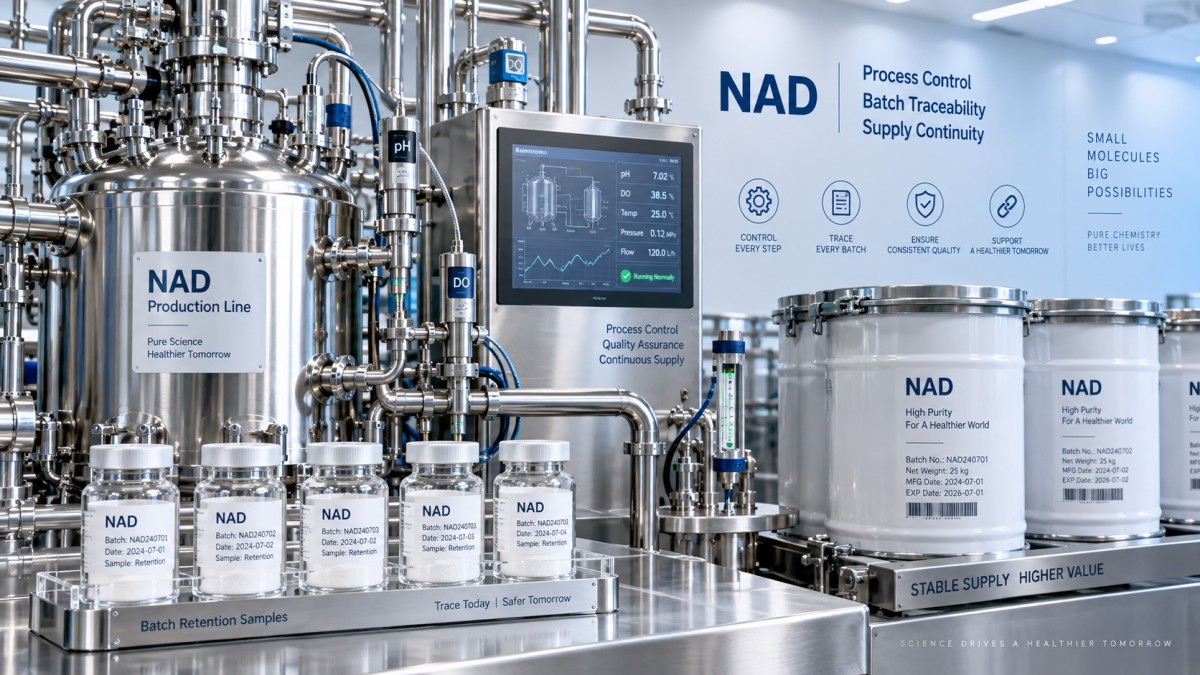
Request a representative completed batch record, with commercially sensitive details redacted where necessary. Follow it from incoming materials to finished packaging. This reveals more than an isolated certificate of analysis because it shows whether instructions, actual operating conditions, deviations, and release decisions connect.
Depending on the production route, relevant controls may include temperature, pH, reaction time, separation conditions, drying endpoints, and exposure during handling. Do not impose a generic checklist as if every NAD process were identical. Ask the manufacturer which variables affect quality, how those relationships were established, and what operators must do when a limit is exceeded.
- Which parameters are recorded during production, rather than reconstructed afterward?
- How are equipment calibration, maintenance, and cleaning linked to batch records?
- What controls prevent mix-ups or cross-contamination on shared equipment?
- Can reprocessed material be identified, and what evidence supports its release?
Traceability should work in both directions: from a finished lot back to its starting materials, and from a raw material lot forward to every affected batch. Ask the site to demonstrate this using a selected record, not merely describe its software.
Check what the purity figure leaves out
A high purity percentage is useful only when its measurement basis is understood. Chromatographic area percentage and quantitative assay are not necessarily equivalent. Ask whether results are reported on an as-is or dry basis and how moisture affects acceptance. Otherwise, two suppliers can quote similar purity while supplying materially different quantities of the target compound.
Request the rationale for the impurity panel. Depending on the route and application, this may cover related substances, degradation products, residual solvents, elemental impurities, or microbiological quality. Limits should reflect the agreed use and applicable requirements, not simply whatever the supplier already tests.
For critical tests, review method suitability, reference standards, representative chromatograms, and out-of-specification investigations. Compare multiple recent commercial batches where available. Repeatedly identical COA values warrant clarification about reporting and rounding practices, though they do not by themselves prove a problem. Confirm whether the laboratory is internal or external and who reviews the underlying data.
Keep precursor specifications separate from NAD specifications
This distinction matters when a sourcing project includes NAD-related ingredients. For example, Nicotinamide Riboside Chloride is an NAD+ precursor, not NAD itself. Its listed specification includes purity of at least 98%, a white to off-white powder appearance, water solubility, and a 24-month shelf life. Those details help define an initial inquiry, but they do not establish interchangeability or finished-product performance.
For supplement, wellness, or skincare projects, confirm the assay method, impurity limits, storage conditions, and stability evidence supporting that shelf life. Water solubility alone does not demonstrate stability in a finished formulation. Likewise, COA, SDS, and TDS documents serve different purposes; references to cGMP or ISO should be checked for site, scope, and current status rather than treated as blanket approval.
Test supply continuity against actual constraints
“We have sufficient capacity” is not a delivery plan. Ask which operation limits throughput and whether quoted capacity means theoretical output, scheduled production, or released saleable material. Drying, laboratory release, or packaging may constrain deliveries even when upstream equipment is available.
Separate lead time into raw material procurement, production scheduling, processing, testing, and dispatch. Then discuss what changes during maintenance, demand spikes, or failed batches. A credible contingency plan identifies qualified alternatives and realistic approval steps. A backup raw material supplier that has never been evaluated is still a dependency, not a ready replacement.
Inventory also needs scrutiny. Ask how much stock is released, how much is awaiting testing, and how much remaining shelf life is guaranteed at delivery. Confirm moisture protection, transport conditions, and packaging suitability. Holding extra inventory can reduce interruption risk, but only if the material remains usable when needed.
Compare cost per accepted batch, not just price per kilogram
Evaluate quotations on the same specification, quantity, packaging, delivery terms, and remaining shelf life. Add freight, import expenses where applicable, incoming testing, qualification work, and inventory carrying costs. Consider rejection and delay exposure separately rather than assigning unsupported probabilities. The lowest invoice price can still create the highest operational burden.
Jinan Jianfeng Chemical Co., Ltd., established in 2011, focuses on research, development, and global supply for pharmaceutical, nutraceutical, and cosmetic customers. Its portfolio spans active ingredients, cosmetic raw materials, functional ingredients, vitamins, plant extracts, and OEM/ODM dietary supplements. For a supplier with this breadth, a practical inquiry should identify the specific ingredient, production responsibilities, required documentation, and customization needs—not assume one qualification covers the entire portfolio.
Close the audit with evidence gaps and agreed actions. Unresolved identity, traceability, or release-control issues should block approval; less critical gaps may justify conditional qualification. Before placing recurring orders, document specification changes, notification periods, delivery commitments, complaint handling, and contingency responsibilities in a quality agreement. These are the details that turn an attractive quotation into a manageable supply arrangement.
News
- ▶ Pharma West Africa 2026
- ▶ NAD Factory Audits: Questions About Process Controls and Supply Continuity
- ▶ Sexam Factory Due Diligence: Verify Product Identity and Manufacturing Scope
- ▶ PDRN Powder Specifications: Understanding DNA Size Distribution and Purity
- ▶ Paraxanthine as a Nootropic Ingredient: Evidence and Formulation Trade-Offs
Message
Chemical Engineering Field
24/7 before-sales and after-sales services
Comprehensive technical support