



Buying Sexam Raw Material: Resolve Product Identity Before Comparing Quotes
Before comparing quotes for sexam raw material, establish exactly what each supplier is offering. A trade name or ambiguous product label is not enough to confirm chemical identity, intended application, or quality requirements. Request the full chemical name, CAS number where applicable, specification sheet, and batch-specific certificate of analysis. Without that foundation, a lower price may simply reflect a different substance, chemical form, or testing package.
The practical question is not “Who has the cheapest kilogram?” It is “Which offer meets our approved requirement, and what will it cost to receive, qualify, and use that material?” Resolving identity early prevents commercial negotiations from getting ahead of technical approval.
Treat the search term as a lead, not a specification
Do not assume that “sexam” identifies a standardized chemical or that every supplier uses it consistently. It may be a trade label, an internal name, or a transcription issue; the wording alone cannot settle the question. Ask suppliers to map the quoted name to a documented identity rather than suggesting an identity for them to confirm.
A useful initial request asks for:
- The full chemical name, synonyms, and CAS number where applicable.
- The chemical form: free base, salt, hydrate, solution, or blend.
- The molecular formula and molecular weight, consistent with that form.
- For mixtures, composition, concentration, carrier, and relevant identifiers.
- The proposed grade, intended use, specification, and analytical methods.
Cross-check these details across the quotation, technical data sheet, safety data sheet, and COA. A matching CAS number is useful, but it does not establish purity, impurity limits, or suitability for a particular formulation. If one document describes a hydrate and another gives a different chemical form, pause the comparison until the discrepancy is explained in writing.
A named biochemical is a useful reference—not an automatic match
Consider a specialty biochemical listing such as Spermine Dihydrate. Its supplied product information lists identifier 403982-64-9, purity of at least 98%, a white crystalline appearance, water solubility, and a 24-month shelf life. These details give a purchasing team something concrete to investigate. They do not establish that an ambiguous sexam raw material inquiry refers to this product.
The molecular formula and molecular weight stated in the listing also warrant reconciliation against the named hydrate and a reliable chemical reference before approval. Do not copy unresolved identity information into the purchase order. Request a corrected, internally consistent technical document and supporting identity evidence.
The listed uses include biochemical research, cell culture, molecular biology, and cosmetic R&D. References to nutritional or cosmetic applications require separate suitability checks. A research-use material is not automatically acceptable for a finished supplement or commercial cosmetic. Likewise, high analytical purity does not, by itself, prove better bioavailability or safety.
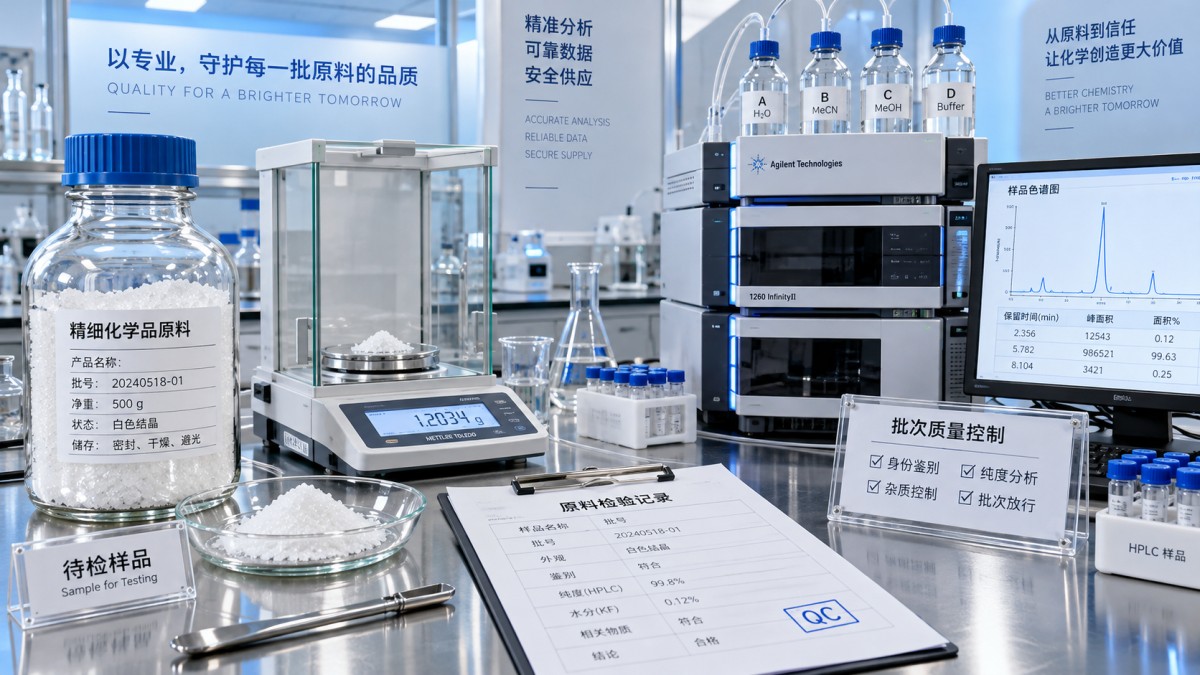
Make the specification reflect what the material must do
Once identity is settled, define acceptance criteria around the actual process. A laboratory studying molecular interactions may need a different testing package from a team developing a water-based cosmetic formulation. For cell culture work, endotoxin or microbiological requirements may matter, depending on the experiment. For formulation development, pH, dissolution conditions, color, and compatibility may deserve attention.
“Purity ≥98%” needs a method and reporting basis. Ask whether the figure represents chromatographic area purity, an assay result, or another measurement, and whether it is reported on an as-is or corrected basis. These are not interchangeable. Water content and chemical form can affect how much relevant substance a weighed quantity provides.
For water-soluble materials, request the conditions behind that description if dissolution matters to production: concentration, temperature, pH, and any observed residue. A material that dissolves adequately in a dilute laboratory preparation may behave differently in a concentrated formulation.
Avoid ordering every conceivable test. Agree with the technical team which attributes determine acceptance, which need initial qualification, and which can be monitored through supplier documentation. Testing should control a defined risk, not merely make the specification look comprehensive.
Separate documentation from evidence
A sample COA helps assess the supplier’s reporting format. It does not describe the batch you will receive. Obtain a batch-specific COA before release or dispatch, according to your purchasing procedure, and check that it includes the lot number, results, methods, and relevant manufacturing or expiry information.
An SDS addresses handling hazards; a TDS describes technical characteristics; a COA reports batch testing. None replaces the others. Similarly, references to ISO or cGMP should trigger requests for the applicable standard, site, scope, current evidence, and relevance to the quoted material. A document list is not proof of certification or product approval.
Jinan Jianfeng Chemical Co., Ltd., established in 2011, describes its business around research, development, and global supply for pharmaceutical, nutraceutical, and cosmetic customers. Its portfolio includes active ingredients, plant extracts, vitamins, functional ingredients, and customized solutions. That breadth can be useful when discussing application requirements, but qualification should still focus on the specific product, manufacturing site, and batch—not the breadth of the catalogue.
Compare the cost of usable material
Only place quotations side by side after suppliers have confirmed the same identity and acceptance criteria. Then normalize the commercial terms: quantity, packaging, currency, Incoterm and named place, freight, payment conditions, lead time, and quotation validity. Ask whether testing and required documents are included.
Pack size can change the economics. The biochemical listing above offers 1 kg aluminum foil bags and 25 kg fiber drums. A drum may reduce packaging cost per kilogram, but it can be a poor choice for intermittent consumption if repeated opening creates handling or contamination concerns. Confirm the inner liner, resealing instructions, storage conditions, and whether smaller sealed units are available.
Treat the stated 24-month shelf life as conditional on the supplier’s storage requirements. Ask how much remaining shelf life is guaranteed at dispatch or delivery. Material that arrives close to expiry may cost more in testing, write-offs, or replenishment than its unit price suggests.
For a new source, agree on sample approval, initial shipment acceptance, change notification, and the response to an out-of-specification result before paying for a production quantity. A technically suitable sample should remain traceable to the proposed supply route and specification.
If a supplier cannot resolve the identity behind “sexam,” keep its quotation outside the approved price comparison. Send a revised RFQ containing the agreed chemical identity, grade, test requirements, packaging, and delivery terms. Price negotiation becomes meaningful only when everyone is quoting the same thing.
News
- ▶ Pharma West Africa 2026
- ▶ Paraxanthine Stability in Formulations: Testing pH, Heat, and Storage Effects
- ▶ Buying Sexam Raw Material: Resolve Product Identity Before Comparing Quotes
- ▶ Sexam Laboratory Grade: Confirming Chemical Identity Before Research Use
- ▶ Evaluating a PDRN Manufacturer: Traceability, Capacity, and Batch Consistency
Message
Chemical Engineering Field
24/7 before-sales and after-sales services
Comprehensive technical support