



Choosing a PDRN manufacturer requires more than comparing quotations and specifications. Buyers need documented origin, dependable production capacity, and consistent quality across commercially representative batches.
For procurement teams sourcing polydeoxyribonucleotide raw materials, these factors determine whether an attractive sample can become a dependable ingredient supply for ongoing production and formulation development.
The strongest evaluation combines traceability records, comparable batch results, and evidence of achievable delivery commitments. Certificates and sales assurances alone cannot establish manufacturing reliability or suitability.
Start by defining your intended application and acceptance criteria. Then assess whether the supplier can repeatedly meet those requirements, with documentation connecting incoming materials to released lots.
Can the Supplier Trace a Released Batch Back to Its Source?
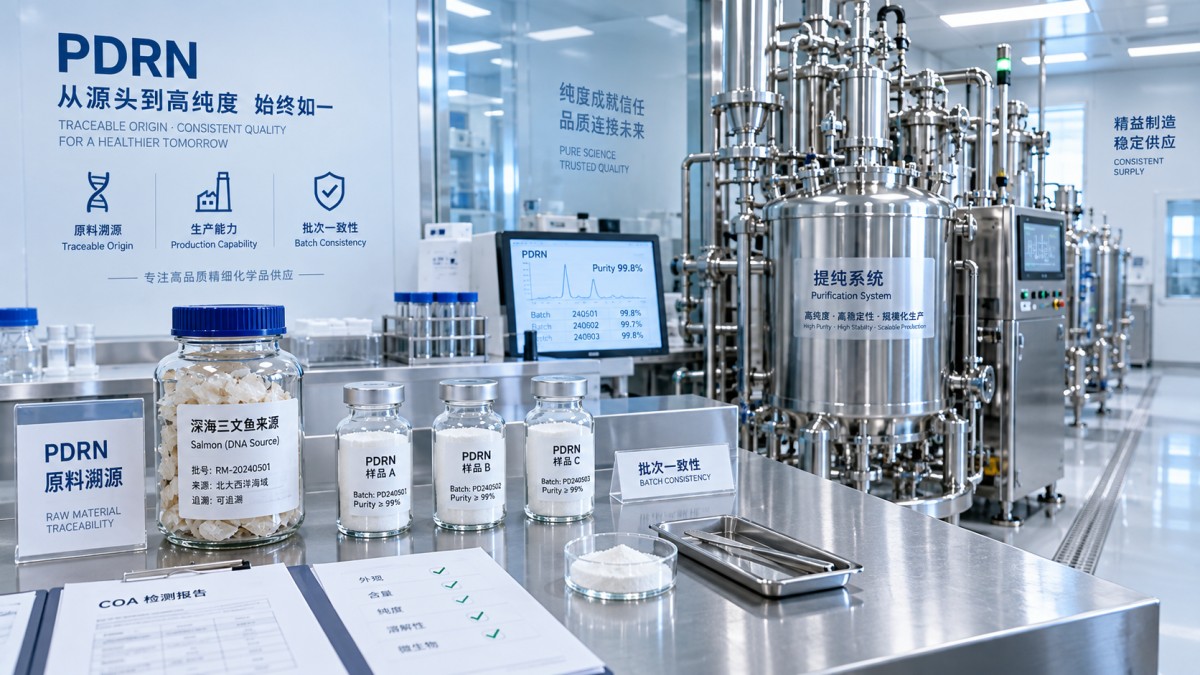
Traceability should explain where the starting material originated, how it entered production, and which processing steps produced the delivered lot. A country name alone is insufficient.
Where PDRN is derived from fish material, request the species, tissue source, geographic origin, and upstream supplier controls. Confirm whether sourcing changes require advance customer notification.
Ask for a traceability walkthrough using an actual released batch. The manufacturer should connect raw material identification, production records, quality testing, packaging, and shipment documentation.
Confidential commercial details may be redacted, but the underlying relationships must remain verifiable. Missing links between starting materials and finished batches weaken investigation and recall capability.
Review how extraction and purification controls address source-related impurities. Request evidence relevant to residual proteins, processing chemicals, and microbiological risks, rather than accepting an undefined purity claim.
Requirements depend on intended use, destination market, and downstream processing. Cosmetic formulation suitability does not establish suitability for pharmaceutical manufacturing or an injectable finished product.
Also identify the contracting supplier, actual manufacturing site, and testing laboratory. A distributor can provide dependable service, provided responsibilities and access to manufacturing evidence are clear.
Does the Certificate of Analysis Describe the Material You Need?
A certificate of analysis, or COA, should identify the batch, applicable specification, test methods, acceptance limits, and results. Check whether values are measured or simply reported as compliant.
PDRN is a mixture of DNA fragments, so one headline purity percentage cannot describe every relevant attribute. Fragment distribution and impurity controls deserve separate attention.
Request the analytical method and reporting basis for molecular weight or fragment length distribution. Results generated through different methods may require reconciliation before meaningful supplier comparisons.
Clarify whether stated content is reported on an as-received or dry basis. Moisture can affect purchasing comparisons, weighing calculations, and the concentration delivered into formulations.
Build specifications around relevant identity, content, fragment distribution, moisture, and impurity attributes. Add microbial limits, endotoxin testing, or other controls when justified by the application.
Do not impose universal acceptance limits copied from unrelated products. Establish limits with your technical team, considering formulation behavior, applicable requirements, and the manufacturer's demonstrated process capability.
For critical attributes, ask about method suitability, precision, and reference materials. Independent testing can support qualification, but conflicting results require investigation before either dataset is accepted.
What Proves That Commercial Batches Will Match the Approved Sample?
A successful development sample establishes initial compatibility; it does not establish reproducibility. Qualification should examine multiple recent production lots made through the intended commercial process.
Request comparable COAs from at least three commercial lots as an initial screen. For higher-risk applications, expand the review using longer-term trends and additional independent testing.
Compare actual values, not only pass statements. Look for shifts in fragment distribution, content, moisture, and relevant impurities that could affect processing or finished formulation performance.
Ask whether samples represent routine production or specially selected material. Confirm that future orders will use the same manufacturing site, process, specification, and packaging configuration.
Evaluate selected lots in your own formulation under consistent conditions. Observe dissolution, appearance, handling, and stability using methods appropriate to the intended product and development stage.
If every lot passes specifications but performs differently, investigate whether an important attribute is missing. Purchasing specifications should evolve from observed behavior and technically justified requirements.
A quality agreement should define change notification, deviation handling, complaint investigation, and corrective actions. Include changes to source materials, processing, test methods, sites, and subcontractors.
Is Quoted Capacity Actually Available for Your Orders?
Annual nameplate capacity says little about the quantity available when you need it. Ask for routine batch size, recent output, production scheduling, and existing customer commitments.
Separate installed capacity from qualified output and available allocation. A plant may possess equipment capacity while purification, drying, laboratory release, or packaging limits deliverable volume.
Request a lead-time breakdown covering raw material procurement, manufacturing, testing, release, and dispatch. This reveals whether the quotation includes the full interval before shipment readiness.
For increasing demand, ask how larger orders will be supplied: additional batches, larger batches, or another production line. Each route may require different comparability evidence.
If the supplier proposes scale-up, request supporting batch data before relying on the expanded volume. Confirm whether additional equipment changes process conditions or quality attributes.
Discuss forecast windows, minimum order quantities, reserved capacity, and order flexibility. Written allocation terms provide clearer planning assumptions than a general promise of continuous availability.
Business continuity arrangements should address critical equipment, raw material dependencies, and recovery timelines. Any proposed backup site should undergo qualification before becoming an accepted supply route.
Which Documents and Packaging Details Reduce Purchasing Risk?
Verify the scope, site, issuing body, and validity of any claimed ISO certification or GMP status. Relevant documentation supports evaluation but does not replace material-specific evidence.
Request the technical data sheet, safety data sheet, storage instructions, and supporting stability information. Confirm the basis for the stated shelf life or retest period.
Packaging specifications should address moisture exposure, closure integrity, container compatibility, and identification. Confirm the pack size and whether opening or repacking changes recommended handling conditions.
Ask whether transport conditions have been assessed for your shipping route. Temperature controls should reflect stability evidence and shipment duration, rather than assumptions based on product category.
When comparing quotations, include testing, freight, storage, rejected material, and production disruption. The lowest unit price can create higher total costs if qualification or delivery repeatedly fails.
How Should Procurement Evaluate a Supplier’s Broader Ingredient Portfolio?
Jinan Jianfeng Chemical Co., Ltd., established in 2011, describes a business covering active ingredients, cosmetic raw materials, nutraceutical ingredients, plant extracts, vitamins, and customized solutions.
That portfolio may be relevant to buyers consolidating ingredient sourcing. However, qualification should establish product-specific manufacturing responsibilities, technical support, and documentation for each proposed supply relationship.
For skincare projects, AHK-Cu is presented as a cosmetic peptide powder with OEM/ODM availability. Evaluate its identity, specification, and formulation suitability through a separate qualification process.
For copper peptide materials, confirm whether reported identifiers, molecular formulas, and analytical results describe the supplied complex, peptide component, or another stated form before approving documentation.
A broader purchasing relationship becomes useful when it improves coordination and technical responsiveness. Each ingredient still needs appropriate evidence; portfolio breadth cannot demonstrate PDRN manufacturing competence.
Make the Sourcing Decision Against Defined Evidence
Before approval, require a traceability review, comparable commercial batch results, an agreed specification, and a credible delivery plan. Document unresolved gaps with owners and completion dates.
Treat unclear material identity, unexplained batch variation, and unverifiable manufacturing arrangements as qualification blockers. Commercial advantages should not compensate for evidence missing from essential quality requirements.
Use a staged commitment: document review, representative samples, formulation evaluation, and an initial commercial order. Expand purchasing after the supplier demonstrates acceptable quality and delivery performance.
A dependable PDRN manufacturer makes origin, quality, and supply commitments verifiable. Procurement gains the strongest protection when those commitments become measurable specifications and documented operating expectations.