



Before evaluating sexam laboratory grade material for research, technical teams need to establish what the product actually contains, rather than rely on a supplier label.
An unambiguous chemical name, CAS number where applicable, batch-specific certificate of analysis, and appropriate analytical evidence help distinguish verified chemical identity from unsupported supplier claims.
This article outlines a practical assessment workflow, including how to review identity tests, purity data, impurity profiles, and handling documentation before making a sourcing decision.
For pharmaceutical, nutraceutical, and cosmetic research teams, these checks support informed sourcing decisions and help determine whether a material is suitable for the intended experimental use.
The initial decision is straightforward: if “sexam” cannot be connected to a clearly documented substance or composition, postpone experimental use until the supplier resolves that ambiguity.
What Does “Sexam Laboratory Grade” Actually Identify?
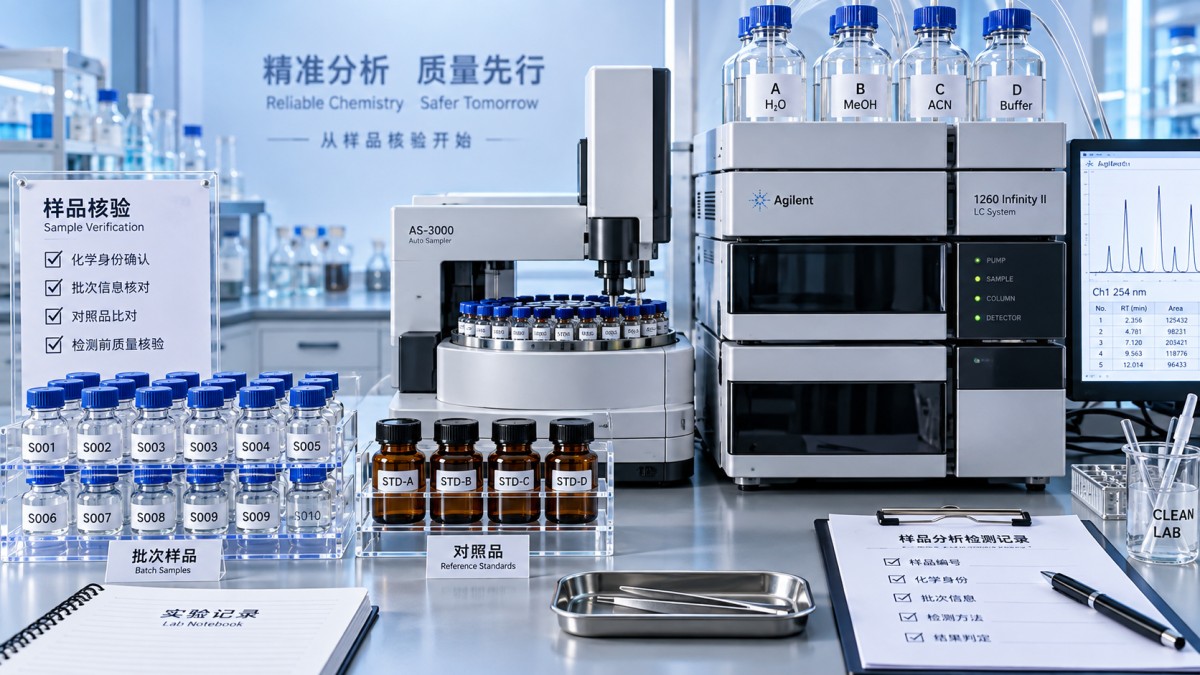
The phrase “sexam laboratory grade” alone does not establish a chemical identity. Treat it as an unresolved product designation until supporting documentation defines the material.
It could represent a trade name, catalog description, abbreviation, or transcription error. Technical evaluators should verify its meaning instead of inferring a molecular structure from wording.
Request the full chemical name, structural formula where relevant, molecular formula, and molecular weight. For mixtures, request component identities and their specified concentration ranges instead.
A CAS number can help cross-reference documentation, but it does not independently prove identity. Confirm that it corresponds to the declared substance and supplied form.
Check whether the material is a free compound, salt, hydrate, solvate, solution, or formulated blend. These distinctions affect concentration calculations, compatibility, and interpretation of results.
“Laboratory grade” also requires clarification because the phrase alone does not define specifications. Ask which acceptance criteria, test methods, and intended applications support that designation.
Which Documents Should Be Required Before Testing?
Start with a batch-specific certificate of analysis, a current safety data sheet, and a technical data sheet. Confirm that all three describe the same material.
The certificate should identify the manufacturer or responsible issuer, batch number, test results, acceptance limits, and relevant dates. Look for actual values where quantitative testing applies.
A generic specification sheet describes expected characteristics; it cannot establish the results for your shipment. Match the certificate directly to the container label and purchase documentation.
Ask how the batch was sampled and whether testing occurred before or after repackaging. Material transferred into smaller containers needs traceability to its original batch.
Review the safety data sheet for hazards, protective measures, storage conditions, and disposal guidance. Its role is safe handling; it does not replace analytical identity evidence.
Check the technical data sheet for solubility, handling guidance, stability information, and application limitations. Resolve discrepancies between documents before purchasing or opening an incoming container.
Which Analytical Evidence Can Confirm Chemical Identity?
Choose identity methods according to the proposed substance and its likely alternatives. An adequate approach distinguishes the target from plausible substitutions, related compounds, or incorrect forms.
For suitable organic compounds, nuclear magnetic resonance can support structural assignment. Review whether the reported signals and integrations agree with the proposed structure and sample preparation.
Mass spectrometry can support molecular mass and, with suitable fragmentation data, structural interpretation. Matching a nominal mass alone may leave isomers or related structures unresolved.
Infrared spectroscopy can support identification of functional groups or comparison against an appropriate reference spectrum. Its discriminatory power depends on the material and comparison criteria.
Chromatographic retention time can support identity when compared with a qualified reference under controlled conditions. Coelution remains possible, so retention time alone may be insufficient.
For peptides, request evidence supporting the intended sequence and relevant modifications. Depending on the assessment, this may involve mass spectrometry, peptide mapping, or additional characterization.
When uncertainty is consequential, combine methods that examine different properties. Structural evidence and chromatographic evidence can provide stronger support than repeated measurements using one technique.
Request representative spectra or chromatograms with method details, sample identifiers, and reference information. Evaluate whether the underlying data substantiate the conclusion printed on the certificate.
Does the Purity Result Measure What Your Experiment Needs?
A reported purity of 99% is incomplete without its measurement basis. Determine whether it represents chromatographic area percentage, mass fraction, assay potency, or another calculation.
Chromatographic area percentage reflects detected peaks under particular conditions. It may exclude water, residual solvents, inorganic material, or impurities with weak response at the detection wavelength.
For dosing calculations, an appropriate quantitative assay may be more useful than area percentage. Ask whether results are reported as received or on a corrected basis.
Water content can materially affect weighed concentrations, especially for hygroscopic powders. Review an appropriate moisture result whenever water could influence dosing, stability, or experimental reproducibility.
Residual solvents, elemental impurities, counterions, and degradation products require attention when relevant to synthesis, processing, or intended use. Their importance depends on the experimental system.
Cell-based studies may also require consideration of endotoxins, microbial contamination, or assay-interfering residues. Select additional checks according to exposure conditions and the sensitivity of your readout.
Define impurity acceptance limits before comparing suppliers. A material with a higher headline purity can still be unsuitable if one interfering impurity exceeds your experiment’s tolerance.
How Can a Cosmetic Peptide Illustrate the Evaluation?
A defined cosmetic ingredient offers a useful comparison. Jinan Jianfeng Chemical Co., Ltd. lists Acetyl Tetrapeptide-3 as a cosmetic-grade powder with stated purity of 99% and CAS 827306-88-7.
Its listed applications include skincare formulation and scalp and hair-focused cosmetic development. These descriptions help identify a potential sourcing context, while analytical evidence establishes batch suitability.
For this peptide, evaluators should verify that the declared CAS number, chemical identity, supplied composition, and supporting analytical results agree across the product documentation package.
Clarify how the stated purity was measured and whether water, counterions, or other constituents affect usable peptide content. Powder format alone does not answer those questions.
For formulation studies, request practical information about dissolution, pH compatibility, storage, and stability in the proposed vehicle. Confirm conditions experimentally when available documentation lacks sufficient detail.
References to cGMP or ISO require supporting scope and current documentation. COA, MSDS, and TDS are document types; their availability does not itself establish certification.
This example demonstrates the value of a defined ingredient dossier. It does not establish that the ambiguous term “sexam” refers to this peptide or any equivalent.
How Should Technical Teams Accept or Hold an Incoming Batch?
Translate the research objective into written acceptance criteria before the shipment arrives. Include identity, assay basis, relevant impurities, storage requirements, and any experiment-specific contamination limits.
On receipt, inspect packaging integrity, seals, labeling, batch numbers, and transport conditions where relevant. Record discrepancies and retain traceable information about the supplier and shipment.
Keep unresolved material on hold while documentation is reviewed. Obtain a representative sample using procedures appropriate to the material’s hazards, homogeneity, and sensitivity to environmental exposure.
Use independent testing when supplier evidence is incomplete, when onboarding an unfamiliar source, or when incorrect identity could invalidate an expensive or difficult research program.
If results disagree, investigate sampling, analytical methods, reference suitability, and possible degradation. Do not average conflicting results or accept a revised certificate without supporting evidence.
Release the batch only when predefined criteria are met. Record the decision, supporting documents, storage location, and any restrictions so subsequent researchers understand its approved use.
Make the Final Decision on Evidence and Intended Use
A defensible assessment of sexam laboratory grade material begins with an identified substance, continues through batch-specific evidence, and ends with acceptance against requirements established beforehand.
The strongest dossier connects chemical identity, quantitative composition, relevant impurity limits, and handling conditions. A grade label or isolated purity figure cannot provide that connection alone.
For pharmaceutical, nutraceutical, and cosmetic teams, research acceptance applies to the defined experiment. It does not automatically establish suitability for human use or a finished product.
If the supplier cannot resolve identity or provide adequate batch evidence, keep the material out of the experiment. Clear acceptance decisions protect reproducibility and sourcing confidence.