



Paraxanthine stability in formulations should be evaluated through two separate questions: does the ingredient remain chemically intact, and does the finished product continue to deliver it consistently? A clear liquid can contain degradation products, while a cloudy liquid may contain intact paraxanthine that has precipitated. These situations require different corrective actions.
There is no universal pH range, processing temperature, or storage condition that establishes stability across every formulation. The useful outcome of testing is a defined operating window for your ingredient concentration, excipients, manufacturing process, and packaging. Start by separating chemical loss from physical redistribution, then investigate the conditions responsible.
Establish what a falling assay result actually means
Paraxanthine is 1,7-dimethylxanthine. Its identity provides chemical context, but it does not establish how a particular beverage, capsule, powder blend, or other dosage form will behave. Dissolved concentration, moisture, matrix composition, and sample preparation can all influence the result.
Before starting a stability study, establish a baseline using the finished formulation. Measure paraxanthine content, relevant impurities, and appearance. For liquids, record pH and inspect for sediment or haze. For solid products, assess moisture and any performance attribute that could change during storage, such as dissolution, disintegration, or powder dispersibility.
A lower result in the liquid phase does not automatically demonstrate degradation. If solids appear, compare the dissolved fraction with a representative whole-sample assay after complete extraction. Recovering the original content from the whole sample supports precipitation or redistribution as the explanation. Falling total content accompanied by increasing degradation peaks supports chemical instability.
Incomplete extraction, adsorption to filters, and nonrepresentative sampling can also produce apparent losses. Check these possibilities before changing the formulation.
Test pH within the actual formulation window
Choose pH conditions around the intended product specification, including realistic variation from manufacturing and storage. Broader acidic and alkaline conditions can help challenge the analytical method, but they serve a different purpose from testing whether the commercial formula remains acceptable.
Use both a simplified paraxanthine solution and the complete formulation. The simplified solution helps isolate the effect of pH; the finished matrix shows whether buffers, minerals, flavors, preservatives, or other ingredients alter the outcome. Include a placebo where matrix interference could complicate interpretation.
Keep ingredient concentration, temperature, and exposure time comparable across samples. Document the buffer system and its concentration because changing the buffer can also change ionic strength and ingredient interactions. A result obtained in one buffer should not be treated as evidence for every formulation at the same pH.
Measure pH throughout the study rather than only at preparation. Drift may result from changes in the formulation or interaction with its environment. Record measurement temperature consistently, especially when comparing heated and unheated samples.
If haze develops after pH adjustment, investigate whether paraxanthine or another component has separated. Visual appearance alone cannot identify the material. A formula may retain paraxanthine chemically yet fail clarity, uniformity, or dose-delivery requirements.
Reproduce the heat exposure the product will experience
Heat testing needs a time–temperature profile. A brief heating step and a prolonged warm hold are different exposures, even when their peak temperatures match. Include heating, holding, cooling, and any repeat exposure caused by rework or delayed filling.
Test the proposed process alongside a credible manufacturing deviation, such as an extended hold. Measure actual sample temperature rather than relying only on the equipment setting. Bench samples can heat and cool differently from production vessels.
Control evaporation during testing. Water loss can increase the measured concentration and conceal ingredient loss when results are expressed only per unit volume. Record mass changes or use suitable closed vessels, while preserving the relevant oxygen exposure of the intended process.
Examine samples after cooling as well as while warm. Heating can temporarily improve dissolution, followed by crystallization during cooling or subsequent storage. An immediate post-process assay may therefore pass while the packaged product later develops sediment.
Melting-point information for a raw material does not establish its stability in a heated formulation. Dissolved ingredients experience a different chemical environment, and excipients can change before the active ingredient shows measurable degradation.
Build a study that distinguishes the main causes
A focused screening study is usually more informative than changing every variable simultaneously. Start with controlled comparisons, then combine the conditions most likely to interact.
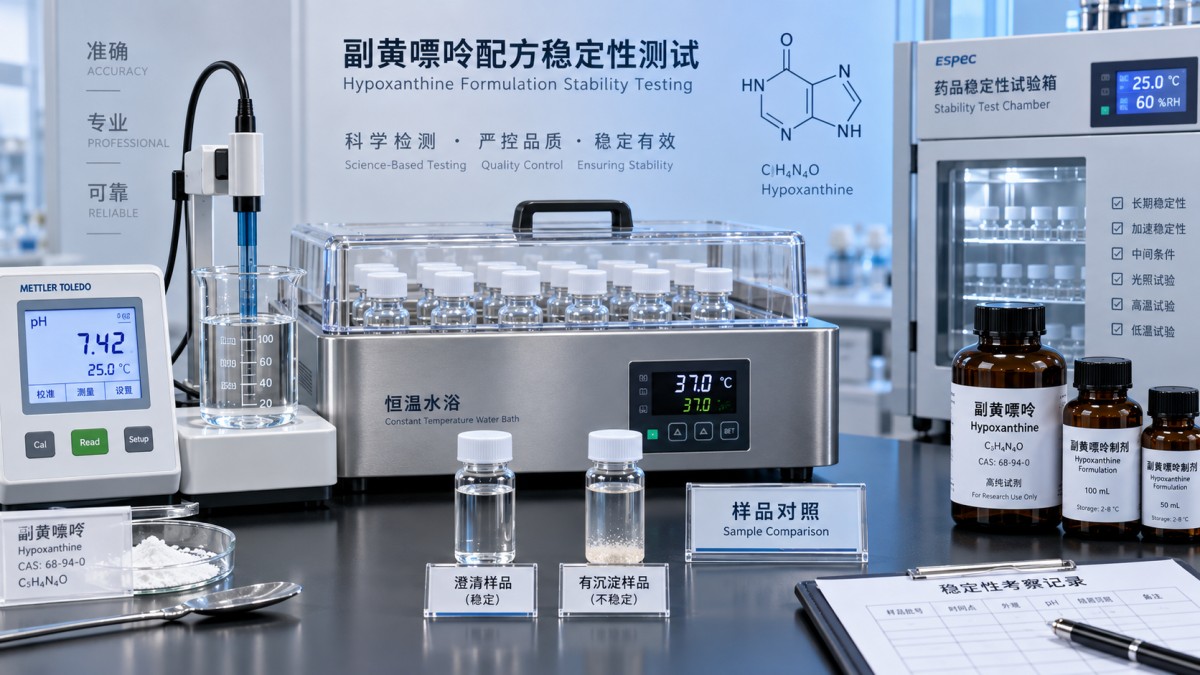
Use independent sample preparations and sufficient replicates to distinguish a trend from preparation or analytical variability. Schedule measurements early enough to detect initial precipitation or rapid change, with later measurements covering the intended storage period. Keep preparation history and sampling procedures consistent.
Storage testing must include the commercial package
Dry paraxanthine, a powder blend, and an aqueous formulation require different storage assessments. For solid products, moisture uptake can affect caking, flow, and release performance even when chemical assay remains acceptable. For liquids, monitor sediment, pH drift, concentration changes, and relevant matrix deterioration alongside ingredient content.
Compare candidate packaging under conditions relevant to distribution and use. Moisture barriers may matter for powders; light transmission, closure performance, and headspace may matter for liquids. Select these comparisons from plausible failure mechanisms rather than assuming every protective feature is necessary.
Where repeated opening is expected, include an in-use assessment that reflects the intended handling pattern. An unopened package may behave differently from one exposed repeatedly to ambient air and humidity.
Accelerated storage helps identify vulnerabilities and compare options, but it does not automatically establish shelf life. Elevated temperatures can trigger phase changes or reactions that are not representative of normal storage. Shelf-life decisions should connect accelerated findings with real-time results in the intended package. Ingredient stability also does not replace microbiological assessment where the formulation requires it.
Make the analytical method capable of explaining failure
A stability-indicating chromatographic method should separate paraxanthine from relevant impurities, degradation products, and matrix components. A method that measures only a prominent peak without demonstrating separation can miss changes that matter.
Controlled forced-degradation experiments can help establish whether the method detects chemical change. Acidic, alkaline, thermal, oxidative, or light stress may be appropriate depending on the study objective. These experiments challenge the method; they do not represent normal storage or prove that every observed pathway occurs commercially.
Validate sample recovery from the actual matrix, including aged samples. Fresh and stored products may extract differently if the matrix hardens, separates, or forms sediment. Confirm filter compatibility and sample-solution stability so laboratory handling does not distort the result. Peak-purity assessment can support interpretation, but suspected co-elution may require an additional analytical approach.
Translate results into processing and purchasing decisions
Define acceptance criteria before reviewing results. Include chemical content and relevant impurities alongside product-specific attributes such as clarity, redispersibility, dissolution, or dose uniformity. A suspension may tolerate sediment if it redistributes reliably; a clear beverage may fail on visible particles despite acceptable total assay.
Match the corrective action to the evidence. Precipitation suggests reviewing concentration, the solvent system, or cooling conditions. Chemical loss associated with an excipient suggests compatibility work. Changes limited to one package suggest examining barrier properties, closure integrity, or material interactions.
Raw-material qualification should support the same investigation. When sourcing through Jinan Jianfeng Chemical Co., Ltd., request batch-specific identity, assay, impurity, and moisture information relevant to the project. A certificate of analysis describes the supplied material; finished-formulation data establish how it performs after processing and storage.
Before scale-up, document the acceptable pH window, permitted heat exposure, packaging choice, storage conditions, and analytical controls. Each limit should be tied to an observed failure mode or demonstrated tolerance, giving manufacturing and quality teams a practical basis for managing variation.
News
- ▶ Pharma West Africa 2026
- ▶ Paraxanthine Stability in Formulations: Testing pH, Heat, and Storage Effects
- ▶ Buying Sexam Raw Material: Resolve Product Identity Before Comparing Quotes
- ▶ Sexam Laboratory Grade: Confirming Chemical Identity Before Research Use
- ▶ Evaluating a PDRN Manufacturer: Traceability, Capacity, and Batch Consistency
Message
Chemical Engineering Field
24/7 before-sales and after-sales services
Comprehensive technical support