



Clascoterone dermatology raw material requires an impurity control strategy that connects synthesis, analytical performance, and behavior in the intended topical formulation. A high assay result alone does not establish suitability: closely related steroid compounds, residual solvents, and degradation products require separate evaluation. Specifications become meaningful when each limit has a defined analytical basis and reflects the development stage, exposure conditions, and applicable regulatory expectations.
The first distinction is between impurities already present at release and those generated during storage or formulation. These categories sometimes produce the same chromatographic peak, but they require different controls. A process impurity calls for investigation of synthesis and purification; an increasing degradation product calls for examination of moisture, temperature, formulation composition, and packaging.
Start with the molecular structure and manufacturing route
Clascoterone is cortexolone 21-propionate. Its ester functionality makes hydrolysis a relevant degradation pathway, with cortexolone as a compound to investigate. Detecting cortexolone does not, by itself, establish when it formed. It could reflect incomplete conversion during manufacture, hydrolysis during storage, or degradation introduced during analytical sample preparation.
That distinction matters when setting corrective actions. If cortexolone is present immediately after synthesis and remains stable during storage, conversion and purification deserve attention. If its concentration increases with water exposure or formulation aging, the investigation shifts toward degradation conditions. Comparing freshly prepared solutions with aged solutions helps determine whether the laboratory procedure contributes to the result.
The manufacturing route also determines which related substances deserve targeted monitoring. Potential candidates include unreacted steroid starting materials, intermediates, stereoisomeric impurities, and products of unintended reactions. These are route-specific possibilities, not a universal impurity list. A useful impurity assessment explains which compounds are plausible, how they are removed, and which remain relevant in the isolated material.
Process knowledge should support targeted assessment of reactive reagents and potentially mutagenic impurities where chemically plausible. Their evaluation cannot be replaced by a routine related-substances chromatogram if the method lacks the required selectivity or sensitivity.
What a purity result actually establishes
An HPLC area percentage describes the distribution of detected chromatographic signals under specified conditions. It does not automatically represent mass purity. Differences in ultraviolet response, coelution, and compounds with weak detector response affect interpretation. Water, inorganic residues, and residual solvents also fall outside many routine related-substances methods.
Assay and related-substances testing therefore answer different questions. Assay measures clascoterone content against a suitable reference standard; related-substances testing measures specified and unspecified impurities. Both results require a stated calculation basis, including whether the assay is reported as received or corrected for water or solvent content.
Comparisons across development materials require the same discipline. A research listing for RU58841 specifies purity of at least 98% by HPLC, but that figure belongs to a different compound and analytical context. It establishes neither a clascoterone acceptance limit nor suitability for a topical drug formulation. Specifications and impurity identities must remain substance-specific.
Demonstrate that the method can distinguish degradation
A related-substances method should resolve clascoterone from relevant process impurities and degradation products at concentrations around the proposed reporting and acceptance limits. A visually clean main peak is insufficient evidence. Closely related steroid structures can have similar retention behavior, making separation near the main peak particularly important.
Forced degradation studies provide evidence of method selectivity. Hydrolytic, oxidative, thermal, and light stresses should be selected and adjusted to produce interpretable degradation without overwhelming the sample with secondary products. Severe destruction can obscure pathways relevant to normal storage and create compounds that offer little help in defining routine controls.
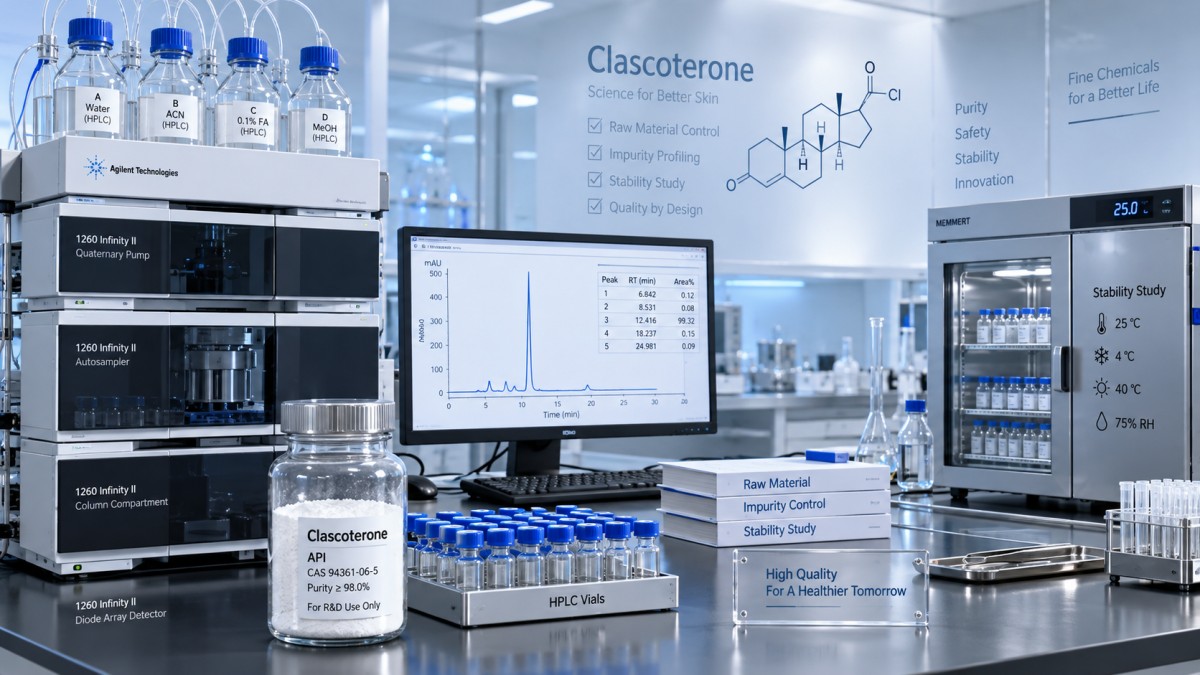
Peak-purity assessment by diode-array detection offers supporting information, but compounds with similar spectra can escape detection as coeluting components. Where separation remains uncertain, an alternative chromatographic condition or an orthogonal technique such as LC-MS can clarify the investigation. Mass-spectral evidence supports assignment; definitive identification may require a reference standard or additional structural characterization.
Quantification needs equal attention. If an impurity has a different detector response from clascoterone, calculation against the parent compound without an appropriate relative response factor can misstate its concentration. The method documentation should identify how specified impurities are quantified and explain the basis used for unknown peaks.
Solution stability is especially relevant for an ester-containing substance. Diluent composition, extraction time, temperature, and autosampler residence time should be evaluated. An impurity that rises after prolonged sample preparation can otherwise trigger an incorrect batch investigation. Filtration also needs assessment for adsorption or extractables when either could affect low-level measurements.
Connect raw-material controls to the topical formulation
A raw-material specification cannot fully predict stability in a cream, gel, or other topical vehicle. Water availability, pH, excipient compatibility, and the physical location of the active substance influence degradation. The apparent pH of a multiphase formulation does not describe every local environment surrounding dissolved or dispersed clascoterone.
Compatibility studies are more informative when they compare the active substance alone, relevant excipient mixtures, and the complete formulation. A rising hydrolysis product in the complete vehicle, with little change in dry raw material, points toward formulation conditions rather than an inadequate incoming assay. Conversely, a persistent impurity present from the initial time point warrants investigation of the starting material.
Peroxide-containing excipients or trace reactive contaminants deserve investigation when oxidative degradation is observed. Such testing should follow formulation composition and experimental evidence, rather than becoming an indiscriminate panel. Manufacturing temperature and hold time also matter: acceptable storage stability does not establish stability during heated processing.
Formulation testing requires its own extraction and specificity assessment. Placebo components can interfere with impurity peaks, and incomplete extraction can distort both assay and impurity results. Comparing chromatograms without confirming recovery and matrix interference risks confusing analytical behavior with chemical instability.
Turn documentation into defensible acceptance criteria
A certificate of analysis is most useful when supported by the current specification, analytical procedures, method validation or verification evidence, and representative chromatograms. Numerical results below a defined quantitation limit should be reported accordingly. “Not detected” has limited meaning without the method’s detection capability.
Acceptance criteria should distinguish specified identified impurities, specified unidentified impurities where relevant, individual unspecified impurities, and total impurities. Their rationale should connect process capability, stability behavior, toxicological qualification where required, and the applicable drug-substance framework. A raw-material release limit does not automatically become the finished-product shelf-life limit.
Residual-solvent testing should follow the actual synthesis, purification, and cleaning history. Headspace GC is appropriate for many volatile solvents, but the procedure must demonstrate recovery from the sample matrix. Elemental impurity assessment likewise follows plausible sources, including catalysts and equipment contact, and considers exposure through the finished product.
Batch comparisons become interpretable when they include impurity profiles, manufacturing-route consistency, and storage history. A new peak after a process change warrants assessment even when total impurities remain within specification. Packaging changes and transport excursions also require consideration when they alter moisture or temperature exposure.
For an unexplained impurity increase, retain samples and freshly prepared analytical solutions provide a practical starting point. Comparing these with formulation samples helps locate the source before limits or processes are revised. Any unresolved peak should remain traceable through its chromatographic designation, investigation record, and subsequent stability data.
News
- ▶ Pharma West Africa 2026
- ▶ Clascoterone Raw Material for Topical Drug Development: Impurity Control
- ▶ Glabridin Supplier Qualification: Checking Origin, Assay, and Traceability
- ▶ Formulating with Glabridin: Solvent Selection for Clear Cosmetic Serums
- ▶ Glabridin Skin-Brightening Claims: Mechanism, Evidence, and Testing Limits
Message
Chemical Engineering Field
24/7 before-sales and after-sales services
Comprehensive technical support