



A clear glabridin serum needs a solvent system that retains the active after water addition, cooling, and storage. Start by measuring solubility in the intended final vehicle, then select an active loading below the lowest reproducible dissolved concentration found under relevant storage conditions. A concentrate that looks clear while warm provides insufficient evidence for a stable finished serum.
Glabridin has limited water solubility, so increasing the aqueous fraction can undermine an otherwise effective solvent blend. The formulation problem is to preserve enough solvent capacity while meeting requirements for skin feel, viscosity, packaging, and processing. Raising solvent content until a fresh sample clears can leave little tolerance for temperature changes or manufacturing variation.
Define the material and the finished vehicle together
Before screening a glabridin cosmetic ingredient, establish whether the raw material is purified glabridin, a standardized licorice extract, or a supplied solution. These materials introduce different amounts of active, carrier, and accompanying extract components. A concentration stated on an ingredient specification does not automatically describe the glabridin concentration in the finished serum.
Calculate active loading from the ingredient addition level and its verified assay. Record any carrier solvents introduced with the raw material as part of the total solvent system. Extract components can contribute color or haze independently of glabridin, so clarity comparisons require consistent material identity and preferably the same lot during initial screening.
Set the intended water fraction, pH range, solvent limits, and texture before choosing candidate blends. Include water carried by botanical solutions, humectant mixtures, and other premixes. A solvent screen conducted at a lower water content than the finished formula will overstate the usable loading.
Choose candidates by their role in the serum
Cosmetic-compatible solvents differ in their ability to dissolve glabridin and in their effects on the finished product. Water miscibility alone does not establish adequate solvent power for this active. Likewise, a pleasant humectant is not automatically an effective primary solvent.
Screen individual candidates before combining them. This reveals whether a blend improves dissolution or simply contains more of the effective solvent. Compare blends at equal glabridin loading and equal total solvent content, with water held constant. Otherwise, the comparison cannot separate solvent identity from solvent quantity.
Measure equilibrium solubility and dilution tolerance separately
Use excess solid to estimate equilibrium solubility in each candidate vehicle. Maintain a controlled temperature, mix, and sample until dissolved concentrations stop changing across successive measurements. Separate undissolved material by a validated method before assay. If filtration is used, assess active recovery because adsorption onto the membrane can make the apparent solubility artificially low.
Visual clarity alone cannot establish equilibrium or confirm the intended dissolved concentration. Fine particles can escape visual detection, and a supersaturated sample can remain clear before crystals appear. Use an appropriate quantitative assay alongside visual inspection; record the separation method, equilibration conditions, and sampling temperature so results are reproducible.
Next, prepare a clear concentrate at a practical process concentration and dilute it toward the intended serum composition. Track cumulative water addition by mass. Inspect immediately, after standing, and after cooling. The point at which persistent haze or crystals appear defines a useful dilution boundary for that particular composition and process.
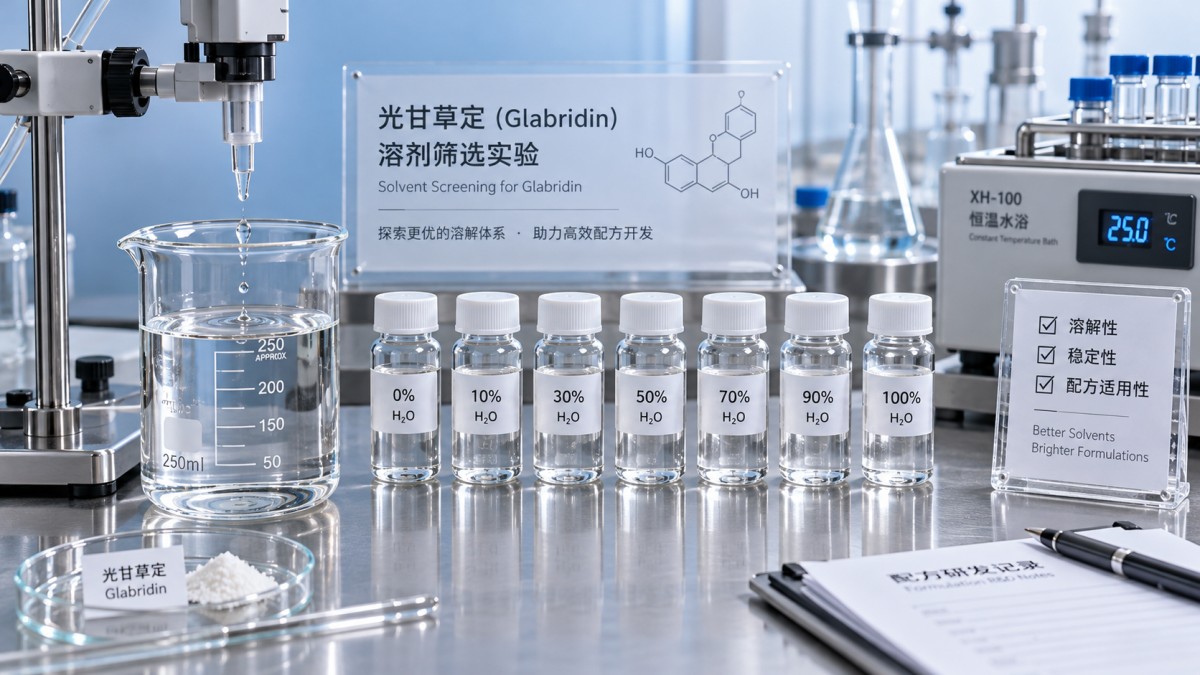
Repeat the dilution study with the actual aqueous base. Preservatives, dissolved salts, buffers, and polymer systems can alter solvent behavior or generate their own haze. A successful test in purified water establishes only an initial screen.
Set loading from the finished formula’s demonstrated capacity. Use the lowest relevant solubility result as the starting boundary and establish a working margin through repeat batches and stability testing. No universal solvent-to-glabridin ratio can replace this measurement.
Control the transition from concentrate to serum
Prepare the active concentrate using the selected solvent blend and confirm dissolution before combining phases. Heating can accelerate dissolution, but the concentrate must also be assessed after cooling. Avoid setting the active loading from what dissolves only at the processing temperature.
During blending, local water-rich regions can trigger precipitation even when the final bulk composition has sufficient solvent capacity. Addition order, mixing intensity, and feed rate therefore matter. Compare plausible addition sequences at bench scale and choose the sequence that avoids persistent clouding without excessive heat or prolonged mixing.
Record batch mass before and after warm or open processing when volatile solvents are present. Solvent loss changes composition and can explain why a scaled batch behaves differently from a sealed laboratory sample. Any replenishment requires a controlled mass balance rather than adjustment by appearance.
For a serum that also includes water-soluble Reduced Glutathione Powder, dissolve that ingredient in the aqueous portion and include it in compatibility trials. Its water solubility does not establish glabridin solubility or protect glabridin against precipitation. Evaluate its chemical stability separately, including oxidation where relevant, while measuring both actives in the combined formula.
Distinguish precipitation from other causes of haze
Glabridin crystallization, polymer incompatibility, dispersed droplets, and entrained air can produce similar initial appearances. Compare the affected serum with an otherwise identical active-free vehicle. Haze in both samples points toward a base-formula issue, although several mechanisms can occur together.
Microscopy helps identify particles and crystal growth. Combine that observation with dissolved-active measurements and, where practical, identification of recovered solids. A decline in dissolved glabridin accompanied by glabridin-containing sediment supports a precipitation diagnosis. Falling assay without solid formation calls for investigation of degradation, sampling, or analytical recovery.
Warming a cloudy sample is a useful diagnostic experiment, but restored clarity does not demonstrate storage stability. Reversible clouding can still make the serum unacceptable during distribution. Increasing viscosity to suspend particles also leaves the underlying dissolution problem unresolved.
Confirm the solvent window in the final package
Evaluate the complete serum under cool, ambient, and elevated conditions chosen to reflect expected storage and distribution. Temperature cycling can expose crystallization that a constant-temperature test misses. Inspect samples at their storage temperature before allowing them to warm, since warming can dissolve evidence of cold-induced precipitation.
Follow clarity, sediment, color, pH, viscosity, and active assay over time. Define appearance criteria using consistent lighting, containers, and an appropriate instrumental method where available. Chemical assay is necessary because a clear serum can still lose active through degradation.
Use the intended package for confirmation, particularly with volatile solvent systems. Closure performance and headspace affect composition during storage and repeated opening. Establish preservation performance independently; the presence of a solvent does not demonstrate adequate microbial protection.
The final formulation record should specify active assay, total water and solvent composition, addition sequence, processing temperature limits, and acceptance criteria. These details make a successful laboratory result reproducible and provide concrete variables to investigate if a later batch develops haze.
News
- ▶ Pharma West Africa 2026
- ▶ Formulating with Glabridin: Solvent Selection for Clear Cosmetic Serums
- ▶ Glabridin Skin-Brightening Claims: Mechanism, Evidence, and Testing Limits
- ▶ PDRN Bulk Supplier Contracts: Setting Batch Acceptance and Change-Control Terms
- ▶ NAD Powder Handling: Controlling Moisture Exposure During Weighing and Storage
Message
Chemical Engineering Field
24/7 before-sales and after-sales services
Comprehensive technical support