



A supplier dossier may show strong tyrosinase inhibition, yet leave a technical assessor unable to answer the most important question: will this ingredient visibly improve uneven skin tone in the proposed cream? Evaluating glabridin skin brightening claims requires separating biological plausibility from finished-product performance. Purity, assay conditions, delivery, stability, and clinical study design all affect that distinction.
For raw-material selection, the useful approach is not to dismiss laboratory findings or treat them as proof. It is to identify what each finding supports, what remains uncertain, and which tests can close the gap before a claim reaches the label.
What the proposed mechanism actually supports
Glabridin is a prenylated isoflavan associated with licorice, particularly Glycyrrhiza glabra. It should not be confused with glycyrrhizin, nor should evidence for a licorice extract automatically be assigned to purified glabridin. Extract composition varies with botanical source, processing, and standardization.
Its brightening rationale centers on interference with melanogenesis, the process through which melanocytes produce melanin. Tyrosinase catalyzes important early reactions in this pathway, including the conversion of tyrosine toward melanin precursors. Experimental studies have reported inhibition of tyrosinase activity and reduced melanogenesis under particular test conditions.
Antioxidant and anti-inflammatory effects provide additional mechanistic interest. Oxidative stress and inflammation can contribute to pigmentation responses, but activity in these pathways does not independently establish visible brightening. A chemical antioxidant assay, for example, measures behavior in a defined reaction system—not correction of facial discoloration.
The appropriate interpretation is conditional: glabridin has a plausible biological basis for investigation, while efficacy depends on exposure, model relevance, and the formulation in which it is delivered.
Reading glabridin skin brightening evidence without overextending it
Evidence should be organized by proximity to the intended claim. A result can be technically sound and still answer the wrong question for a cosmetic product.
Mushroom tyrosinase assays are useful screening tools, but mushroom and human tyrosinase are not interchangeable. Published inhibition percentages or IC50 values should therefore be compared only after checking enzyme source, substrate concentration, incubation time, and solvent conditions. A lower number from a different protocol is not necessarily evidence of a better ingredient.
In cell studies, request viability data alongside melanin measurements and normalize results appropriately. Pigment reduction caused by fewer viable cells is not a desirable brightening mechanism. In spectrophotometric assays, ingredient-only blanks and interference controls help distinguish genuine activity from color, turbidity, or other effects on the readout.
The raw material can change the entire interpretation
A purchase specification stating “glabridin content” is only the beginning. Technical assessors need to establish whether the material is purified glabridin, a standardized botanical extract, or a carrier-based preparation. These forms cannot be substituted solely on nominal percentage.
- Identity: request an appropriate analytical identification method and, for extracts, botanical traceability.
- Assay basis: distinguish HPLC area percentage from a validated quantitative mass assay. Confirm reference-standard suitability and whether results are reported on a dry or as-is basis.
- Impurities: review relevant residual solvents, elemental impurities, microbiological quality, and botanical contaminants according to source and intended use.
- Consistency: compare batch results, chromatographic profiles, and storage recommendations rather than relying on a single certificate.
Dose calculations must use actual active content. For example, adding 0.1% of an extract standardized to 10% glabridin gives a nominal glabridin level of 0.01%, assuming a mass-based specification. That figure still says nothing about how much remains dissolved, survives storage, or reaches relevant skin layers.
Why a promising powder may disappoint in a cream
Glabridin has limited aqueous solubility. In practical formulation work, this creates risks of precipitation, uneven distribution, and reduced availability. A product that appears uniform immediately after manufacture may develop crystals during cooling, temperature cycling, or storage.
Solvent systems, emulsions, and encapsulation approaches can improve incorporation, but improved incorporation should not be equated with improved skin delivery. Assess the ingredient in the actual vehicle, including its behavior after application as water or volatile components evaporate.
Stability testing should measure retained glabridin using a suitable, preferably stability-indicating analytical method. Evaluate relevant temperature, light, oxygen, pH, packaging, and ingredient-interaction conditions. Appearance and odor are useful observations, not substitutes for active-content measurements.
For delivery studies, distinguish surface deposition, skin retention, and receptor-fluid permeation. A brightening ingredient intended to act within skin does not automatically benefit from greater systemic passage. Recovery and mass-balance checks also matter: missing material can otherwise be mistaken for successful delivery.
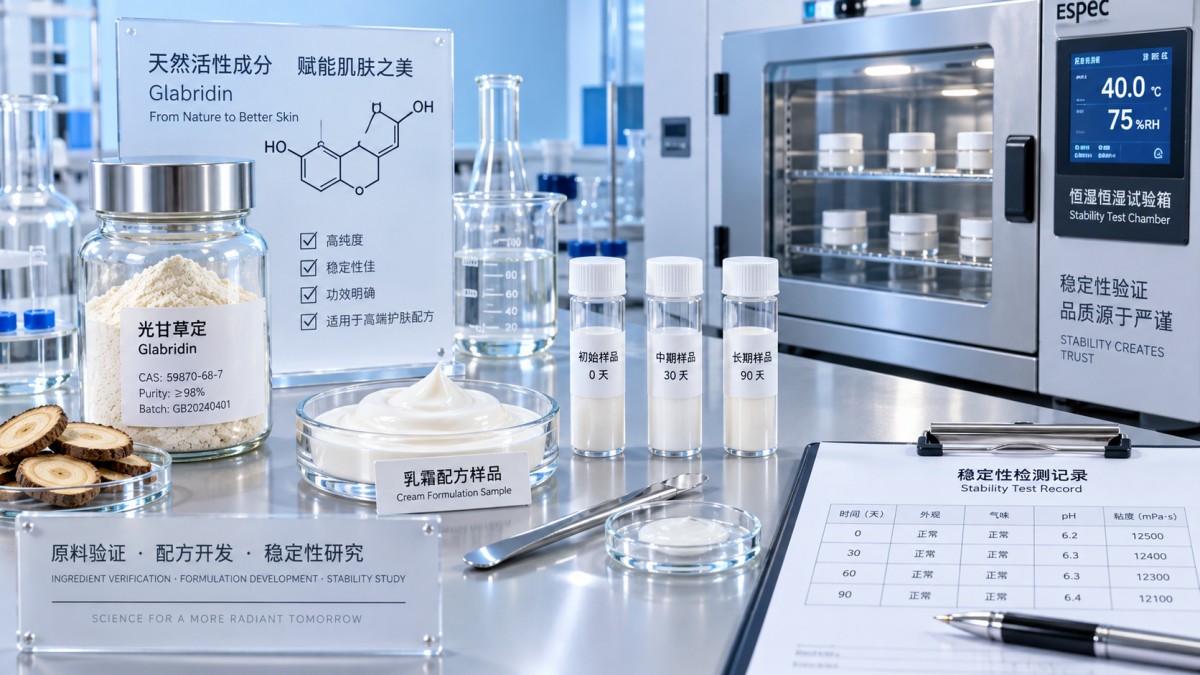
A practical validation sequence is identity and assay → formulation compatibility → stability and delivery → biological activity → human efficacy. Each stage should establish that the next experiment is testing the intended material at a credible exposure.
Designing a human study that answers the commercial question
For visible brightening claims, finished-formulation human evidence is more directly relevant than isolated ingredient assays. Studies of multi-ingredient products may support the tested product, but cannot establish glabridin’s individual contribution unless the comparator and design permit that conclusion.
A vehicle-controlled, randomized study is particularly useful when the objective is to isolate the ingredient’s effect. Where feasible, blinding reduces expectation bias. Sample size and duration should be justified against the endpoint and expected response, rather than selected simply because a short trial is convenient.
Predefine what “brightening” means. Increased overall lightness, reduced dark-spot contrast, and improved tone uniformity are related but different outcomes. Instrumental color measurements, melanin-index measurements, standardized photography, and trained grading can complement one another. None should be interpreted without considering measurement variability and clinical visibility.
Control or document sun exposure, sunscreen use, concomitant products, adherence, and relevant seasonal changes. Consistent site selection and acclimatization conditions improve measurement reliability. Record irritation and other adverse effects: inflammation may worsen pigmentation, especially in susceptible participants.
Statistical significance alone is insufficient. Review effect size, uncertainty, participant-level variation, and whether the change is perceptible. Findings should not be generalized beyond the skin tones, pigmentation concerns, and use conditions actually studied.
Supplier documentation is a starting point, not efficacy certification
Jinan Jianfeng Chemical Co., Ltd., established in 2011, supplies raw materials and customized solutions across cosmetic, pharmaceutical, and nutraceutical applications. For technical procurement, the useful conversation centers on traceable specifications, analytical methods, sample evaluation, and documentation applicable to the particular ingredient—not simply the breadth of a supplier’s portfolio.
The same discipline applies to separately listed materials such as Paraxanthine, a xanthine compound offered with a stated ≥98% HPLC purity specification and sample availability. That product information does not provide evidence for glabridin efficacy or imply an interchangeable brightening function. Different ingredients require their own identity, safety, regulatory, and performance assessments.
Likewise, quality-system documentation does not certify a cosmetic claim. Confirm the scope and validity of relevant documents, then assess whether the evidence package actually represents the material and finished formula under review.
Match the claim to the evidence boundary
“Inhibits tyrosinase in a laboratory assay” and “helps visibly improve uneven skin tone” require different substantiation. Claims involving treatment of pigmentation disorders may cross into medicinal territory, depending on jurisdiction and presentation.
The defensible decision is to select glabridin on a documented technical basis and qualify claims to the strongest relevant evidence. Mechanism explains why testing is worthwhile; formulation-specific validation determines what can responsibly be promised.
News
- ▶ Pharma West Africa 2026
- ▶ Glabridin Skin-Brightening Claims: Mechanism, Evidence, and Testing Limits
- ▶ PDRN Bulk Supplier Contracts: Setting Batch Acceptance and Change-Control Terms
- ▶ NAD Powder Handling: Controlling Moisture Exposure During Weighing and Storage
- ▶ NAD Factory Audits: Questions About Process Controls and Supply Continuity
Message
Chemical Engineering Field
24/7 before-sales and after-sales services
Comprehensive technical support