



Glabridin Supplier Qualification: Checking Origin, Assay, and Traceability
Choosing a glabridin supplier takes more than comparing prices and reviewing a certificate of analysis. For procurement teams sourcing this licorice-derived ingredient, botanical origin, assay methods, and batch traceability are essential checkpoints for managing quality and supply-chain risk. Can the supplier document the source material, explain how purity is measured, and link each shipment to verifiable production records? Those questions matter because two quotations labeled “glabridin” may describe materially different products.
A workable qualification process separates three decisions: whether the material is what the supplier claims, whether it meets the intended application, and whether repeat shipments can be controlled. Price comparison becomes meaningful only after these points are settled.
Define the material before comparing quotations
“Licorice extract,” “glabridin-enriched extract,” and isolated glabridin are not interchangeable purchasing descriptions. An extract can contain other licorice constituents, while an isolated material requires a different specification and analytical approach. Ask for the chemical identity, botanical source, stated glabridin content, and disclosure of any carriers or formulation aids. The quotation, specification, and COA should describe the same material.
Agree on the reporting basis as well. A dry-basis assay excludes moisture from the calculation; an as-is result does not. That distinction affects what arrives in the drum and how much material a formulation requires. If competing offers use different bases, procurement should have quality staff reconcile them before ranking prices.
Application suitability needs its own review. Cosmetic formulation acceptance does not establish suitability for a nutraceutical or pharmaceutical project. Ingredient status, impurity limits, and documentation requirements depend on the intended use and destination market. A supplier’s broad application list is not an approval.
Botanical origin: ask beyond “licorice”
Glabridin is associated with Glycyrrhiza glabra, but “licorice” alone is too broad for source qualification. Request the botanical name, plant part, country or region of origin, and the method used to authenticate incoming botanical material. These details help distinguish a documented extraction supply chain from a trader’s generic product description.
Do not confuse the location of the sales office with the origin of the plant. The botanical raw material may be harvested in one country, extracted in another, and purified or repacked elsewhere. None of that automatically disqualifies a supplier. The problem is an unexplained chain, especially when different documents name different manufacturers.
Source authentication should occur where it is technically meaningful. Testing purified glabridin cannot necessarily reconstruct the botanical history of the starting material. Incoming botanical identification records and upstream lot links therefore matter alongside finished-product testing. Ask what happens when a source region, botanical vendor, or extraction site changes: is the buyer notified before shipment, or only after a discrepancy appears?
An HPLC number is not the whole assay
A COA stating “purity by HPLC” leaves an important question unanswered: does the number represent chromatographic area percentage or a quantitative glabridin assay against a reference standard? Area normalization measures the relative response of detected peaks under specified conditions. It does not automatically establish glabridin mass fraction, and it may not account for water, residual solvents, or components that respond differently to the detector.
For qualification, request the method identifier and revision, a representative chromatogram, reference-standard information, and the reporting basis. The supplier should explain how identity is confirmed and how glabridin is separated from relevant neighboring peaks. Detailed proprietary methods may require a confidentiality agreement, but a refusal to explain what the reported result means is a legitimate concern.
An independent laboratory can help resolve an assay dispute, provided both parties agree on the method and calculation basis. Otherwise, an area-percentage result from one laboratory may be compared with a calibrated mass-based result from another, producing an argument rather than useful evidence.
The wider release specification should address risks arising from botanical inputs and processing. Depending on the application, that may include residual solvents, elemental impurities, pesticides, moisture, and microbiological quality. Limits and testing frequency need project-specific justification; they should not be copied from an unrelated ingredient.
Traceability must survive repacking and shipment
A batch number printed on a label is only the starting point. Ask the supplier to demonstrate how a finished shipment connects to purification records, upstream extract lots, and botanical input records. If several input lots are combined, that relationship should remain visible. If a distributor assigns a new lot number during repacking, the original manufacturer’s lot must still be recoverable.
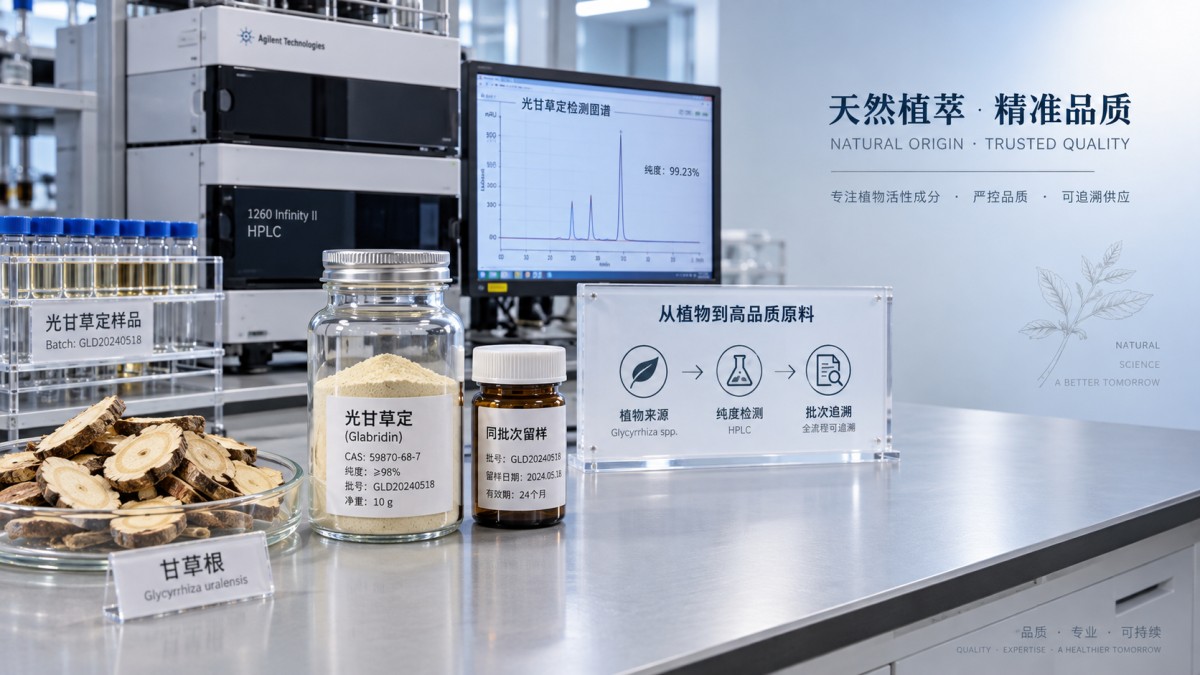
One practical qualification exercise is to select a sample lot and request its document chain: manufacturer identity, production and release dates, COA, packing record, and upstream references. Sensitive records can be redacted or reviewed during an audit. What matters is whether the chain remains coherent, not whether the supplier sends a large folder.
- Confirm whether the qualification sample represents the commercial shipment or a separate development lot.
- Check that package labels, shipping documents, and release records carry matching or explicitly cross-referenced lot numbers.
- Establish retained-sample availability and a process for investigating out-of-specification results.
- Require advance notification of changes to manufacturing sites, critical processing steps, or specifications.
ISO or cGMP claims need scope verification: which facility, which activities, and which products are covered? A COA, safety data sheet, or technical data sheet serves a different purpose and is not itself certification of the manufacturing system.
Compare usable cost, not just price per kilogram
For offers with comparable, verified mass-based assays, ingredient price divided by glabridin mass fraction gives a preliminary cost per kilogram of contained glabridin. It is not a complete buying model. A lower-assay extract may introduce more co-extractives, affect color or formulation behavior, and require additional development work. Conversely, paying for higher purity than the formulation needs can waste budget.
Add incoming testing, freight, duties, minimum order quantities, rejected-batch exposure, and inventory holding costs. Ask whether quoted lead time means production completion or delivery. Storage conditions and shelf life should be supported by material-specific stability information, rather than borrowed from another product’s documentation.
Broad portfolios deserve equally specific qualification. Established in 2011, Jinan Jianfeng Chemical Co., Ltd. describes a research, development, and global supply focus across pharmaceutical, nutraceutical, and cosmetic raw materials. Its RT offering concerns peptide materials for research and formulation development, not glabridin. Such products may be relevant to a separate sourcing program, but their purity specifications or supporting documents cannot qualify a glabridin batch.
Before placing a commercial order, close the gaps that could change the purchasing decision: confirmed identity, interpretable assay, application-specific acceptance criteria, traceable manufacturing, and written change control. If the supplier can provide only a price and a generic COA, keep the order at evaluation scale. The evidence should justify the commitment—not the other way around.
News
- ▶ Pharma West Africa 2026
- ▶ Clascoterone Raw Material for Topical Drug Development: Impurity Control
- ▶ Glabridin Supplier Qualification: Checking Origin, Assay, and Traceability
- ▶ Formulating with Glabridin: Solvent Selection for Clear Cosmetic Serums
- ▶ Glabridin Skin-Brightening Claims: Mechanism, Evidence, and Testing Limits
Message
Chemical Engineering Field
24/7 before-sales and after-sales services
Comprehensive technical support