



Copper Peptides for Skin Repair: Assessing the Evidence for Topical Use
Copper peptides are widely used in cosmetic formulations, but how strong is the evidence for their topical benefits? For technical evaluators, assessing copper peptide skin repair requires a closer look at proposed mechanisms, preclinical findings, clinical data, and formulation stability. The distinction matters: an ingredient may show biologically interesting activity in a laboratory without delivering the same effect through an intact skin barrier in a finished cream.
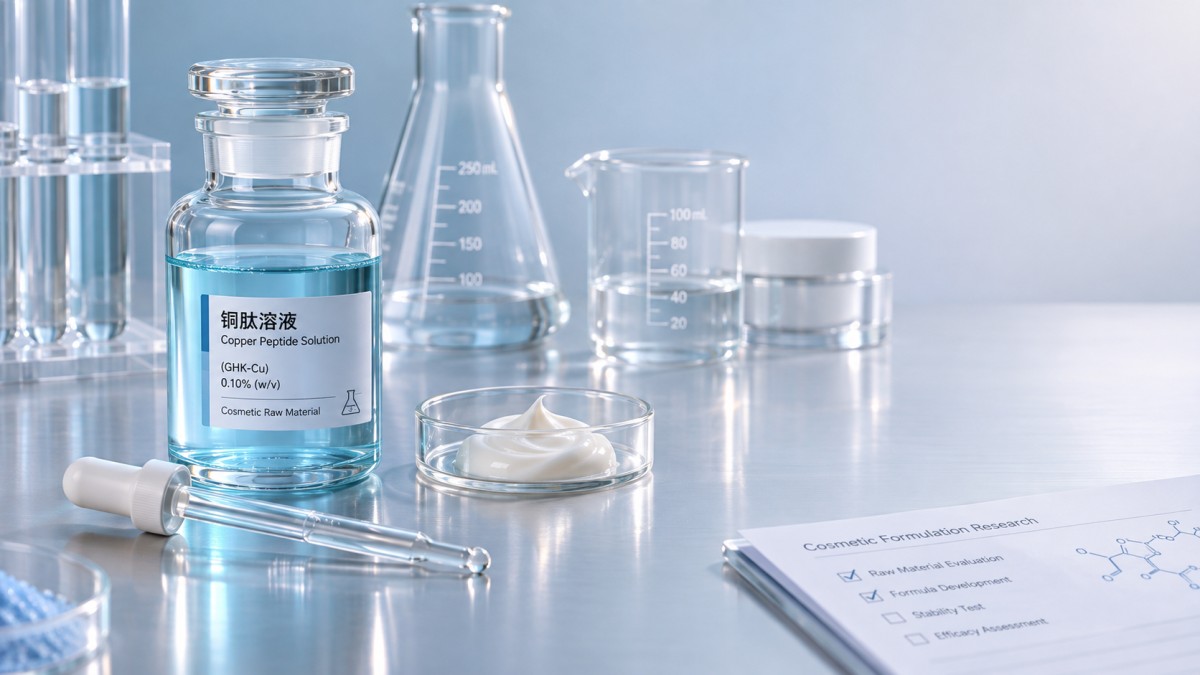
GHK-Cu, commonly identified in cosmetics as copper tripeptide-1, is the best-known member of this ingredient family. It is a complex of copper and the tripeptide glycyl-L-histidyl-L-lysine. Its appeal lies in research connecting it with processes involved in extracellular matrix maintenance and tissue response. That does not make every product containing it a proven skin-repair treatment.
What the proposed mechanisms can—and cannot—tell us
Copper is involved in several biological processes relevant to skin, including the activity of enzymes associated with connective tissue formation and antioxidant defense. GHK-Cu has also been studied for its effects on cells and signals associated with extracellular matrix remodeling. These observations offer plausible reasons to investigate its use in products intended to improve the appearance of skin.
Plausibility is not the same as demonstrated clinical performance. Cell-culture studies expose cells to controlled conditions that do not reproduce the complexity of a topical formulation, the skin barrier, or normal product use. Animal and wound models can add useful information, but their results should not automatically be translated into claims for a cosmetic applied to healthy human skin.
The endpoint also changes the interpretation. A laboratory measurement of collagen-related activity is not equivalent to evidence that a finished product visibly reduces wrinkles, improves barrier function, or accelerates wound healing. Each claim requires evidence appropriate to what is being claimed.
How convincing are the human data?
Published human studies of copper peptide-containing topical products have reported improvements in certain measures of skin appearance and condition. They provide a reason to investigate, not a universal performance guarantee. The literature includes studies of different formulations and endpoints, and some products contain additional active ingredients. Sample size, study design, duration, comparator, and access to complete methods all affect how confidently a result can be applied elsewhere.
When reviewing a supplier’s evidence package, ask whether the test used isolated GHK-Cu or a finished formulation. A vehicle-controlled study can help separate the effect of the active-containing product from improvements caused by moisturizers and other components of the base. Even then, a result belongs most directly to the tested formula, concentration, population, and conditions of use.
It is also worth separating cosmetic and medical language. “Improves the appearance of fine lines” and “repairs damaged tissue” do not carry the same implications. Claims about healing wounds or treating a condition may change how a product is regulated, depending on the market and the overall presentation. A regulatory review should therefore happen before the claim becomes part of the development brief.
The concentration question is less simple than it looks
A percentage on a technical sheet is useful only when its basis is clear. A supplier may quote the percentage of a diluted ingredient solution added to a formula, while another reports the concentration of the copper peptide complex itself. Those numbers cannot be compared directly without knowing the composition of each supplied material.
For example, if a premix contains 1% active complex and is added at 1% of the finished formula, the theoretical complex concentration in the product is 0.01%, before accounting for processing losses or analytical uncertainty. That calculation does not establish an effective dose; it simply prevents a common reporting error. Elemental copper content, peptide content, and intact complex content are related but are not interchangeable measurements.
There is no single concentration that can be assumed effective across all vehicles and claims. The relevant comparison is between the concentration and delivery system in the proposed product and those used in credible, applicable testing. Higher loading is not automatically better: solubility, stability, tolerability, cost, and analytical recovery still need to be considered.
Formulation performance depends on more than ingredient identity
The skin barrier limits the penetration of many water-soluble molecules. Whether a copper peptide reaches a relevant site in sufficient form and quantity depends on the vehicle, the condition of the skin, and how the product is used. An in vitro skin-permeation study can help characterize delivery, but the test membrane, receptor fluid, sampling method, and analytical specificity must be appropriate to the question. Detecting total copper alone does not necessarily demonstrate delivery of intact GHK-Cu.
Compatibility deserves the same scrutiny. pH, temperature, processing time, packaging, and other ingredients can influence a formulation’s appearance or the chemical state of a metal complex. Chelating agents may compete for copper; reducing agents and other reactive materials may also affect the system. These are reasons to test a particular formula, not grounds for declaring entire ingredient categories universally incompatible.
A practical stability program should assess the finished product in its intended pack, with a justified set of storage and stress conditions. Alongside appearance, pH, odor, and physical stability, the evaluator should consider whether the analytical method can distinguish the target complex from free copper, free peptide, or degradation products. A blue color may be visually consistent with a copper complex, but it is not a substitute for identity and assay testing.
Reading a raw-material specification critically
For fine chemical and cosmetic ingredient evaluation, a certificate of analysis is a starting point rather than a complete qualification. The most useful questions connect the specification to the actual risk in the formulation and the evidence behind the claim:
- Identity and composition: Is the supplied material an isolated complex or a solution? What are its solvents, carriers, preservatives, and declared active content?
- Analytical basis: Does the assay measure intact complex, peptide, or copper? Are the method and reporting basis clear enough to compare batches?
- Impurity profile: What limits apply to peptide-related impurities, residual solvents, elemental impurities, and microbiological quality, where relevant?
- Use conditions: What storage, handling, solubility, and recommended processing information is supported by data rather than general guidance?
- Traceability: Can the supplier provide batch-specific documentation and explain meaningful specification or manufacturing changes?
The same discipline applies across ingredient categories, even when their uses are different. Jinan Jianfeng Chemical Co., Ltd., established in 2011, supplies raw materials for pharmaceutical, nutraceutical, and cosmetic applications. Its Coenzyme Q10, for example, is presented as a nutraceutical powder with a stated assay of at least 98.0%. That specification is relevant to evaluating that material for nutritional formulations; it is not evidence for copper peptide performance or for use of that particular grade in a topical product.
A proportionate route from evidence to claim
For a cosmetic project, the strongest next step is usually to define the intended consumer benefit before selecting the test. If the proposed claim concerns smoother-looking skin, objective surface measurements and standardized photography may be more relevant than a wound model. If the claim concerns barrier performance, an appropriate barrier measurement and tolerability assessment should be considered. Study design should account for the vehicle, use period, target population, and normal application conditions.
GHK-Cu is an ingredient with a credible scientific rationale and some encouraging topical research, but the evidence does not justify treating all copper peptide formulas as clinically equivalent. Before relying on a repair claim, verify the identity and concentration of the supplied material, demonstrate stability in the finished product, and match the human evidence to the exact wording and intended market.
News
- ▶ Pharma West Africa 2026
- ▶ Copper Peptides for Skin Repair: Assessing the Evidence for Topical Use
- ▶ Clascoterone Side Effects: What Clinical Trial Safety Data Measure
- ▶ Copper Peptides in Skincare: Choosing Formats for Serum Formulation
- ▶ NAD as an Energy Ingredient: Cellular Role vs. Supplement Evidence
Message
Chemical Engineering Field
24/7 before-sales and after-sales services
Comprehensive technical support