



Select a copper peptide for skincare by first establishing the identity and concentration of the copper-containing species, then evaluating its stability in the intended serum base. A concentrated powder offers formulation flexibility, while a diluted aqueous solution can simplify dosing. Neither format guarantees better performance: the useful comparison is the amount and integrity of the specified complex delivered into the finished formula.
For a water-based serum, the choice often turns on four practical questions: Is the peptide supplied as a defined copper complex? Is its content reported on an appropriate basis? Will it remain compatible with the serum’s pH and other ingredients? Can the chosen format be dispensed and mixed reproducibly at the intended scale?
Distinguish the copper complex from the peptide
Copper tripeptide-1 is a commonly encountered copper peptide cosmetic ingredient. Its peptide component, GHK, and the corresponding copper complex should not be treated as interchangeable entries on a specification sheet. A material described only as “peptide” or “copper peptide” leaves too much uncertainty to calculate a meaningful dose or compare batches.
Request the exact ingredient identity, including the cosmetic ingredient name and a description of the supplied form. Also establish whether the material is an isolated complex, a blend containing the complex, or a solution prepared from it. A peptide assay alone does not necessarily establish how much copper is complexed, while a total copper result does not establish how much intact copper peptide is present. Where complex integrity is important, ask which analytical method supports that claim and what the result actually measures.
Adding a copper salt to an uncomplexed peptide during serum manufacture is a separate formulation exercise, not an automatic equivalent to using a characterized copper peptide raw material. The resulting mixture depends on the chemical environment and requires analytical confirmation of the species present.
Compare formats on a common active basis
A blend percentage is not the same as the percentage of copper peptide in that blend. For example, a serum containing 2% of a solution whose specified copper peptide content is 0.1% contains 0.002% of that ingredient by calculation, assuming both figures use the same mass basis. Confirm whether the reported content refers to the intact complex, peptide content, or another assay basis before using the calculation in a formula.
Powders also require attention to the stated assay basis. A result reported on a dry basis cannot automatically be used as the as-received concentration if moisture or other volatile material is present. For either format, use the batch certificate and technical documentation to establish the basis used for formulation calculations.
Build compatibility around the complete serum
Begin with the supplier’s documented solubility and pH guidance for the specific material. Dissolve a small sample in the intended water phase, observe clarity and color, and record the preparation temperature and time. A clear initial solution establishes only that the material appears dispersed or dissolved at that point; it does not establish chemical stability.
The final pH matters because it affects both the peptide environment and other components of the formula. A strongly acidic exfoliating serum may sit outside the recommended range for a particular copper peptide grade. Conversely, moving the pH to accommodate the peptide can alter the performance or solubility of the exfoliating ingredient. Resolve this conflict using the individual ingredient specifications and finished-formula testing, rather than assuming that a single pH is suitable for every active.
Chelating agents deserve particular attention. Ingredients such as EDTA are often included to control trace metals, but a chelator can also interact with copper. The extent and significance of that interaction depend on the formulation and the relative affinities of the ingredients involved. Do not assume that removing all chelator will improve stability either: uncontrolled metal contamination can create separate problems. Compare otherwise similar prototypes and use an appropriate analytical method where preservation of the complex is a defined requirement.
Strong reducing agents, oxidizing ingredients, and reactive botanical mixtures also warrant compatibility screening. A color shift, precipitation, or loss of clarity is a reason to investigate, but visual change alone does not identify the chemical cause or quantify peptide degradation. Separate samples containing the serum base, the copper peptide, and the questioned active can help narrow down the source of a change.
Color is an observation, not an assay
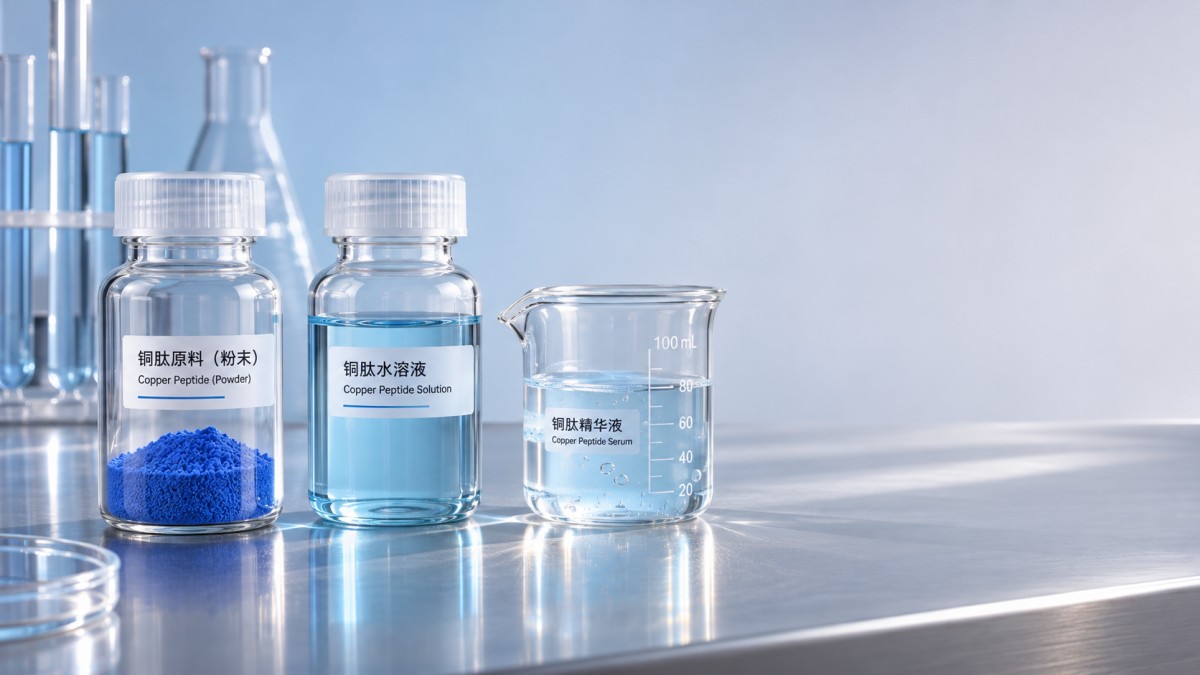
Some copper peptide materials and solutions have a blue appearance. The intensity observed in a serum is affected by concentration, the other ingredients, and packaging. A pale or changing color cannot by itself confirm either an insufficient dose or degradation. If color consistency matters commercially, set an agreed visual or instrumental acceptance method alongside a suitable identity and content test.
Set an addition process that survives scale-up
For a concentrated powder, prepare a controlled premix when direct addition would make accurate dispensing difficult. Use a compatible vessel and solvent, mix until the material is adequately dissolved, and account for the premix water in the batch formula. Follow the material’s documented temperature guidance; where heat sensitivity has not been established, a cool-down addition is a sensible starting point for evaluation, not a substitute for stability data.
A liquid grade avoids very small powder weights, but its carrier can change the finished serum. Water content affects the formula balance; preservatives, solvents, salts, or pH adjusters in the solution may affect viscosity, preservation, or compatibility. Include the entire supplied composition when reviewing the batch, and define a mixing time sufficient to distribute the addition without unnecessary aeration.
For either format, compare laboratory and pilot batches using the same order of addition and sampling approach. Uneven color or inconsistent assay results between samples can indicate incomplete mixing, but can also reflect sampling or analytical variability. Investigate those possibilities before changing the target concentration.
Separate copper-peptide selection from other peptide choices
Not every cosmetic peptide is a copper complex. Acetyl hexapeptide-38 is described as a white powder with a stated main-component content of 99% for cosmetic formulation work. It belongs to a different peptide selection question and should not be substituted on an equal-weight basis for a copper peptide. If both are considered for a facial serum, their identities, assay bases, recommended handling, and compatibility need separate evaluation.
Use stability data that match the decision
A raw material’s certificate of analysis establishes batch attributes at release; it does not demonstrate stability in every finished serum. Test the selected prototype in the intended packaging and include relevant storage conditions, including exposure to elevated temperature and light where appropriate. Compare it with a control without the copper peptide and, when assessing an interaction, a control without the suspected incompatible ingredient.
Record pH, appearance, odor, and viscosity at defined intervals. Where the claim or specification depends on retention of the copper complex, include a validated or otherwise suitable stability-indicating assay capable of distinguishing the relevant species. Microbiological quality and preservative effectiveness also need assessment for the complete water-based product; a stable-looking serum is not evidence that its preservation system remains effective.
Before committing to a format, align the proposed use level with the raw material’s actual complex content, the processing method, and the finished-product test plan. A format that is easy to dose in the laboratory is useful only if the same concentration and quality can be reproduced in the final serum.
News
- ▶ Pharma West Africa 2026
- ▶ Copper Peptides in Skincare: Choosing Formats for Serum Formulation
- ▶ NAD as an Energy Ingredient: Cellular Role vs. Supplement Evidence
- ▶ Water-Soluble Copper Peptides: Solubility Checks for Skincare Formulas
- ▶ Formulating Cosmetics With 3-O-Ethyl-L-Ascorbic Acid: Stability Factors
Message
Chemical Engineering Field
24/7 before-sales and after-sales services
Comprehensive technical support