



Moisture control for NAD powder depends on how the container is opened, how long the material remains exposed, and how it is resealed—not simply on whether it is stored in a cool place. During weighing, moisture uptake can change handling behavior and introduce uncertainty into the amount of material delivered. The practical priority is to prepare the weighing operation before opening the package and keep exposure within limits supported by the supplier’s instructions or an approved handling procedure.
There is no universal humidity limit or safe exposure time for every material sold as NAD. Confirm the exact chemical identity, form, water specification, and storage requirements for the supplied grade. NAD+, NADH, and different salt or hydrate forms should not be treated as interchangeable materials with identical stability requirements.
Establish what the weight actually represents
A balance measures total mass, including any water present. If powder gains moisture during handling, a stable balance reading does not prove that the intended quantity of NAD has been weighed. Where formulation or analytical work requires a defined amount of active material, the calculation must follow the approved basis: as-received assay, dried-basis assay, or another specified convention.
Water content also needs careful interpretation. A defined hydrate, such as Spermine Dihydrate, illustrates why water associated with a chemical form is not automatically the same as unwanted atmospheric moisture. For NAD, use its own specification and analytical method rather than assuming all measured water represents deterioration.
Review the certificate of analysis alongside the technical data sheet and safety data sheet. The certificate describes the tested batch; it does not establish how long an opened container remains suitable. If the documentation does not address repeated opening, obtain handling guidance or establish a qualified internal procedure before routine dispensing.
Prepare the weighing area before opening the package
Arrange the balance, clean dispensing tools, receiving container, labels, and closure materials in advance. Confirm the target quantity and tare the receiving vessel before exposing the powder. Searching for a scoop or correcting a label while the source package remains open adds exposure without improving the operation.
Tools and receiving vessels must be clean and dry under the applicable procedure. Equipment recently washed with water can retain moisture in joints or on surfaces even when it appears dry. Allow it to dry adequately and avoid bringing damp gloves, cleaning cloths, or wet packaging into the dispensing area.
Measure temperature and relative humidity near the actual weighing location. A room display away from the workstation may not represent conditions beside a frequently opened door or ventilation outlet. Record conditions at the frequency needed to capture meaningful changes during handling.
If the material is refrigerated, allow the sealed package to reach the permitted handling temperature before opening. Opening a cold container in warmer, humid air can cause condensation on the powder or internal packaging. Acclimatization time depends on package size and temperature difference; it should not be replaced by an arbitrary waiting period. Keep warming within the supplier’s permitted conditions.
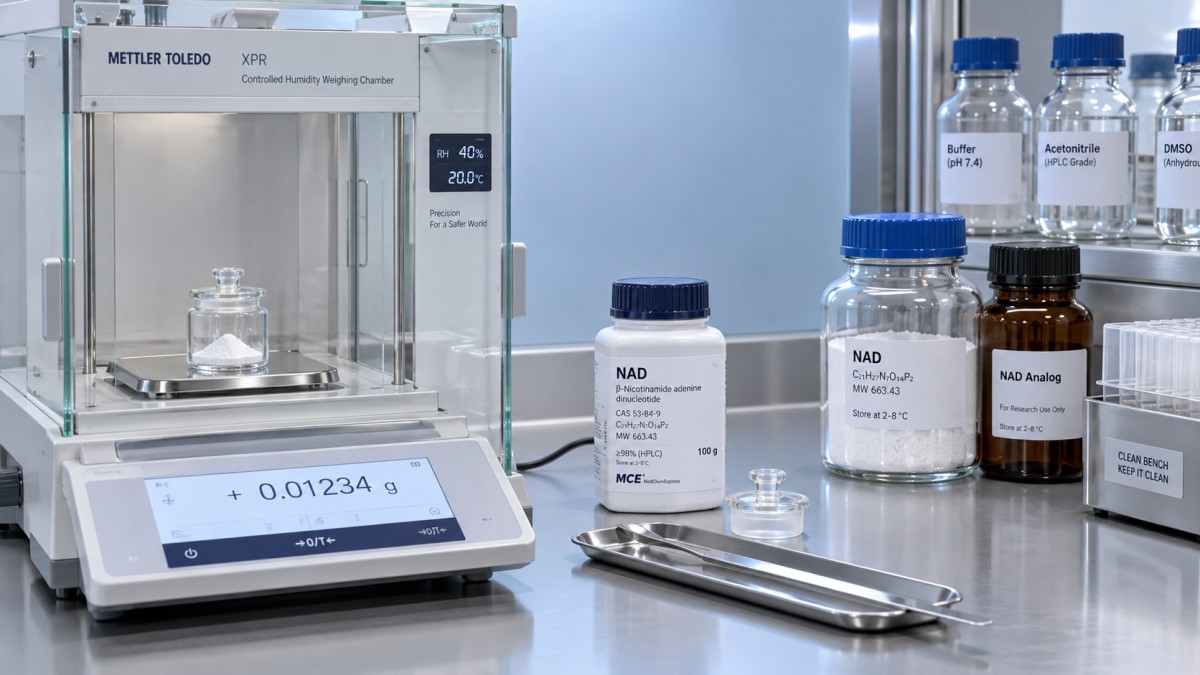
Where ambient conditions cannot meet the established handling limits, use an appropriate controlled-humidity enclosure or dry dispensing system. A conventional extraction hood is not inherently a moisture-control device: room air may continuously pass across the material. Any enclosure must also provide suitable dust containment without compromising balance performance.
Keep dispensing short, but do not rush the measurement
Exposure time should be reduced by preparation and package management, not by sacrificing weighing accuracy. Open only the closure necessary for access, dispense the required quantity, and close the source container promptly. Do not leave the bulk package open while checking calculations or completing batch records.
- Use a suitably sized, dry scoop to reduce repeated transfers.
- Keep the receiving vessel covered whenever weighing is paused.
- Use the balance draft shield appropriately; do not direct a dry-air stream across the weighing pan.
- Keep withdrawn excess separate unless an approved procedure explicitly permits its return.
- Record opening or dispensing details when required for exposure tracking.
Balance drift can indicate moisture exchange, but it can also result from static charge, air currents, vibration, or temperature differences. If readings continue changing, stop and investigate rather than repeatedly adjusting the quantity. An apparent gain in mass alone is not sufficient evidence of moisture uptake.
For repeated small withdrawals, approved aliquoting can reduce the number of times the main inventory is opened. The advantage depends on making the aliquots under controlled conditions and using qualified containers. Dividing material into unsuitable small bags can increase moisture exposure and create additional traceability problems.
A practical dispensing procedure should define what happens when the operation is interrupted. Close both source and receiving containers before leaving the workstation. If a qualified exposure limit is exceeded, hold the affected material for assessment rather than assuming resealing resets its exposure history.
Resealing matters as much as the storage location
A fiber drum or rigid outer container may provide mechanical protection while an inner liner supplies the moisture barrier. Closing the outer lid does not compensate for an inadequately sealed inner package. Inspect the liner, closure, and sealing area before returning material to storage.
Remove powder from closure surfaces using the approved method. Powder trapped in a seal can prevent reliable closure. For heat-sealed liners, use the specified sealing conditions and inspect seal continuity. For screw-cap containers, follow the established closure method rather than assuming greater tightening always improves protection.
Use original packaging where suitable, or a qualified replacement with an appropriate moisture barrier and closure. The description “plastic container” is not enough to establish suitability: polymer type, wall thickness, liner, and closure design all affect moisture protection.
Desiccant can help control residual moisture in a properly designed package, but it cannot compensate for an open or leaking container. Use it only where permitted, with suitable separation from the powder. A humidity indicator describes conditions around the indicator; it does not directly measure the water content of NAD powder.
Label opened containers with the required opening date, lot identity, and any approved in-use period. An unopened shelf-life claim should not automatically be applied to material that has been repeatedly exposed or transferred into different packaging.
Store to the material specification, not a general rule
Follow the specified temperature range, light protection, and packaging requirements. Refrigeration is not a universal remedy for moisture-sensitive powders. It may support stability where required, but repeated cooling and warming can introduce condensation risks if containers are opened before appropriate equilibration.
Organize inventory so that daily dispensing does not require opening the entire stock. Where qualified, a working aliquot and an unopened reserve can limit repeated exposure. Keep both traceable to the original lot, and avoid combining remnants from different containers merely to simplify storage.
If inert-gas protection is specified, follow the approved purging and closure procedure. Dry gas handling requires suitable equipment and controls; uncontrolled gas flow can disperse powder, disturb weighing, or introduce contamination. It should not be improvised as a substitute for effective packaging.
Know when a handling change requires a quality check
New caking, reduced flow, sticky deposits, discoloration, visible condensation, or a damaged seal should trigger assessment. These observations are warning signs, not definitive proof of moisture uptake or chemical degradation. Fine powders may agglomerate for other reasons, and unchanged appearance does not establish acceptable water content or assay.
Separate questionable material from released stock and document the observed condition, storage history, exposure conditions, and packaging integrity. Select testing according to the material specification and suspected failure mode. Water determination, assay, or impurity testing may answer different questions; no single visual check can replace them.
Do not oven-dry, grind, or sieve affected NAD powder to restore its appearance unless a validated procedure authorizes that treatment. Such actions can alter material quality or conceal the original problem. The decision to use, reprocess, or reject the material should rest on documented acceptance criteria—not on whether the powder becomes free-flowing again.
News
- ▶ Pharma West Africa 2026
- ▶ NAD Powder Handling: Controlling Moisture Exposure During Weighing and Storage
- ▶ NAD Factory Audits: Questions About Process Controls and Supply Continuity
- ▶ Sexam Factory Due Diligence: Verify Product Identity and Manufacturing Scope
- ▶ PDRN Powder Specifications: Understanding DNA Size Distribution and Purity
Message
Chemical Engineering Field
24/7 before-sales and after-sales services
Comprehensive technical support