



Pharmaceutical-Grade Glabridin: What Buyers Should Verify Before Sourcing
Sourcing glabridin pharmaceutical grade requires more than comparing prices and supplier claims. Procurement teams need to assess identity, purity, analytical methods, batch consistency, and documentation against their intended application and regulatory requirements. This guide outlines the key checks buyers should make before selecting a supplier, from reviewing certificates of analysis and traceability records to evaluating manufacturing controls and supply reliability. Use these criteria to reduce sourcing risks and make more confident purchasing decisions.
Start with the intended use, not the grade on the label
Glabridin is a constituent of licorice root extracts, but a licorice extract and isolated glabridin are not interchangeable purchase specifications. A quotation may refer to total extract, a standardized concentration, or a higher-purity isolate. Before comparing prices, confirm exactly what percentage refers to glabridin itself and what the remainder of the material contains.
The phrase “pharmaceutical grade” also needs context. It is not, by itself, evidence that a material is suitable for use in a particular medicine or accepted by a particular regulator. Requirements depend on whether the material is intended as an active pharmaceutical ingredient, an ingredient for development work, or a component of another regulated product. The buyer’s quality and regulatory teams should define the applicable standard, documentation package, and manufacturing expectations before procurement requests a quote.
That distinction matters commercially. A supplier may be able to provide a material with a high assay result but not the process history, change controls, or audit access needed for a pharmaceutical project. Discovering the gap after formulation work has begun can be more expensive than a higher initial purchase price.
Read the COA alongside the analytical method
A certificate of analysis is a starting point, not a substitute for technical review. Request a recent batch-specific COA and check that the lot number, manufacture or retest dates, specification limits, actual results, and test methods are identifiable. A typical or sample COA can help with initial screening, but it does not establish the quality of the batch that will be shipped.
For assay, ask how glabridin is identified and quantified, which reference standard is used, and whether the reported percentage is calculated on an as-is, dried, or other stated basis. Chromatographic methods such as HPLC can be used for this type of analysis, but the method details determine whether two results are comparable. Ask for relevant method validation or qualification information and representative chromatograms when the application warrants them.
A single purity figure does not describe the full impurity profile. Depending on the source and process, the specification may need to address related constituents, residual solvents, elemental impurities, microbiological quality, water content, and other risks identified by the manufacturer and the buyer. Limits should be agreed for the intended use rather than assumed from a generic grade description.
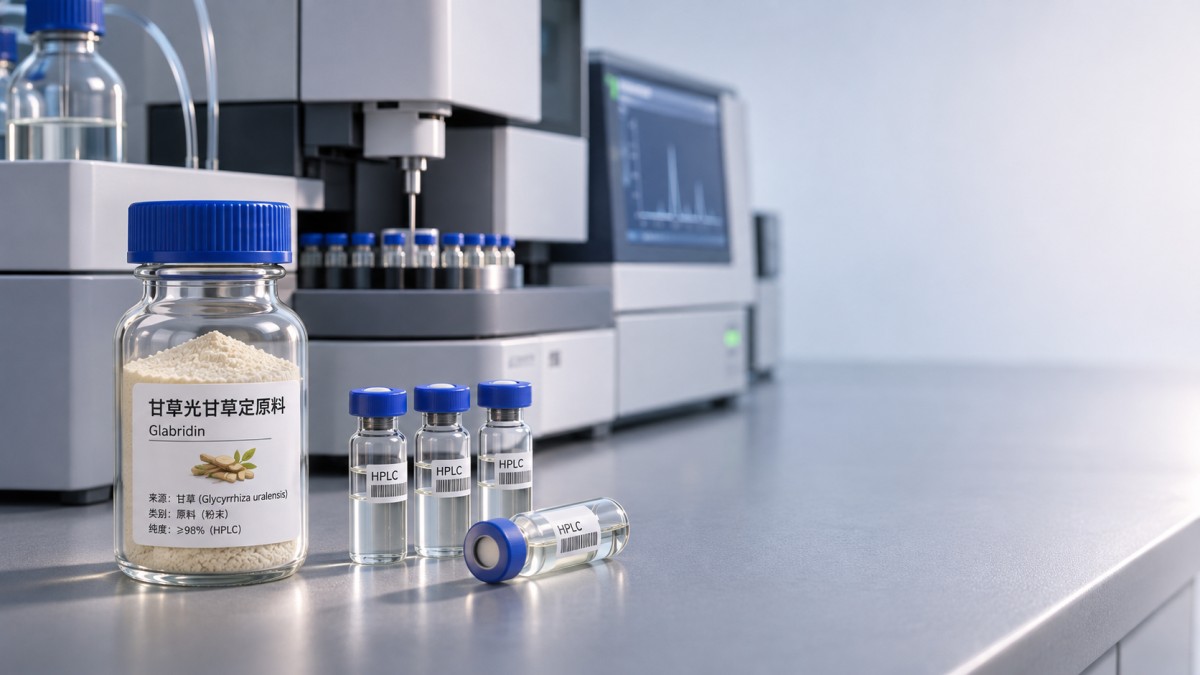
If independent testing is part of qualification, agree on sampling, test methods, reference standards, and how discrepant results will be investigated before the first shipment. Otherwise, a disagreement over assay may be a difference in methodology rather than a genuine quality failure.
Traceability is a supply question as well as a quality question
Ask the supplier to describe the chain from botanical starting material through extraction, purification, testing, and packing. Confirm the botanical source, the part of the plant used, and whether the material comes from a consistent process. Buyers do not necessarily need proprietary process details in an initial quotation, but they do need enough information to assess source-related risks and determine what can be disclosed under a confidentiality agreement.
Identify the actual manufacturer and the role of any trader, repacker, or testing laboratory. A supplier’s ability to provide documents is useful; knowing who generated them and who controls the process is more useful. Where relevant, request a quality agreement covering deviations, out-of-specification investigations, complaint handling, recalls, and advance notice of changes to the source, process, test method, or manufacturing site.
For pharmaceutical use, ask which manufacturing controls apply to the material and whether an audit or other qualification assessment is possible. A reference to GMP in a sales document should be checked against its scope, the relevant site, and the buyer’s intended application. It should not be treated as a blanket approval for every product a company sells.
Compare the cost of usable material
A lower price per kilogram can conceal a higher cost per kilogram of glabridin. For an initial comparison, divide the quoted material price by the glabridin fraction, provided the assays use comparable methods and reporting bases. This gives a useful theoretical cost per kilogram of contained glabridin; it does not account for processing losses or whether the material meets the rest of the specification.
Then add the costs that differ between offers: freight, import charges where applicable, independent testing, qualification work, storage, and the cost of carrying minimum-order quantities. A material that requires further purification or additional analytical work may be less attractive than its unit price suggests. Conversely, paying for documentation or controls that the intended application does not require may add cost without reducing a relevant risk.
Request quotes on the same basis: quantity, assay specification, packaging, delivery terms, destination, lead time, and validity period. Ask whether the price applies to an existing batch or future production, and whether the supplier can reserve stock or support a forecast. For projects with uneven demand, clarify minimum order quantity, shelf life or retest period, and any storage conditions before committing to bulk inventory.
Qualify the first batch before planning the next one
A sample should be representative of the proposed commercial material. Ask whether it comes from the batch offered for sale or from a comparable process, and whether commercial batches will be made at the same site. Test the sample against the agreed specification and, where appropriate, assess its behavior in the intended formulation. Appearance alone is not enough to predict solubility, stability, or compatibility with other ingredients.
Review multiple batch records or COAs when available, looking for trends rather than identical numbers. Results clustered close to a specification limit deserve a question about process capability and investigation practices. Also ask how the supplier manages batch allocation, retain samples, packaging integrity, and transport conditions. A technically acceptable ingredient still creates risk if it arrives without adequate remaining shelf life or with documentation that cannot be matched to the shipment.
The same discipline applies across ingredient categories, although acceptance criteria differ. For example, Acetyl Hexapeptide-8 is offered as a 99% cosmetic-grade powder for skincare formulation. Its cosmetic designation and supplied specifications should not be confused with the evidence needed to qualify glabridin for a pharmaceutical application.
Make the request for quotation specific enough to compare
Jinan Jianfeng Chemical Co., Ltd., established in 2011, supplies raw materials and customized solutions across pharmaceutical, nutraceutical, and cosmetic applications, including plant extracts and functional ingredients. When discussing a glabridin requirement with any supplier, provide the intended application and destination market, target assay and reporting basis, required impurity limits, estimated annual volume, and the documents needed for qualification. Ask the supplier to identify any requirements it cannot currently support.
A workable decision is not simply the lowest compliant-looking quote. It is an offer backed by a clear specification, verifiable batch data, an understood manufacturing and documentation scope, and delivery terms that fit the project. Resolve the open questions before placing a commercial order, especially when changing supplier later would require further testing or regulatory review.
News
Message
Chemical Engineering Field
24/7 before-sales and after-sales services
Comprehensive technical support