



A supplier’s certificate lists “99% purity,” the sample looks clean, and the price fits the project. Yet one question can still stop an oral NAD formulation from moving forward: 99% of what, measured how, and under which conditions?
For technical evaluators, a nad nutraceutical grade label is a starting point—not proof of suitability. Qualification depends on chemical identity, assay methodology, impurity control, moisture, microbiological quality, and stability during processing and storage. Those specifications must also match the intended dosage form and target market. Raw-material purity alone cannot establish oral bioavailability or finished-product efficacy.
Define the ingredient before comparing suppliers
NAD is often used loosely in commercial descriptions. Before comparing quotations, specify whether the material is oxidized nicotinamide adenine dinucleotide, NAD+, or its reduced form, NADH. These are not interchangeable purchasing identities. Nicotinamide riboside and nicotinamide mononucleotide are different ingredients, not alternative names for NAD.
For NAD+, request confirmation of the intended beta form, salt or counterion where applicable, hydration state, molecular formula, and molecular weight used for calculations. A CAS number is useful, but it does not replace analytical identity confirmation or explain the basis of the assay.
“Nutraceutical grade” is not a globally harmonized specification. Ask the supplier to define it through measurable release criteria and manufacturing controls. Separately, verify whether the exact ingredient and intended use are permitted in the destination market. Acceptance of another NAD-related ingredient does not establish acceptance of NAD+.
Which specifications deserve priority?
The most useful specification sheet connects every reported result to a method and an acceptance criterion. “Conforms” without a defined limit offers little help when deciding whether two batches are equivalent.
Not every test needs equal emphasis for every project. A capsule manufacturer may prioritize moisture, flow, and blend uniformity. A liquid-product developer needs closer attention to solution stability. The specification should reflect those risks rather than copy a generic purchasing template.
A high HPLC purity result is not necessarily a high assay
Chromatographic area percentage and quantitative assay answer different questions. Area normalization describes the proportion of detected chromatographic signal assigned to NAD under a particular method. It may not account adequately for water, inorganic salts, residual solvents, or substances with weak detector response.
A quantitative assay against a qualified reference standard is more useful for calculating ingredient loading. Even then, the reporting basis matters: as-is, dried basis, and anhydrous basis are not equivalent. A powder can meet a high dry-basis assay while supplying less NAD per gram as received because of its water content.
Ask whether the method separates NAD from plausible process impurities and degradation products. Depending on the manufacturing route and degradation pathway, these may include related nucleotides, nicotinamide, or other breakdown products. A stability-indicating method should demonstrate meaningful separation; a clean-looking chromatogram alone does not prove that capability.
For initial qualification, obtain representative chromatograms and method performance information. Independent testing can help resolve uncertainty when methods differ or the supplier’s documentation leaves the assay basis unclear.
Moisture and stability: evaluate the material you will actually use
Water content deserves more than a passing glance. Karl Fischer testing is often useful for specific water measurement, while loss on drying may also capture other volatile losses. The appropriate choice depends on the material and method suitability.
The objective is not automatically the lowest possible moisture result. It is a controlled, justified range that supports potency, handling, and stability. Request data linking water content and packaging conditions to those outcomes.
Stability also has to be evaluated under intended use conditions. Dry-powder storage data do not establish stability in a beverage, gummy premix, or aqueous processing step. Temperature, pH, exposure time, light, oxygen, and interactions with other ingredients may change the degradation profile.
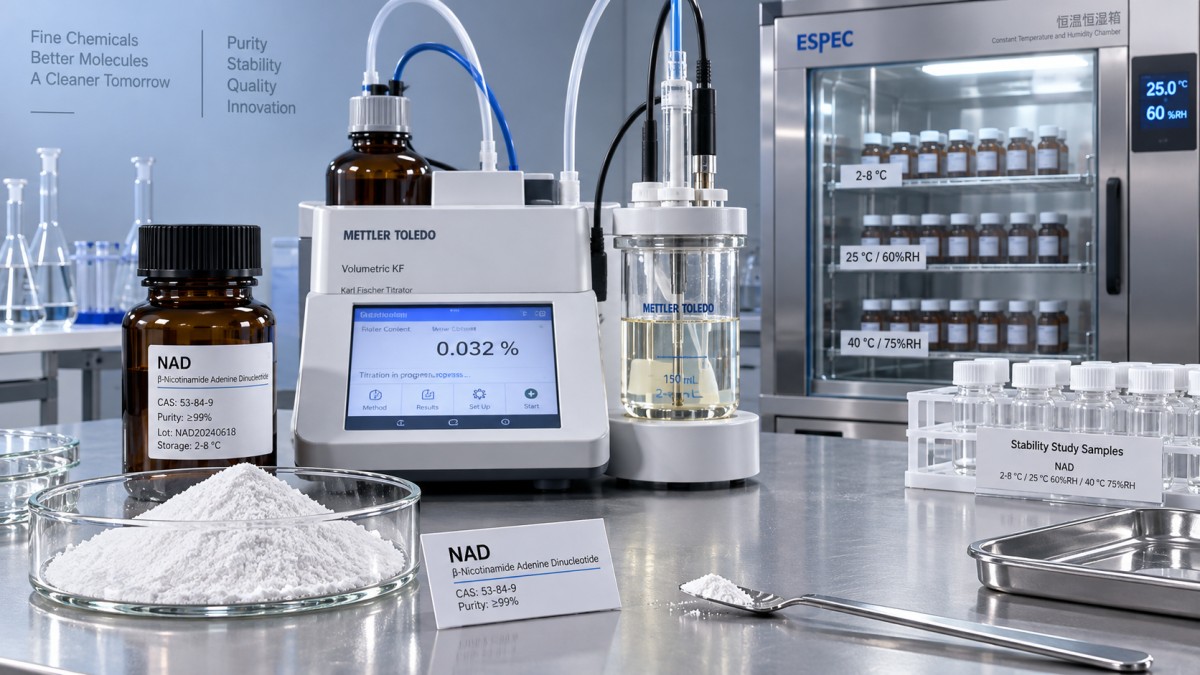
A practical evaluation follows the material through three stages:
- Receipt and storage: confirm packaging protection, storage instructions, and support for the stated shelf life or retest period.
- Processing: examine realistic mixing, heat, humidity, and hold-time exposures.
- Finished-product storage: assess NAD content and relevant degradants in the proposed formulation and package.
Where a formulation uses protective delivery technology, evaluate its performance separately. Claims about encapsulation, absorption, or biological benefit cannot be inferred from the incoming powder’s certificate of analysis.
Contaminant limits need an exposure-based rationale
A specification copied from an unrelated ingredient may be too permissive—or unnecessarily restrictive. Elemental impurity and residual-solvent limits should consider the manufacturing process, intended daily ingredient intake, applicable requirements, and contribution to finished-product exposure.
Request actual numerical results where available, together with detection or quantitation limits. “Not detected” is meaningful only when the method’s sensitivity is appropriate for the decision.
Microbiological limits require similar care. Obtain total-count limits and specified-organism requirements appropriate to the intended oral product. Testing should demonstrate that the sample preparation and method can recover microorganisms reliably. An acceptable incoming batch does not eliminate contamination risks introduced during blending or filling.
Keep cosmetic qualification separate from oral qualification
Multi-category suppliers can simplify sourcing, but documentation must remain ingredient- and application-specific. Jinan Jianfeng Chemical Co., Ltd., established in 2011, describes its business around research, development, and global supply for pharmaceutical, nutraceutical, and cosmetic customers. Technical evaluators should therefore request the relevant NAD dossier rather than rely on company-wide descriptions.
The distinction is clear with Dipeptide Diaminobutyroyl Benzylamide Diacetate, a peptide offered for topical cosmetic and research applications. Its skincare positioning is separate from oral NAD qualification. Cosmetic product data cannot establish oral suitability, and certificates or quality-system statements associated with another ingredient should not be transferred to NAD without verifying their scope.
Make the purchasing decision batch-based
Before approving a nad nutraceutical grade source, review results from multiple recent commercial batches. Look for consistent assay, water content, impurity patterns, and physical properties—not merely repeated “pass” statements.
The qualification package should include a controlled specification, batch-specific certificate of analysis, manufacturing-site traceability, relevant process information, stability support, and change-notification expectations. An SDS supports safe handling; it does not replace an oral-use safety or regulatory assessment. Likewise, a quality-system certificate should be checked for site, activity, scope, and validity.
A defensible approval rests on three separate conclusions: the ingredient is correctly identified and consistently controlled; it remains suitable through the intended formulation process and storage period; and its proposed use has an adequate regulatory and safety basis. When one remains unresolved, further testing or documentation is more valuable than negotiating a slightly higher purity claim.
News
- ▶ Pharma West Africa 2026
- ▶ Paraxanthine Stability in Formulations: Testing pH, Heat, and Storage Effects
- ▶ Buying Sexam Raw Material: Resolve Product Identity Before Comparing Quotes
- ▶ Sexam Laboratory Grade: Confirming Chemical Identity Before Research Use
- ▶ Evaluating a PDRN Manufacturer: Traceability, Capacity, and Batch Consistency
Message
Chemical Engineering Field
24/7 before-sales and after-sales services
Comprehensive technical support